Two Times in the Quantum World ✛
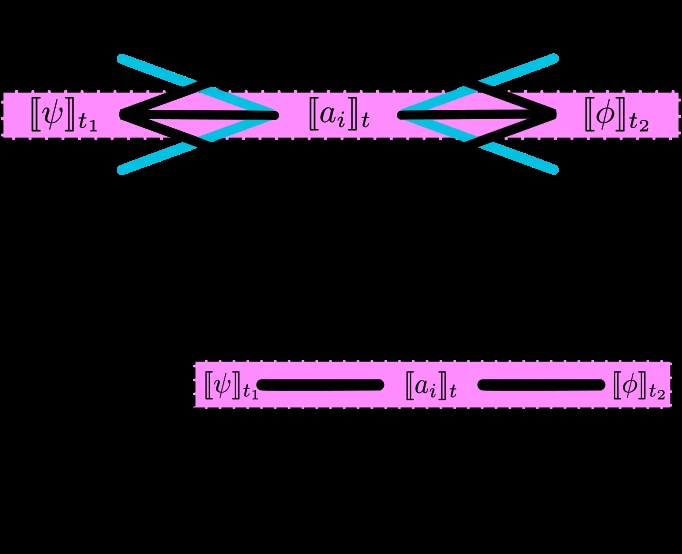
The quantum world does not recognize the usual flow of time. One approach, developed by Wheeler, asserts: all events — past, present, future — already coexist, like frames on a film reel. In this 'timeless' picture, our life is merely the projector's path across a static spacetime strip. The ticking of clocks is an illusion, born from the growth of disorder in the system.
Another method, proposed by Aharonov, goes beyond the Standard Model and adds a hidden property to particles, allowing them to move in both directions along time — as if the film reel could be run forward and backward simultaneously. Every event gets a mirror twin from the reverse flow. On large scales, the symmetry of these two directions adds up to the familiar arrow of time.
If the two-time approach were correct, every particle in the Universe would have its 'twin,' living in the reverse time flow.
As in the movie 'Tenet,' where heroes move backwards through time, so this model suggests the existence of reverse motion for fundamental particles.