Light with One-Way Motion: The Magic of Rydberg Atoms express
Ordinary light scatters in all directions, but physicists turned it into something like a conveyor belt — a one-way stream that doesn't turn back. To do this, they sent two counter-propagating beams through a cloud of Rydberg atoms, bloated to the size of a tiny dust speck. The thermal jitter of these giants breaks the symmetry, forcing light to move only forward.
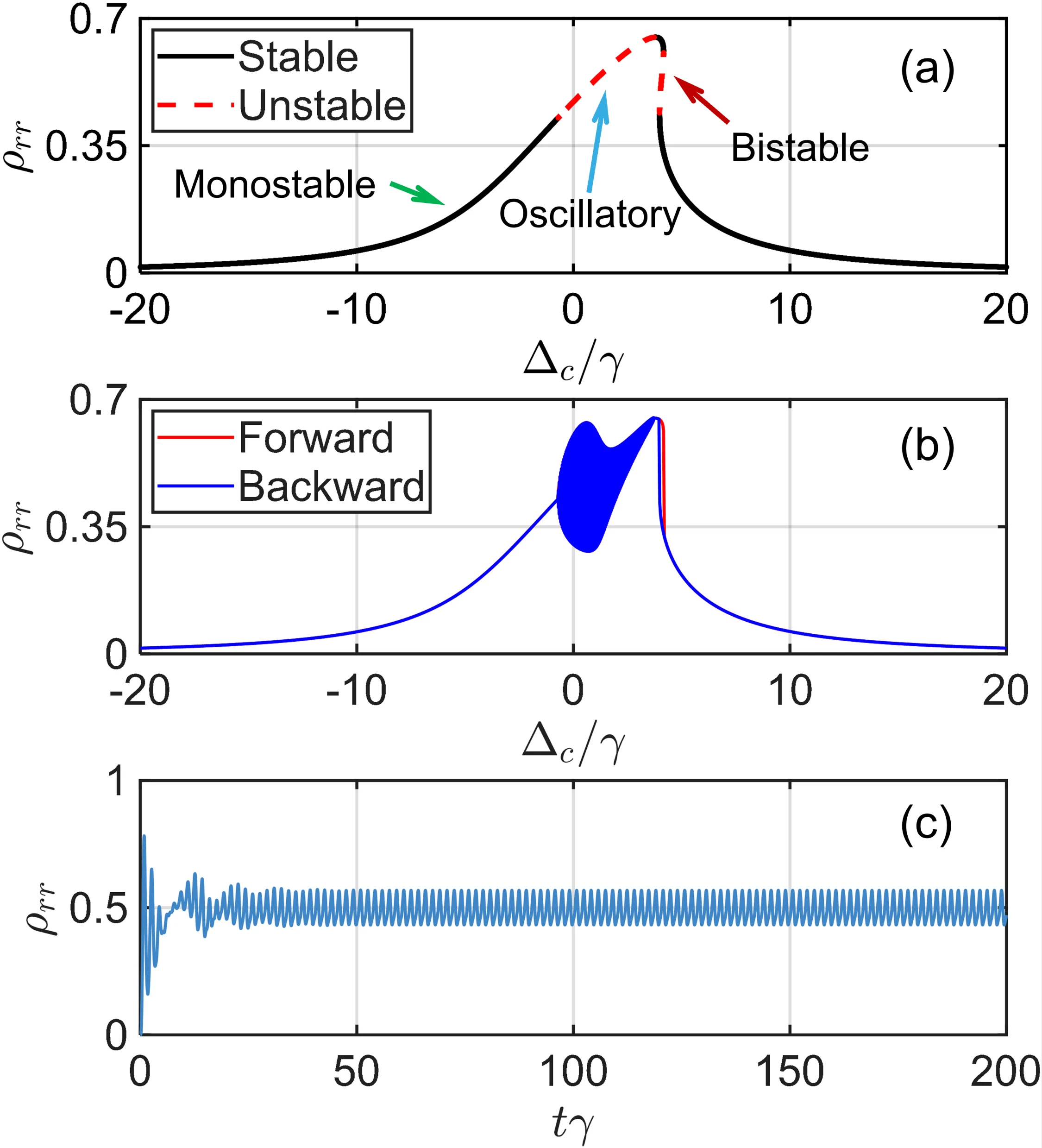
This light conveyor forces all atoms to oscillate in sync, like boxes bouncing in a single rhythm. A periodic structure emerges, resembling a time crystal — an idea proposed by Frank Wilczek in 2012. The effect was observed at room temperature using photometry (measuring brightness) and spectroscopy (studying spectra). Such one-way motion paves the way for tiny optical chips without interference.
Original abstract
as written by the authors arXiv:2510.03024
Optical non-reciprocity is a fundamental phenomenon in photonics. It is crucial for developing devices that rely on directional signal control, such as optical isolators and circulators. However, most research in this field has focused on systems in equilibrium or steady states. In this work, we demonstrate a room-temperature Rydberg atomic platform where the unidirectional propagation of light acts as a switch to mediate time-crystalline-like collective oscillations through atomic synchronization. We find that thermal-motion-induced coupling asymmetry, enabled by counterpropagating probe and control fields, generates persistent oscillations; conversely, co-propagation quenches this effect. We identify, through both numerical and analytical approaches, the criteria for realizing optical non-reciprocity within a synchronization regime. These results provide key insights for chiral quantum optics and promote the on-chip integration of non-reciprocal devices in nonequilibrium many-body systems.
Rydberg atoms can reach the size of a bacterium — about 0.001 mm, which is thousands of times larger than a normal atom.
Similar rhythmic, never-damping oscillations are described in sci-fi as 'eternal clocks' or temporal anomalies.