Temperature measurementspectroscopy is a set of techniques that use the light emitted, absorbed, or scattered by a substance to determine its temperature without direct contact. Instead of a thermometer, scientists analyze the spectrum of light — its intensity at different wavelengths — to infer how hot a gas, plasma, or distant star is. This is essential in environments where a physical probe is impossible, such as the interior of a fusion reactor, the atmosphere of a star, or the early universe.
History
The foundations were laid in the 19th century with the work of Gustav Kirchhoff and Robert Bunsen, who linked spectral lines to chemical elements and temperature. The quantitative use of spectral line ratios for temperature measurement developed in the early 20th century with the advent of quantum theory.
How it works
The key principle is that atoms and molecules emit or absorb light at specific wavelengths, and the relative strength of these spectral lines depends on temperature. For example, in a hot gas, more atoms are in excited states, so absorption lines from those states become stronger. By comparing the intensities of different lines, or by fitting the overall shape of a continuous spectrum (blackbody radiation), scientists can extract a precise temperature. In some advanced methods, like frequency-comb spectroscopy, a laser with a spectrum of equally spaced lines is used to measure absorption with extreme accuracy, allowing temperature mapping in gases and flames.
In practice
Used in astrophysics to determine stellar temperatures, in plasma physics to monitor fusion experiments, and in combustion research to map flame temperatures in engines and turbines.
Fun fact
The cosmic microwave background radiation, which fills the universe, is a perfect blackbody spectrum with a temperature of 2.725 Kelvin — measured so precisely that it reveals tiny variations of a few microkelvin, which are the seeds of galaxies.
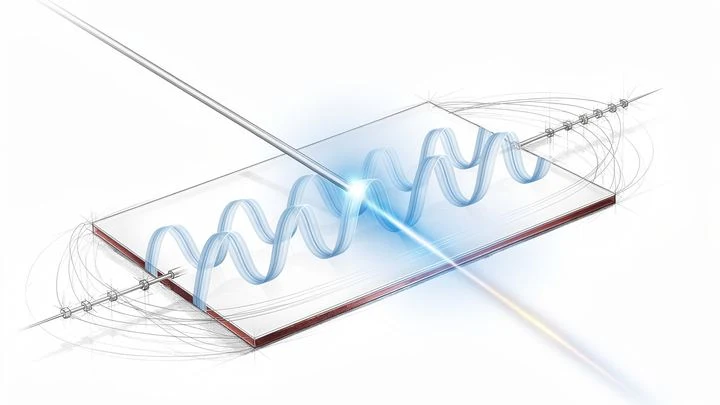
A laser beam strikes a thin target hidden inside layers of another material. Within billionths of a second, the material is compressed to a density of 25 grams per cubic centimeter, as if a piece of lead became more than twice as heavy without moving an inch.
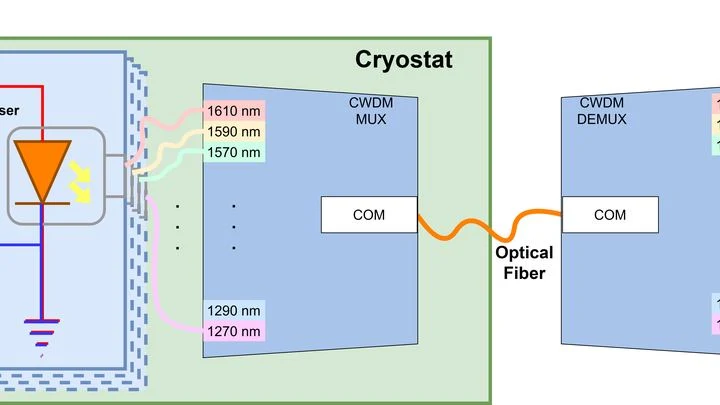
Quantum technology urgently needs a universal 'translator' between the languages of microwaves and light. Superconducting qubits communicate on centimeter wavelengths, while photons in optical fiber talk at optical frequencies.
Dark matter detectors are essentially incredibly sensitive microphones, capable of hearing a whisper amid the roar of a rock concert. Their job is to catch the rare nudges from hypothetical dark matter particles, which are thought to occasionally collide with atomic nuclei of ordinary matter.
Strike a diamond and it rings, but sound lives inside it even without a strike. Waves of compression and rarefaction constantly ripple through it, like the ripples a stone makes on water. Except this ripple is the thermal jitter of the atoms themselves, and it can be detected with a laser.
A neutron star is the dead core of a massive star, crushed to the size of a city. A teaspoon of its material weighs as much as a mountain. Dark matter particles fly through such a dense medium almost unimpeded, but occasionally they do hit neutrons and get stuck, like bullets bogging down in deep sand.
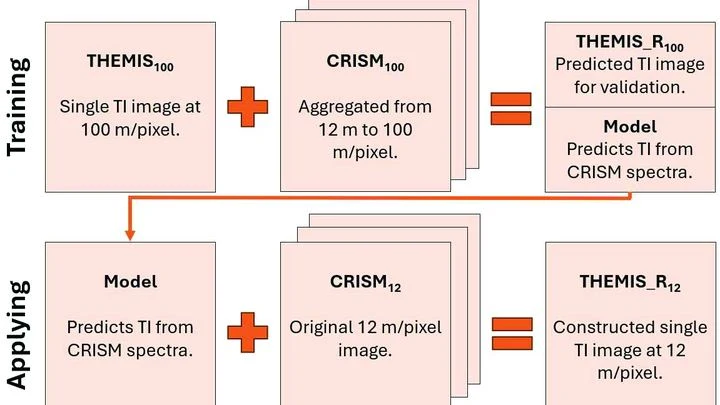
Warm rock and cold sand cool at different rates at night. An instrument orbiting Mars measures this heat, revealing whether the surface is loose dust, a dense crust, or solid rock. But thermal images have a resolution of 100 meters per point: an entire football stadium fits into a single pixel. Fine details (the beds of ancient streams, the edges of lava flows) are simply invisible.
A tiny glass bead hangs in a laser beam like a speck of dust in sunlight. Around it is a rarefied gas: atoms of krypton, xenon, and heavy molecules of sulfur hexafluoride. They collide with the bead, and each hit transfers a tiny impulse, like a pea thrown at a taut sheet makes it tremble.
Impulse is a measure of motion: mass times velocity.
A metal needle descends onto a piece of superconductor. All of this happens inside a refrigerator that cools the sample to 30 thousandths of a degree above absolute zero — a hundred times colder than outer space. A weak current is passed through the needle, and by how electrons travel through the tiny contact point, physicists read what is happening inside the material.
Gas is nearly invisible, but it has a temperature, and you can read it from how the gas 'shadows' the thermal background. In the experiment, a camera looks at a warm screen through a jet of carbon dioxide. If the gas is cooler than the background, it appears as a dark spot; if warmer, it appears bright.
A radiation sensor in the city is like a street musician: it has to hit the right notes even when fingers go numb from cold or the instrument is baked by the sun. Usually, such devices are kept in greenhouse conditions, with heating or cooling, otherwise the energy scale (which distinguishes harmless potassium in concrete from dangerous cesium) starts to lie.
A thermos of liquid xenon cooled to minus 100 degrees Celsius. Inside are sensitive sensors that catch rare signals from dark matter particles. To bring these signals out, copper cables are usually used. But over the long haul, the signal weakens, and adjacent cables start 'cross-talking' — that's called crosstalk.
When a bright spot flares up on a star, astronomers want to know how much energy was released into space. They used to picture a flare as a growing campfire: the area of the fire increases, but the heat remains the same. That made calculations simpler, but reality turned out to be different.
At the South Pole, where the air is dry and transparent to millimeter waves, stands a telescope that looks not at stars but at the oldest light in the universe. This light is the cosmic microwave background — the radiation left over from the Big Bang, filling the entire sky.
A conventional thermal camera is like a thermometer that slowly heats up and cools down. It shows where heat is well, but it can't keep up with fast motion. The new sensor works differently: it counts individual quanta of heat, like a droplet counter during rain.
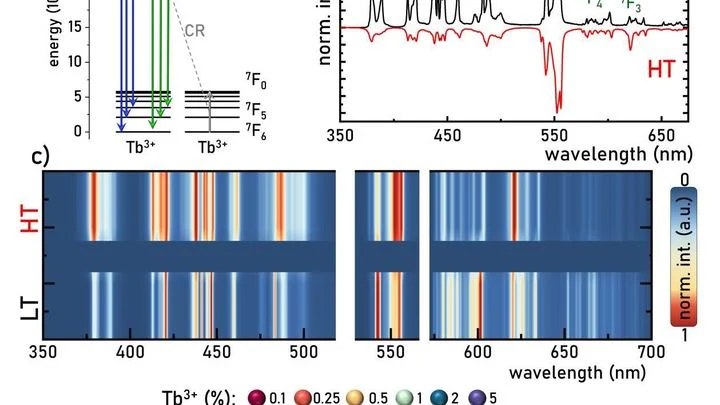
A piece of material glows blue. Heat it up, and the glow turns green, as if someone flipped a switch at a traffic light. That's how the new luminescent thermometer described in the paper works.
Inside the material are terbium ions — a rare-earth metal that knows how to shine. At room temperature, they emit blue light.
A laser beam passes through a glass cell containing rubidium vapor, and by how the atoms absorb light, you can determine their temperature. This is like measuring the speed of cars by the blur in a photograph: the faster the atoms move, the wider the absorption line becomes.
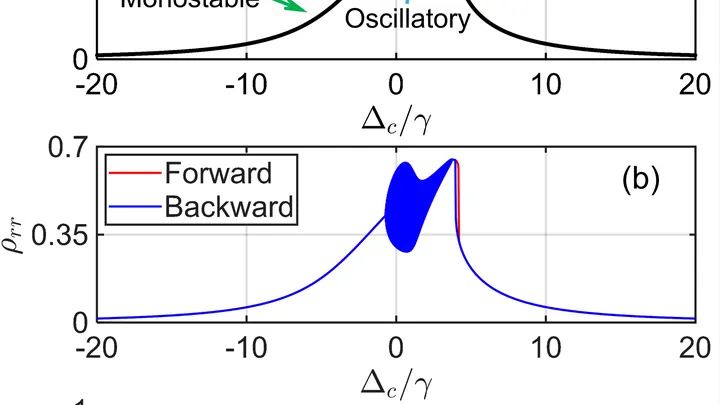
Ordinary light scatters in all directions, but physicists turned it into something like a conveyor belt — a one-way stream that doesn't turn back. To do this, they sent two counter-propagating beams through a cloud of Rydberg atoms, bloated to the size of a tiny dust speck.