In 1859, Gustav Kirchhoff, together with chemist Robert Bunsen, lit a burner and noticed: sodium vapor gave a bright yellow line in the flame; and if white light was passed through it, a dark band appeared in the same place in the spectrum. Thus spectroscopy was born. Kirchhoff generalized: for any body in thermal equilibrium, the ratio of emissive power E(λ,T) to absorptivity A(λ,T) is a universal function depending only on wavelength and temperature, not the material. The function f(λ,T) is the famous blackbody radiation later described by Planck. A simple consequence: a good absorber is always a good emitter. Thanks to Kirchhoff's law, astronomers deciphered the chemistry of the Sun and distant stars.
History
Gustav Kirchhoff, professor at Heidelberg University, in 1859–1862 theoretically established the inseparable connection between absorption and emission of thermal radiation. Together with Robert Bunsen, he created the method of spectral analysis and demonstrated that each chemical element gives a unique set of spectral lines. Kirchhoff's law became a cornerstone of astrophysics and the physics of thermal radiation, pointing the way to the blackbody function, later derived by Max Planck. The idea of the universality of blackbody radiation stimulated the development of quantum theory.
How it works
The law strictly holds only under conditions of thermodynamic equilibrium: the temperature of the emitter and the radiation field must be the same. In real laboratory or astronomical conditions, this approximation is often satisfied. The law underpins methods of pyrometry, infrared thermography, and the design of spacecraft thermal protection. Furthermore, it allows the chemical composition of gases and plasmas to be deduced from absorption spectra.
In practice
All pyrometers (non-contact thermometers) operate on Kirchhoff's law: by measuring the infrared radiation from a surface, we calculate its temperature based on its known emissivity. In astrophysics, stellar spectra with dark absorption lines directly reveal the chemical composition of their atmospheres.
Fun fact
It is precisely because of Kirchhoff's law that infrared motion sensors see people but not glass: glass is transparent to visible light and barely emits in the IR, while a person emits as an almost perfect blackbody.
A sculptor looks at a block of marble and sees the figure within, waiting to be freed from excess material. Instead of adding clay, he removes everything that is not part of the form. The authors of a new study on magnetic resonance took a similar approach: rather than complicating the tissue model by adding ever more details, they stripped away the superfluous to reveal the essence.
The Sun is a giant cauldron where light struggles through a thick layer of scorching matter. On its way out, photons (light particles) constantly bump into atoms and lose energy. How strongly matter holds back light is called "opacity," and it determines how quickly heat escapes.
Iron is one of the main culprits for opacity in the Sun's interior.
In a room, air touches the skin, and we feel its temperature. But if your body suddenly accelerated at a colossal rate, heat would come even from absolute emptiness. This is not fiction but a strict consequence of quantum field theory: for an accelerating observer, the vacuum becomes a warm bath.
In a pot of boiling soup, tiny droplets of fat occasionally flare up — a hundred times hotter than the broth. That's roughly how future fusion plasma works: the bulk of ions heats to hundreds of millions of degrees, while a small admixture of "fast" particles (born from nuclear fusion) is accelerated even further.
A pot of soup forgotten on the stove cools to room temperature. It seems everything has come to rest. But if you look inside with a quantum magnifying glass, you'll find that water molecules haven't frozen: they continue their dance. It's just that now the dance is steady, not turbulent like when boiling.
In a thin semiconductor channel, electrons behave not like lone runners but like a crowd at rush hour. They constantly bump into each other, and these collisions determine how easily heat and electric current pass through the material.
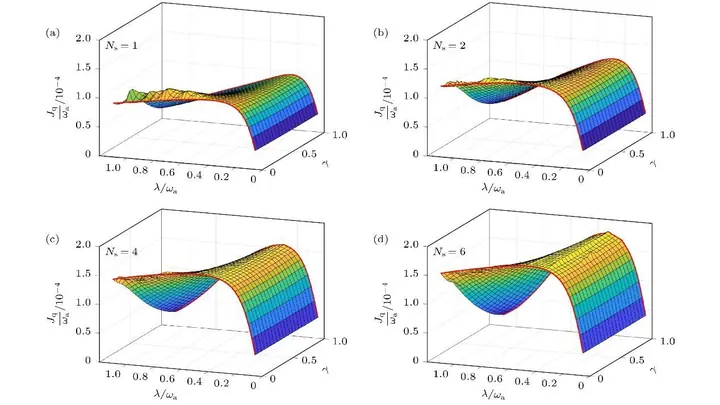
Light and atoms, like dancers, can move in sync or out of step. When their interaction is anisotropic (that is, direction-dependent) the dance gets trickier. In a new study, physicists considered a model where many atoms (qubits) collectively interact with an anisotropic light field, and each component is connected to a thermal reservoir.
A hot coffee cools by radiating invisible light. To maintain temperature, it must receive exactly as much light back. This silent trade of photons is what we feel as steady warmth.
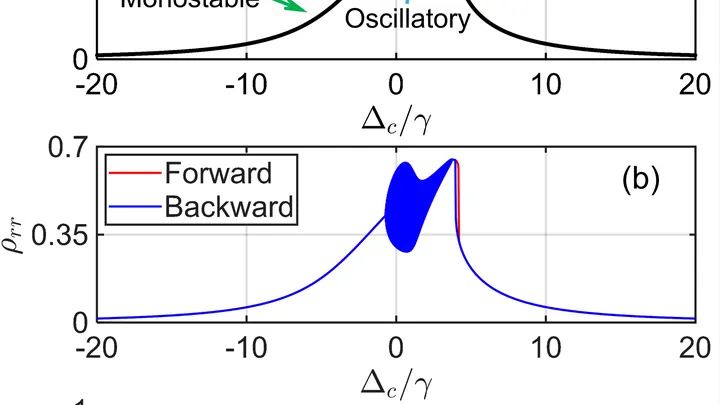
Ordinary light scatters in all directions, but physicists turned it into something like a conveyor belt — a one-way stream that doesn't turn back. To do this, they sent two counter-propagating beams through a cloud of Rydberg atoms, bloated to the size of a tiny dust speck.
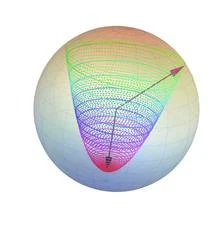
The road to equilibrium for a quantum detector resembles a mountain route: the climb is always faster than the descent. An atom accelerated through the vacuum, sensing quantum field fluctuations, heats up to the Unruh temperature.