Popular

Light with One-Way Motion: The Magic of Rydberg Atoms ⚡ экспресс

Original: "Non-reciprocal Synchronization in Thermal Rydberg Ensembles"
· Yunlong Xue, Zhengyang Bai
arXiv:2510.03024 · 2025-10-03 · CC BY 4.0 · ⏱ 1 min · Quantum Physics Atomic Physics
Physicists created conditions where light only moves forward, generating stable rhythmic oscillations.
Abstract

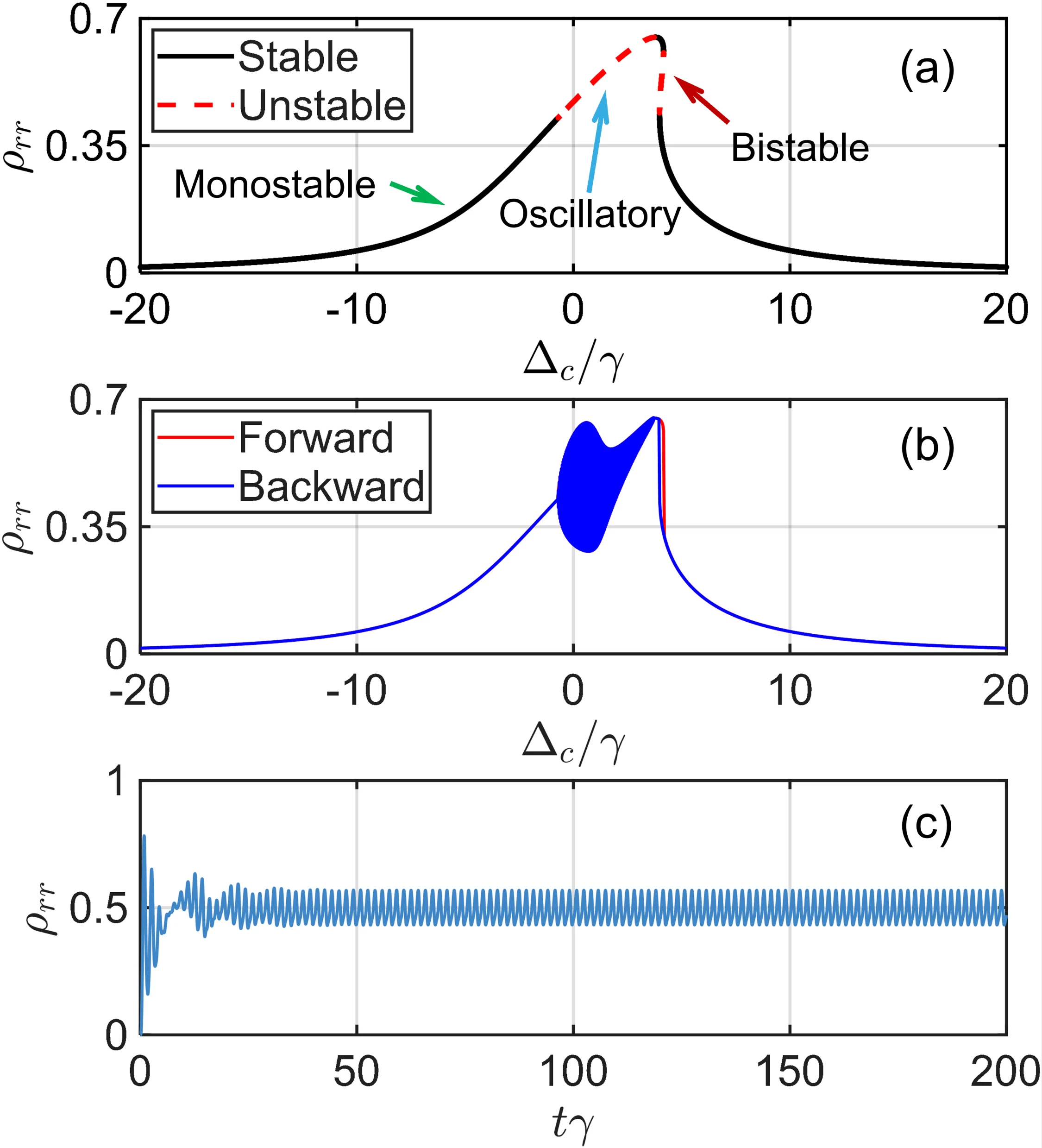
In an experiment at room temperature, one-way light propagation was achieved in a cloud of Rydberg atoms (highly excited atoms). When two laser beams travel toward each other, the thermal motion of atoms creates a coupling asymmetry that triggers collective synchronous oscillations resembling a time crystal—a system that periodically changes without energy input. When the beams are co-propagating, the effect vanishes. This paves the way for compact optical isolators and circulators for non-equilibrium quantum optics.

Links in the knowledge graph 1

📄 Showing the "Simple" version — "Popular" is not ready yet. Add it to favorites to help prioritize it.

Ordinary light scatters in all directions, but physicists turned it into something like a conveyor belt — a one-way stream that doesn't turn back. To do this, they sent two counter-propagating beams through a cloud of Rydberg atoms, bloated to the size of a tiny dust speck. The thermal jitter of these giants breaks the symmetry, forcing light to move only forward.

This light conveyor forces all atoms to oscillate in sync, like boxes bouncing in a single rhythm. A periodic structure emerges, resembling a time crystal — an idea proposed by Frank Wilczek in 2012. The effect was observed at room temperature using photometry (measuring brightness) and spectroscopy (studying spectra). Such one-way motion paves the way for tiny optical chips without interference.

Interestingly, the size of a Rydberg atom is comparable to the wavelength of visible light — which is why they, like oversized luggage on a conveyor belt, so effectively set the direction of motion.

🎯 Rydberg atoms can reach the size of a bacterium — about 0.001 mm, which is thousands of times larger than a normal atom.

🎬 Similar rhythmic, never-damping oscillations are described in sci-fi as 'eternal clocks' or temporal anomalies.

Scientists
Christian DopplerD. B. McLaughlinDidier QuelozMichel MayorR. A. RossiterAlbert Einstein
Tags
spectroscopy photometry speed of light
Laws
Doppler effectprinciple of constancy of the speed of lightmass–energy equivalenceMaxwell's equationsPlanck's lawLorentz transformations
Original: arXiv:2510.03024 · CC BY 4.0 · bridge42worlds