How Birds See Earth's Magnetic Field express
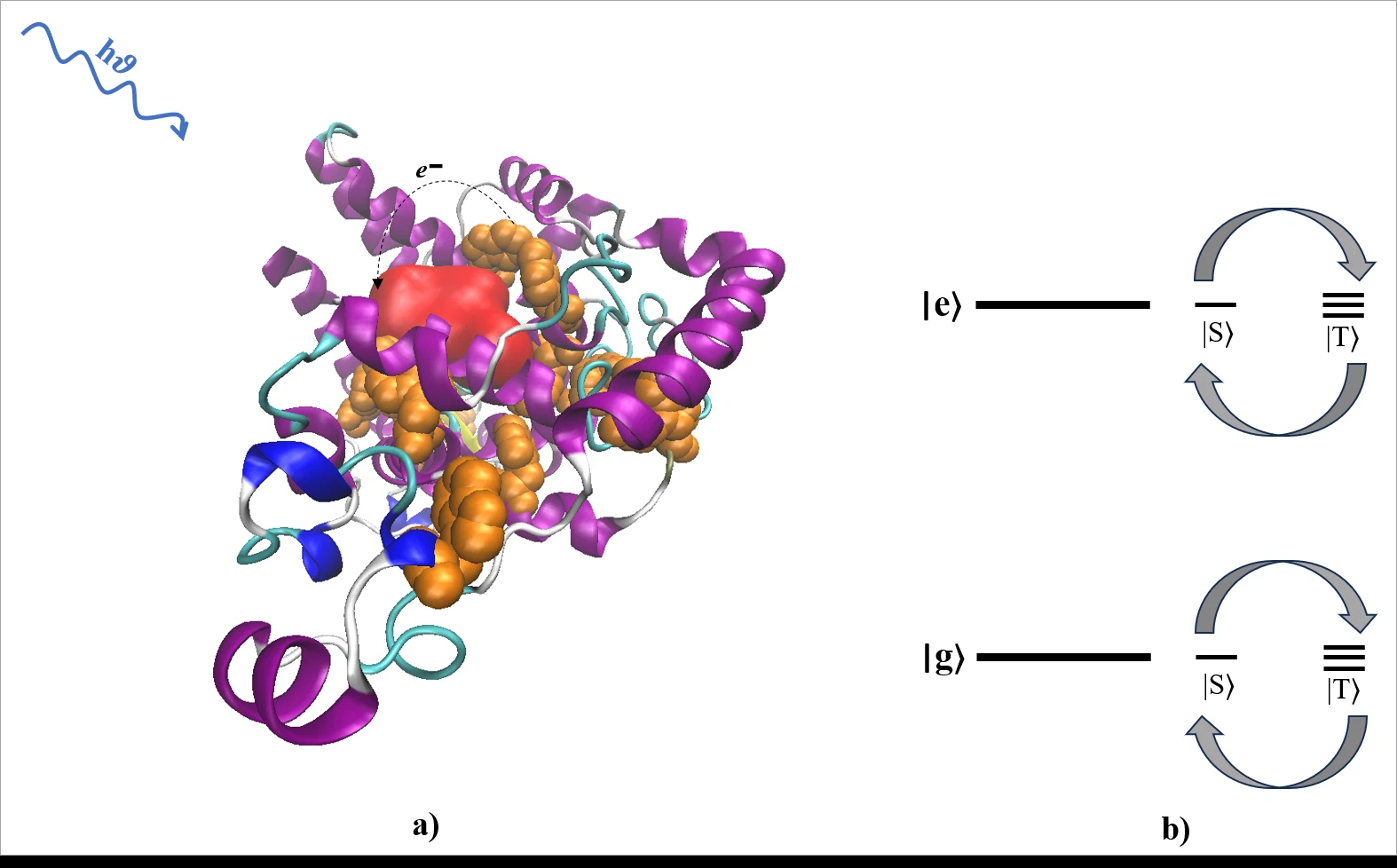
Birds migrate using the magnetic field. In their eyes, there's a protein called cryptochrome. It captures sunlight, especially blue light, and triggers a reaction. Absorption of light leads to the formation of a particle pair that is acutely sensitive to magnetic fields.
Under the field's influence, these particles change their mutual position, causing a weak electric current in the protein. This current travels to the brain and is perceived as a visual sensation, as if a transparent grid of magnetic lines is overlaid on the world. Surprisingly, this compass only works in daytime blue light; at dusk the system shuts down, and at night birds rely on the stars.
Understanding this mechanism not only reveals the secret of navigation but also promises new technologies. The protein is made of ordinary organic compounds, including carbon, so scientists hope to create biosensors that are more compact and sensitive than their electronic counterparts.
Original abstract
as written by the authors arXiv:2510.13840
Photoreduction of cryptochrome protein in the retina is a well-known mechanism of navigation of birds through the geomagnetic field, yet the biosignal nature of the mechanism remains unclear. The absorption of blue light by the flavin adenine dinucleotide (FAD) chromophore can alter the distribution of electrons in cryptochrome and create radical pairs with separated charges. In this study, the spin dynamics of electrons in the radical pair including its spin-orbit coupling were investigated by quantum mechanical modeling. Spin-orbit coupling is negligible relative to other terms and has no significant role in the dynamics. However, it engages the spatial states of the radical pair and make possible to study spatial related observables. Several interactions were considered in the presence of an external magnetic field, and the resulting electric dipole moment in cryptochrome was computed as the quantity emerging from this coupling. The computations show the induced electric dipole moment clearly depend on the characteristics of the applied magnetic field even after considering dissipative effects. In fact, our findings indicate that the radical pair in cryptochrome protein is a magnetic biosensor, in the sense that in the presence of the geomagnetic field, variations in spin states can influence its electric dipole moment, which may be interpreted via the bird as an orientation signal. The results can be used in the advancement of bio-inspired technologies which replicate animal magnetic sensitivity.
This same protein is present in human eyes too, but in us it only regulates biological clocks, and we don't sense magnetic fields.