Are you one of the authors of this paper? Email us from your institutional or work email address mentioning this article's arXiv ID and we'll verify you and give you edit access to this page.
Are you an author who sees something we missed or got wrong? Write to us — the subject line already carries the paper id. We read every note and correct the write-up.
The ExoClock project updated transit data for 620 exoplanets, increasing precision tenfold.
📄 Showing the "Simple" version — "Advanced" is not ready yet. Add it to favorites to help prioritize it.
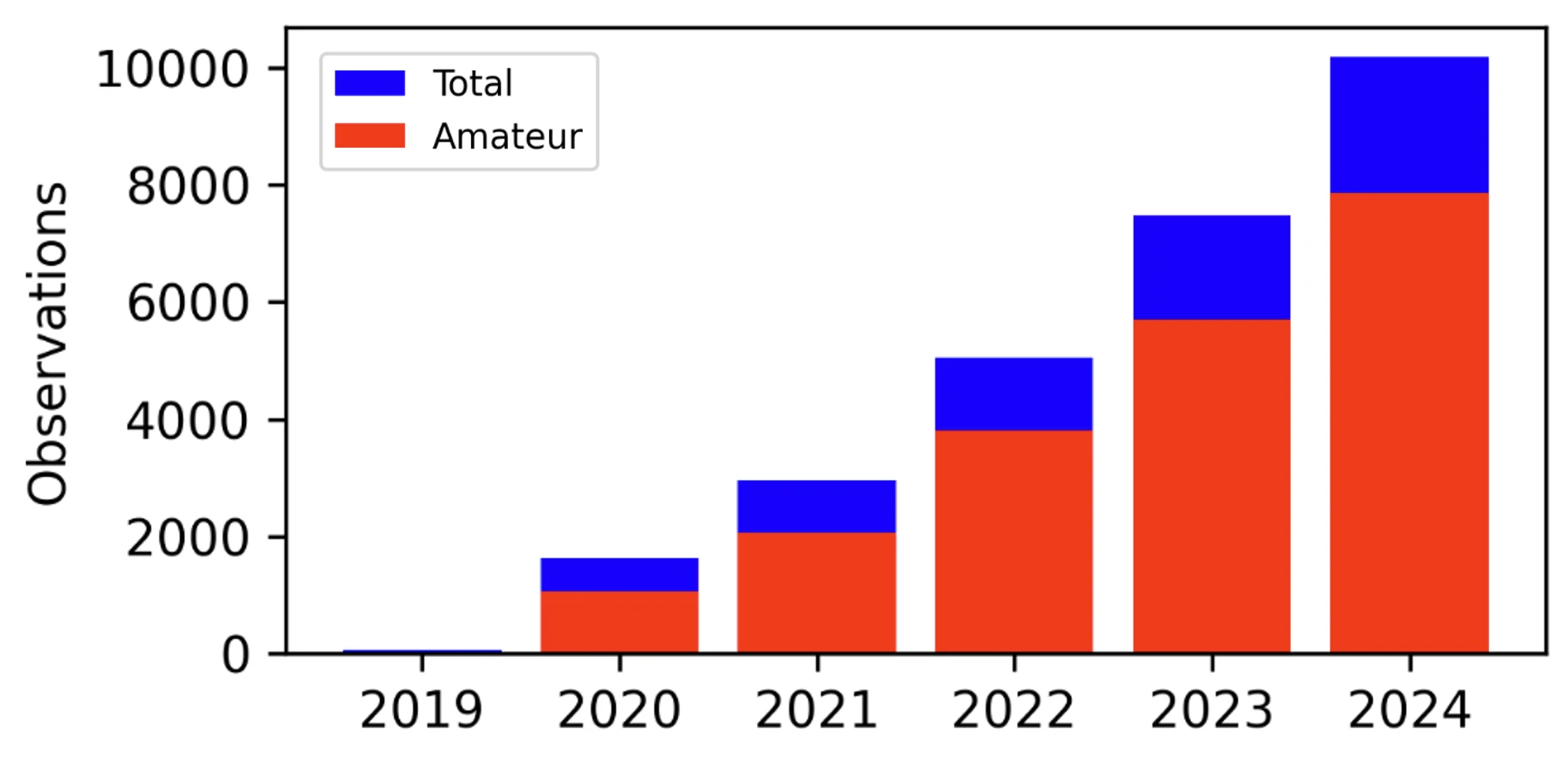
A bus schedule drifts: if you don't check it, you'll miss your ride. Planets around other stars have the same problem – their crossings of the star's disk gradually shift. The ExoClock project pooled 30,000 observations from Earth and space to refine the schedule for 620 distant worlds. For 45% of the planets, transits were found to be off by hours.
The fussiest ones – 277 targets of the TESS mission – whip across the star in minutes or get lost in its glare. To spot them, astronomers synchronized dozens of small telescopes – like photographers trying to catch a group smile. The result: for 45% of planets, the transit schedule got an update, and the timing precision jumped tenfold. Some of them show transit timing variations – they get periodically nudged by the invisible gravity of neighbors, revealing hidden worlds.
Open workshop: all data and tools are available to anyone – from a scientist to a schoolchild.
Now James Webb and other giant telescopes can schedule their observations with surgical precision and never miss the moment when a planet steps into the light, allowing us to study its atmosphere.
The ExoClock project is an open platform aiming to monitor exoplanets by integrating observations from space and ground based telescopes. This study presents an updated catalogue of 620 exoplanet ephemerides, integrating 30000 measurements from ground-based telescopes (the ExoClock network), literature, and space telescopes (Kepler, K2 and TESS). The updated catalogue includes 277 planets from TESS which require special observing strategies due to their shallow transits or bright host stars. This study demonstrates that data from larger telescopes and the employment of new methodologies such as synchronous observations with small telescopes, are capable of monitoring special cases of planets. The new ephemerides show that 45% of the planets required an update while the results show an improvement of one order of magnitude in prediction uncertainty. The collective analysis also enabled the identification of new planets showing TTVs, highlighting the importance of extensive observing coverage. Developed in the context of the ESA's Ariel space mission, with the goal of delivering a catalogue with reliable ephemerides to increase the mission efficiency, ExoClock's scope and service have grown well beyond the remit of Ariel. The ExoClock project has been operating in the framework of open science, and all tools and products are accessible to everyone within academia and beyond, to support efficient scheduling of future exoplanet observations, especially from larger telescopes where the pressure for time allocation efficiency is higher (Ariel, JWST, VLT, ELT, Subaru etc). The inclusion of diverse audiences in the process and the collaborative mode not only foster democratisation of science but also enhance the quality of the results.