A Chain Reaction of Black Holes Generates Gravitational Waves express
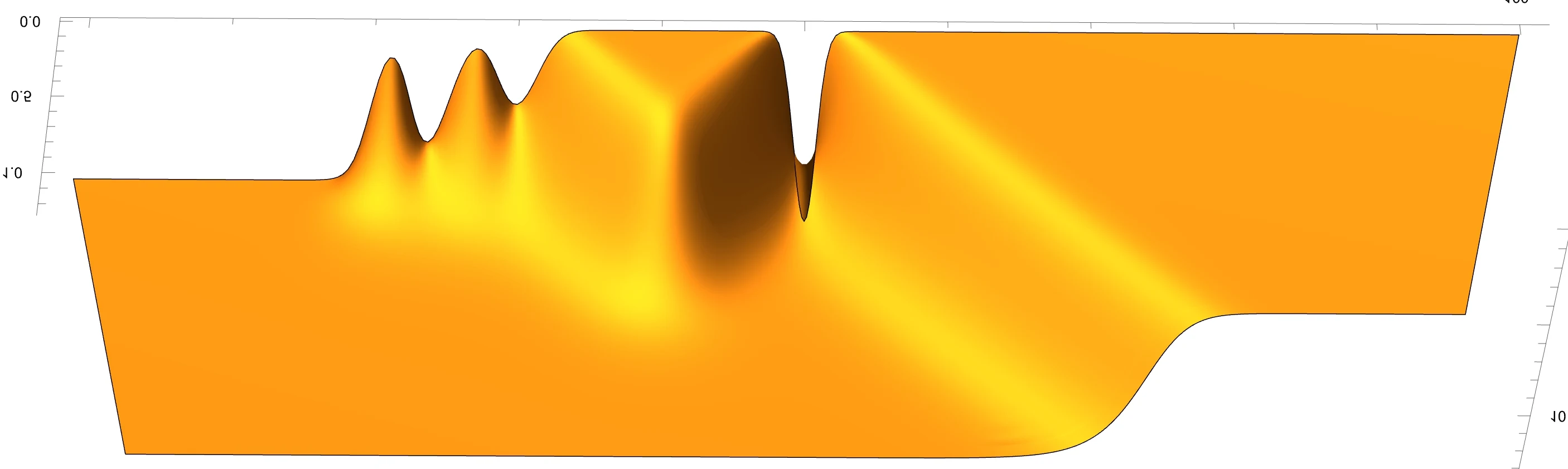
Right after the Big Bang, primordial black holes floated in the hot plasma — clumps of mass the size of a mountain squeezed into the volume of an atom. According to Hawking's prediction, they slowly evaporated, emitting radiation like tiny stoves. But this heat didn't dissipate without a trace: hitting dense plasma clumps, it nudged them toward collapse. Thus, a new hole was born in place of the evaporated one. The process repeated, and a front of black hole birth raced across the universe — exactly like a forest fire where each burning tree ignites its neighbors. The universe’s expansion acted like a downpour: as it cooled, the plasma became too rarefied, and the chain reaction fizzled out. As a memento, it left behind a characteristic low-frequency hum of spacetime — gravitational waves carrying a sharp cutoff signature. Detectors like LISA could pick up this signal: below a certain frequency, deafening silence, as if someone abruptly stopped the recording. Astonishingly, evaporation — usually the death of a black hole — became a mechanism of multiplication in the early universe.
The expansion of the universe acts like a downpour on a forest fire; once the plasma becomes too rarefied, the chain reaction cuts off, imprinting a sharp silence onto gravitational waves at low frequencies.
In sci-fi, self-replicating objects — from replicators to 'grey goo' — often lead to disasters. Here, black holes become cosmic replicators, but only at the dawn of time.