Optical Illusion: How Dense Gas Masquerades as Metal-Poor Galaxies
In a distant galaxy, light from hot gas should reveal its composition. The James Webb Telescope split that light into a spectrum, and astronomers saw: oxygen lines too weak.
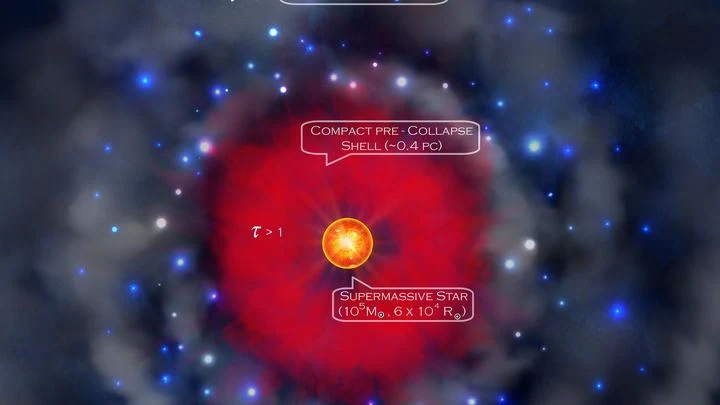
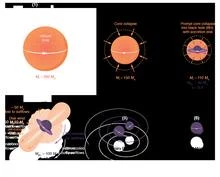
Supermassive black holes formed directly from gas collapse, bypassing star formation.Direct collapse black holes are a proposed pathway for forming supermassive black holes (millions to billions of solar masses) in the early universe without going through the usual route of star formation and subsequent growth. In this scenario, a massive cloud of primordial gas—rich in hydrogen and helium but lacking heavier elements—collapses directly under its own gravity into a black hole of perhaps 10,000 to 100,000 solar masses. This bypasses the intermediate step of forming a normal star, which would otherwise blow away much of the gas and limit the final mass.
The concept was developed in the early 2000s by theoretical astrophysicists including Martin Rees and Volker Bromm, who explored how the first black holes might form in the absence of metals. The term 'direct collapse' became standard in the 2010s as observations of quasars at high redshift demanded a fast formation mechanism.
For direct collapse to occur, the gas cloud must avoid fragmenting into smaller clumps that would form ordinary stars. This requires the gas to stay hot (around 10,000 K) so that pressure prevents fragmentation, while also being dense enough to collapse. A strong ultraviolet radiation field from nearby young galaxies can heat the gas and dissociate hydrogen molecules, which are the main coolants that would otherwise let the cloud cool and fragment. Once the cloud collapses, it forms a supermassive star that quickly becomes unstable and collapses directly into a black hole, or the collapse proceeds through a quasi-star phase where the black hole grows inside a giant envelope.
This mechanism is used in cosmological simulations to explain the origin of supermassive black holes observed less than a billion years after the Big Bang, and it informs predictions for the James Webb Space Telescope and future gravitational-wave observatories.
Direct collapse black holes could be the seeds for the supermassive black holes that power quasars, and they might also explain some of the 'little red dots' seen in early galaxy surveys.