Plasma Sphere Explains Magnetars and Radio Bursts express
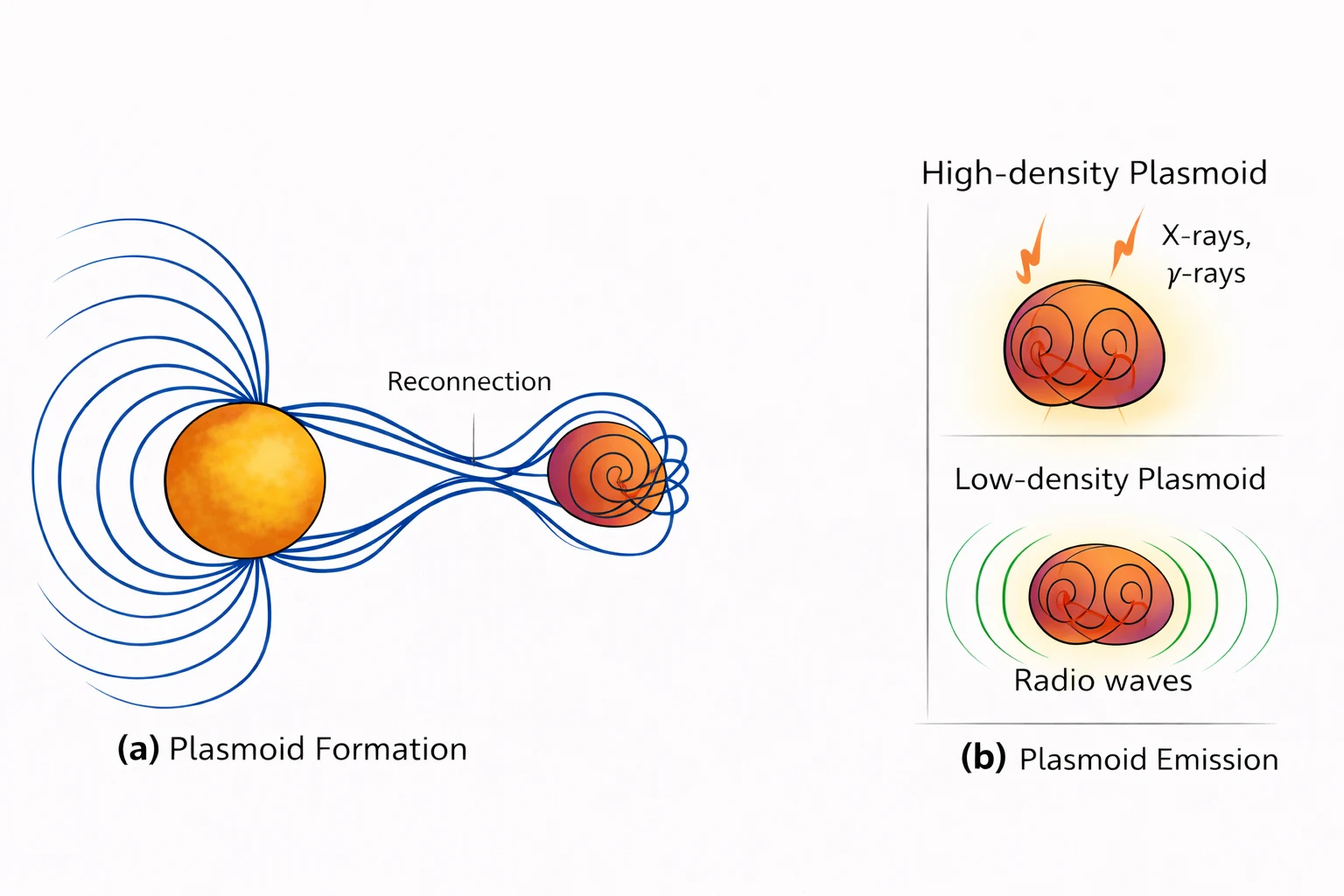
A magnetar is a neutron star with a magnetic field a quadrillion times stronger than Earth's. Sometimes it ejects a blob of plasma, like a tiny balloon with thousands of invisible springs bouncing around inside. The material flies apart at nearly the speed of light, and the flare itself outshines an entire galaxy in a tenth of a second.
What happens next depends on the sphere's density. If it's denser than the surrounding space, it creates an X-ray or gamma-ray burst — a giant magnetar flare. But if the sphere is thinner, yet its magnetic field is wound up tighter, it gives rise to a fast radio burst, a radio wave that can cross half the universe. These signals baffled astronomers for a long time. The more tightly the magnetic field is wound inside the sphere, the slower it expands.
This simple model, for the first time, ties two cosmic wonders together with unified physics. The first pulsar — a cousin of magnetars — was discovered by Jocelyn Bell Burnell; today her successors are unraveling the secrets of the most powerful explosions in the universe.
Original abstract
as written by the authors arXiv:2601.00441v2
Magnetar flares are highly energetic and rare events in which intense X and {\gamma}-ray emission is released from strongly magnetised neutron stars. The events are also accompanied by mass ejection from the neutron star. Fast radio bursts are short and intense pulses of coherent radio emission. Their large dispersion measures support an extragalactic origin. While their exact origin still remains elusive, a substantial number of models associates them with strong magnetic field and high-energy relativistic plasma found in the vicinity of magnetars. There is growing evidence that some fast radio bursts are associated with flare-type events from magnetars. We provide a set of configurations describing a relativistic, spherical, magnetic plasmoid explosion. We proceed by solving the equations of relativistic magnetohydrodynamics for a system that expands while maintaining its internal equilibrium. We find the interdependent relation between pressure, mass density, Lorentz factor, and magnetic field that determines the detailed properties of the solutions. A dichotomy of solutions exists that correspond to higher and lower density and thermal pressure compared to the external one. For stronger toroidal magnetic fields, the maximum permitted expansion velocity becomes lower than the weaker toroidal fields. These solution classes can be applied to magnetar giant flares and fast radio bursts. Those that corresponding to over densities and higher pressure can be associated with magnetar flares, and those corresponding to underdensities can be relevant to fast radio bursts that correspond to magnetically dominated events with low mass loading. [Abridged]
A magnetar flare can outshine all the stars in a galaxy combined in just a tenth of a second.
Like in the movie 'Contact,' fast radio bursts were initially mistaken for alien signals.