A neutron star binary merger is a catastrophic event where two neutron stars, the ultra-dense remnants of massive stars, spiral together and collide. This process releases an enormous amount of energy, primarily in the form of gravitational waves, and produces a burst of electromagnetic radiation across the spectrum, including gamma-ray bursts and, potentially, fast radio bursts. These mergers are also the primary site for the production of heavy elements like gold and platinum through the r-process.
History
The first confirmed neutron star binary merger was detected on August 17, 2017, by the LIGO and Virgo gravitational-wave observatories, accompanied by a gamma-ray burst (GRB 170817A) and a kilonova (AT2017gfo). This event, GW170817, marked the beginning of multi-messenger astronomy with gravitational waves.
How it works
The two neutron stars orbit each other, losing energy through gravitational wave emission, which causes their orbits to shrink. As they approach, tidal forces distort them, and eventually they merge into a single, more massive object, either a larger neutron star or a black hole. The merger ejects a small amount of neutron-rich matter, which undergoes rapid neutron capture (r-process) to form heavy elements. The event is observed as a short gamma-ray burst (sGRB) and a kilonova, an optical/infrared transient powered by radioactive decay of the ejected material.
In practice
Neutron star mergers are used to measure the expansion rate of the universe (Hubble constant) via standard sirens, and to study the equation of state of nuclear matter at extreme densities.
Fun fact
The gold in your jewelry was likely forged in a neutron star merger that occurred billions of years ago.
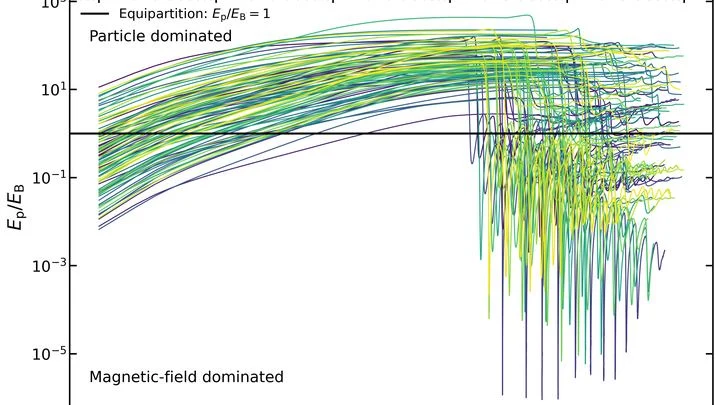
A particle with an energy of $$10^{18}$$ eV hitting Earth's atmosphere is like a tennis ball traveling at 200 km/h slamming into a wall. Astrophysicists have debated for decades where such projectiles come from. Gamma-ray bursts, brief and powerful explosions of gamma radiation, have long been suspected as accelerators.
A star runs out of fuel and rapidly collapses under its own gravity. According to classical ideas, it collapses into a point of infinite density — a singularity. But what if nature abhors infinities? In models of regular black holes, instead of a singularity, a dense core of unknown matter forms at the center.
In 2017, the LIGO and Virgo detectors recorded the spacetime tremor from the collision of two neutron star merger — event GW170817. After the initial burst came an after-ring: a kilohertz oscillation of the newly formed superdense remnant.
Two neutron stars spiral closer and collide. The result: a gravitational wave, a ripple in spacetime, a short gamma-ray burst, and a faint glow astronomers call a kilonova. But sometimes the signal passes by a massive galaxy.
Two ultradense spheres, each the size of a city, whirl in a dance. Their masses are less than the Sun's, but inside them is matter compressed to unimaginable limits. One sphere is a neutron star; the other is a strange star, made entirely of quarks — the elementary particles that build up protons and neutrons.
Boson stars are gravitational atoms. Only instead of electric charge, gravity itself serves as the nucleus, holding a cloud of scalar field in quantized clumps.
When two neutron stars, the ultra-dense cores of dead stars, collide, a kilonova is born: an explosion a thousand times brighter than a typical nova. This is the universe's true smelting works. In the scorching cloud racing outward at near-light speeds, a furious flux of neutrons transmutes atomic nuclei into gold, platinum, osmium.
A detective story unfolded in the GWTC-5 catalog. Hundreds of signals from merging black holes, captured by the detectors of Rainer Weiss and his colleagues, held the secret to the origin of the most massive and rapidly spinning stellar-scale objects.
Two neutron stars, ultra-dense remnants of massive stars, merge into one, and the space around them shudders: a gravitational wave is born, a ripple in the very fabric of spacetime. Almost simultaneously, a narrow stream of matter, the jet, erupts from the scene.
A collision of two neutron stars is a cosmic forge where the heaviest elements of the periodic table are hammered out in seconds. In 2017, detectors picked up gravitational waves from such a merger, and telescopes saw a flash — a kilonova.
LIGO and Virgo detectors catch ripples in spacetime, but some signals force us to rewrite the scripts of stellar death. GW190814 — the merger of a black hole of 23 solar masses with a compact object of 2.6 solar masses — is a discordant chord in the symphony of standard models.
Two stones fall into a pond. Ripples spread from each, but when they collide, there's a splash and a short, sharp clap. That's roughly what the merger of two neutron stars sounds like: those ultra-dense remnants of exploded stars.
Blacksmith's bellows fan the fire by forcefully pushing out air. In space, the shock wave from a supernova, a concept introduced by Fritz Zwicky, acts like such bellows: it catches up with a giant bubble of charged particles and magnetic fields formed around a spinning neutron star…
The Universe is singing. Not in the usual sense: its symphony is recorded in tiny density variations from which galaxies and ourselves grew. After the Big Bang, space was almost uniform, but quantum fluctuations during inflation left a faint pattern — slightly more matter here, slightly less there.
In the centers of galaxies, where supermassive black holes lie dormant surrounded by stellar swarms, lights of monstrous power sometimes flare up — tidal disruption events. But some of these events behave oddly: they repeat again and again, and each new ignition is dimmer than the last.
Two neutron stars whirl in their final dance. If their spin aligns with their orbital motion, the partners merge neatly, launching a narrow jet of superheated matter. If they spin in opposite directions, the dance breaks apart, scattering a thick shroud of debris.
Two burned-out stars, each about the size of Earth but heavier than the Sun, spiral ever closer until one crashes into the other. The impact triggers a thermonuclear explosion, giving birth to a type Ia supernova. Such flashes serve as cosmic beacons for measuring distances across the universe. Yet the details of their origin remain hotly debated.
Atomic nuclei are wrapped in fluffy electron coats — in such attire, they can't get close enough to embrace. But swap the light coat for a heavy one: a muon, a particle from the standard model, shrinks the cloud by nearly 200 times.
In 2017, detectors picked up a tremor in space — gravitational waves from the merger of two neutron stars. Telescopes immediately found a flash of light: a cosmic explosion astronomers dubbed a kilonova. In that fiery cauldron, it turned out, the heaviest elements of the periodic table are born — gold, platinum, uranium.
Two neutron stars (the remnants of dead stars, compressed to the size of a city but weighing as much as the Sun) spiral around each other and eventually collide. At that moment, something between a black hole and a super-powered magnet is born: a field billions of times stronger than that of the most powerful MRI machine.
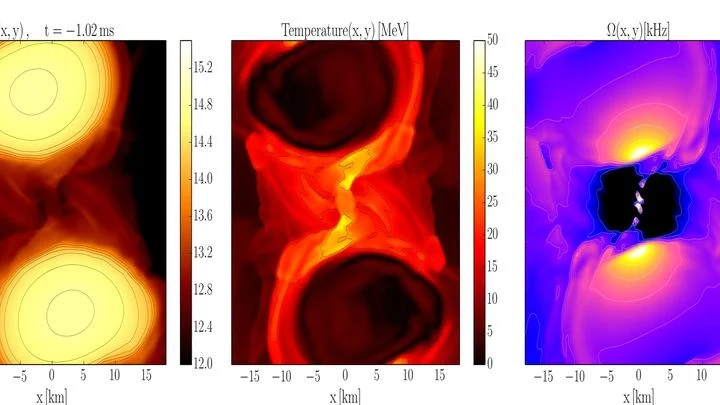
Two ultra-dense stars spiral around each other and eventually collide. This dance lasts only moments, but it sends powerful ripples through space — gravitational waves. After the merger, a rapidly spinning blob remains, ringing like a bell, and that ring carries information about what the stars were made of.
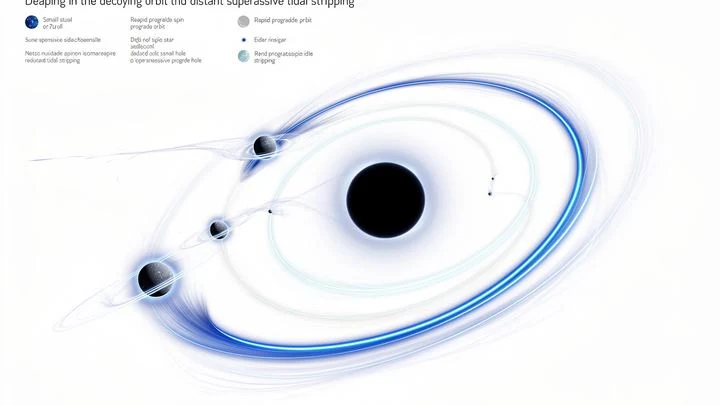
When a neutron star and a black hole merge, they send out gravitational waves — ripples in spacetime that reach Earth. These ripples carry the imprint of their final dance: the orbit before the collision is often elongated, like an ellipse.
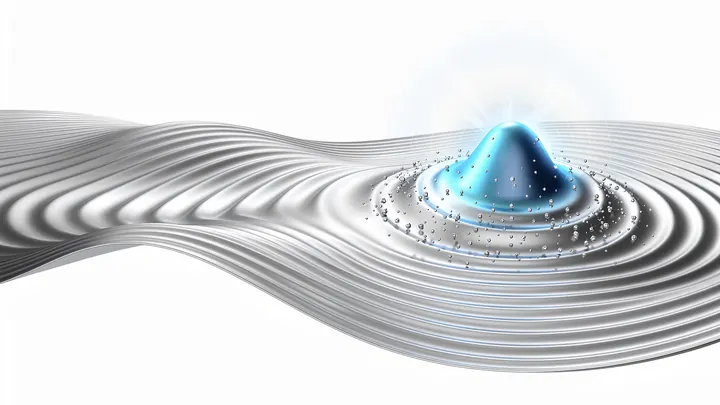
When black holes or neutron stars merge, they disturb the very fabric of spacetime, producing gravitational waves — ripples predicted by Einstein in his general theory of relativity.
Two neutron stars — these are ultra-dense remnants of dead stars, each the size of a city but heavier than the Sun. Their existence was predicted back in 1934 by Fritz Zwicky. A teaspoon of this matter weighs billions of tons. When two such objects draw close before merging, their magnetic fields twist and snap like taut strings.
Two neutron stars collide, and the space around them ripples like the surface of a pond after a stone is thrown. Huge gravitational wave detectors catch these ripples. If the collision also launches a narrow beam of gamma rays, space telescopes see it as a short gamma-ray burst.
Two non-spinning black holes at the moment of merger give birth to gravitational waves — ripples in the very fabric of spacetime, captured by instruments developed with the help of Kip Thorne.
The gravitational waves detectors LIGO and Virgo picked up a deep rumble — the aftermath of two invisible objects merging. Their combined mass turned out to be less than the Sun's. Stellar evolution doesn't produce such lightweight black holes: a dying star doesn't collapse into such a tiny finale.
Two burned-out stellar cores collide and merge into one. That's how R Coronae Borealis stars are born — rare luminaries where oxygen-18 is hundreds of times more abundant than in the Sun. But exactly how this happens has remained a puzzle.
In 1994, astronomers watched as the star V4332 in the constellation Sagittarius suddenly flared up, becoming thousands of times brighter. It hasn't settled down since: its brightness has changed several more times. These outbursts sit between ordinary novae and supernova explosions, and their cause has long been a puzzle.
In the neighboring galaxy, the Large Magellanic Cloud, lives the binary system A0538-66. There, a neutron star — a tiny sphere the size of a city but heavier than the Sun — spins on its axis every 69 milliseconds.
Two galaxies collided, and from their center an invisible fountain erupts. The ALMA and VLT telescopes peered into the heart of the IRAS20100-4156 system — where two stellar islands are merging. There, work is in full swing: hundreds of new suns are being born, and their heat drives a stream of cold gas outward.
This stream is like a giant's exhale.
The Einstein Probe space telescope detected a celestial storm: after a short (0.4-second) gamma-ray burst — a cosmic lightning bolt — came a long roll of X-ray thunder. It lasted nearly 10 minutes. This is the first direct proof that such explosions leave a lingering X-ray afterglow.
In a dark corner of the Milky Way, a natural metronome is at work. Every 8196 seconds, about 2 hours and 16 minutes, X-ray light flares on the surface of a neutron star. The star EP J171159.4-333253 pulls gas from a neighboring star, and this gas, falling inward, accumulates on its surface.
Igniting a miniature sun is a long-held dream of humanity. Typically, scientists try to confine scorching plasma (a gas of charged particles) at temperatures of hundreds of millions of degrees. But plasma tends to escape magnetic traps, and confinement comes at enormous cost.
Massive stars end their lives in a grand explosion — a supernova. Their cores collapse into a neutron star (a super-dense ball where a teaspoon of matter weighs a billion tons) or a black hole. For a long time, the most common type of such outbursts was thought to be the domain of solitary stars.
However, supernova SN 2018gj broke the rule.
Astronomers have been wrestling for years with the mystery of fast radio bursts — ultra-short yet incredibly powerful radio signals from distant galaxies. Some flash repeatedly, like beacons with an irregular rhythm, while others are detected only once, leaving behind nothing but questions.
A pair of neutron stars is like two heavy bowling balls slowly spiraling toward each other. They are born together from a binary system of massive stars, but it can take hundreds of millions of years before they finally collide. When they do, a short gamma-ray burst erupts — a brilliant explosion visible across half the universe.
Short gamma-ray bursts are colossal explosions that release, in a fraction of a second, energy comparable to what our Sun will emit over billions of years.
Neutron stars — the super-dense remnants of supernovae — create gravitational waves when they collide. These ripples in space can be thought of as a silent melody: the more precisely we catch its notes, the better we understand the interiors of these objects.
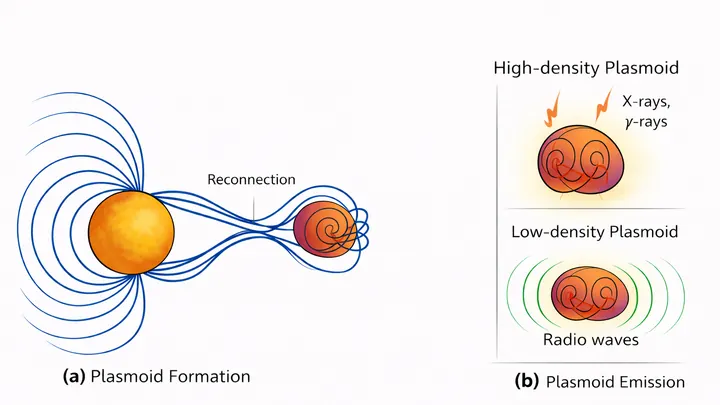
A magnetar is a neutron star with a magnetic field a quadrillion times stronger than Earth's. Sometimes it ejects a blob of plasma, like a tiny balloon with thousands of invisible springs bouncing around inside.