Seven Years of Watching a Cosmic Mirage express
Light from quasar PS J2305+3714 has been traveling toward us for more than eleven billion years. On its way, it passes near a massive galaxy whose gravity bends its path, like a heavy ball denting a stretched sheet. Through a telescope, we see not one quasar but two images — two points of light that are actually the same distant object.
For seven years in a row, from 2018 to 2024, astronomers photographed this pair every few nights using a telescope in the mountains of Uzbekistan. It turned out that the brightness of each image barely changes — the flickering does not exceed a hundredth of a magnitude. This means there are no dense clumps of dark matter between us and the quasar that could distort the picture.
Astronomers measured this delay: 52 days. The brighter image flares first, and 52 days later, the second one does. Knowing the distance to the lens and the angle between the images, one can calculate how fast the Universe is expanding. This is one of the few ways to measure the expansion rate without the distance ladder, which accumulates errors.
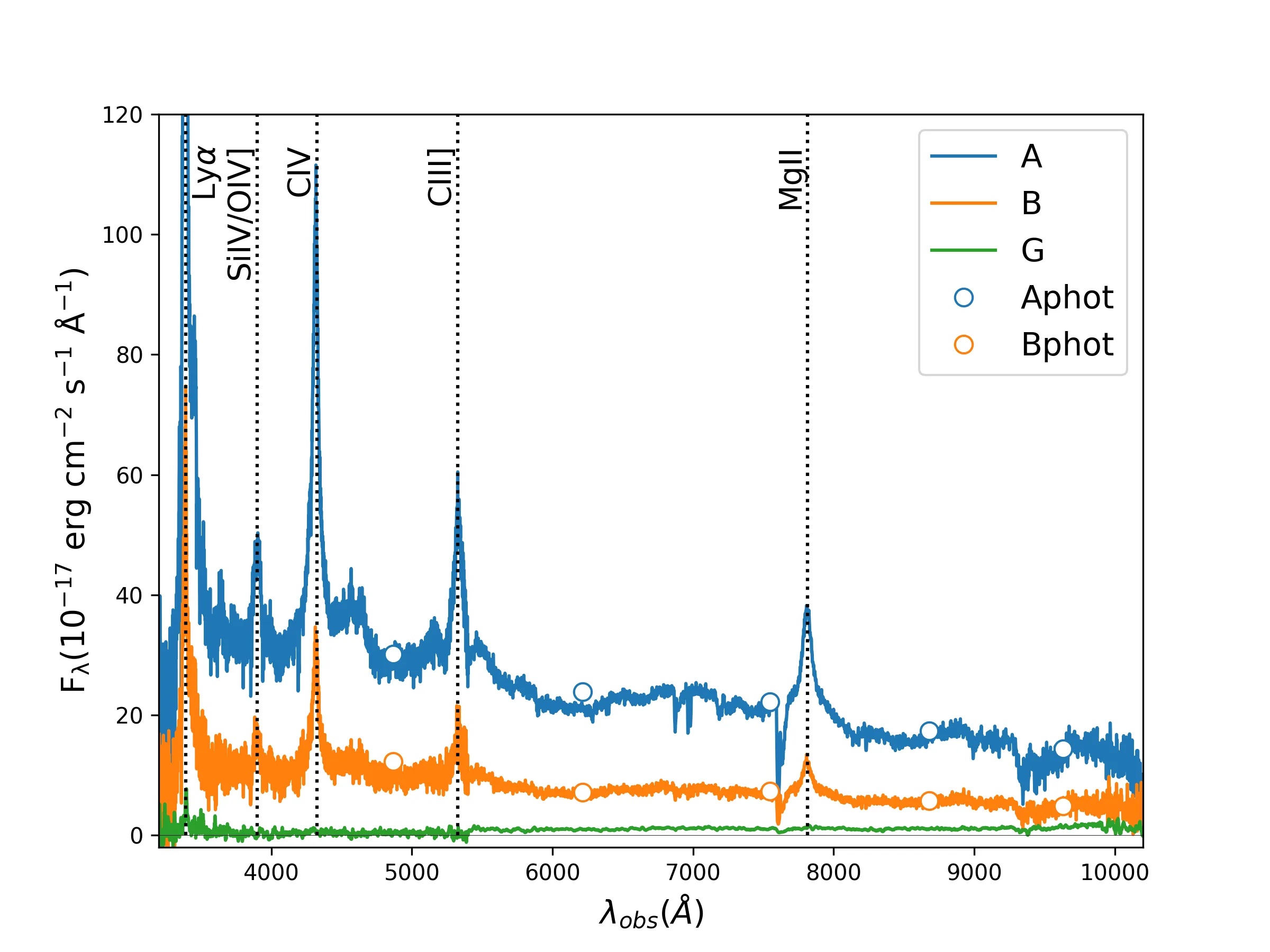
The quasar's spectrum shows that it is moving away from us at a speed corresponding to a redshift of 1.79, while the lensing galaxy has a redshift of 0.47. These numbers, together with the delay and the angle, form a coherent picture that agrees with the standard model of the Universe. PS J2305+3714 becomes another reliable point on the cosmic distance map.
The 52-day delay is like two couriers leaving the same place at the same moment, but one takes a direct route while the other goes around a mountain. The second arrives later, even though they started at the same time.