Aluminum-26: New Data Reshape the Picture express
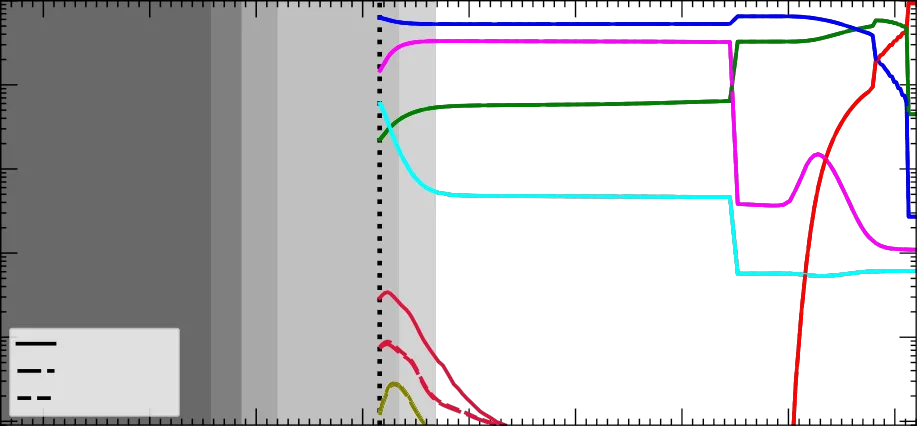
Aluminum-26 is an isotope that doesn't live long by cosmic standards: only about a million years. When a massive star explodes as a supernova, it flings this aluminum into space. Later, it decays, emitting gamma rays that telescopes can catch.
The authors recalculated how much aluminum-26 a star with 20 solar masses should eject. They used newer, more precise data on the nuclear reactions that create and destroy aluminum-26. It turns out the ejected amount changes by a factor of three compared to earlier calculations. It's like baking a cake from a recipe and then discovering you need three times as much flour.
The scientists also compared their results with meteorite data. They looked at ratios of aluminum-26 to other short-lived isotopes. It turned out that a single massive star cannot account for all these ratios. It seems another source is needed — for instance, another star that also exploded and polluted the cloud from which the solar system later formed.
Original abstract
as written by the authors arXiv:2601.05672
Over the last three years, the rates of all the main nuclear reactions involving the destruction and production of $$^{26}$$Al in stars ($$^{26}$$Al(n, p)$$^{26}$$Mg, $$^{26}$$Al(n, $$\alpha$$)$$^{23}$$Na, $$^{26}$$Al(p, $$\gamma$$)$$^{27}$$Si and $$^{25}$$Mg(p, $$\gamma$$)$$^{26}$$Al) have been re-evaluated thanks to new high-precision experimental measurements of their cross sections at energies of astrophysical interest, considerably reducing the uncertainties in the nuclear physics affecting their nucleosynthesis. We computed the nucleosynthetic yields ejected by the explosion of a high-mass star (20 Msun, Z = 0.0134) using the FRANEC stellar code, considering two explosion energies, 1.2 10$$^{51}$$ erg and 3 10$$^{51}$$ erg. We quantify the change in the ejected amount of $$^{26}$$Al and other key species that is predicted when the new rate selection is adopted instead of the reaction rates from the STARLIB nuclear library. Additionally, the ratio of our ejected yields of 26Al to those of 14 other short-lived radionuclides (36Cl, 41Ca, 53Mn, 60Fe, 92Nb, 97Tc, 98Tc, 107Pd, 126Sn, 129I, 36Cs, 146Sm, 182Hf, 205Pb) are compared to early solar system isotopic ratios, inferred from meteorite measurements. The total ejected 26Al yields vary by a factor of ~3 when adopting the new rates or the STARLIB rates. Additionally, the new nuclear reaction rates also impact the predicted abundances of short-lived radionuclides in the early solar system relative to $$^{26}$$Al. However, it is not possible to reproduce all the short-lived radionuclide isotopic ratios with our massive star model alone, unless a second stellar source could be invoked, which must have been active in polluting the pristine solar nebula at a similar time of a core-collapse supernova.
Aluminum-26 is used to date events in the early solar system: its abundance in meteorites tells when the first solid bodies formed.
In Arthur C. Clarke's novel "Rendezvous with Rama," astronomers detect anomalous gamma radiation from aluminum-26, hinting at unusual processes in space.