Half-life is the time required for half of the atoms in a radioactive sample to decay. For aluminum-26, this is about 717,000 years, meaning that if you start with a kilogram of it, after 717,000 years you'd have half a kilogram, after another 717,000 years a quarter, and so on. It's a statistical measure that applies to large numbers of atoms, not a prediction of when any single atom will decay.
History
The concept was introduced by Ernest Rutherford in 1907, who used it to describe the decay of radioactive elements and their dating potential.
How it works
Radioactive decay is a random process at the level of individual atoms, but with a constant probability per unit time for each atom. This probability is characterized by the decay constant, and the half-life is simply ln(2) divided by that constant. The exponential decay law emerges naturally from this constant probability, giving the characteristic 'half-life' behavior.
In practice
Half-lives are used in radiometric dating (e.g., carbon-14 for archaeology, uranium-lead for geology), in nuclear medicine for isotope dosing, and in nuclear waste management to plan storage times.
Fun fact
The half-life of aluminum-26 is long enough that it was present in the early solar system and its decay is used to date meteorite formation.
In 1946, proposed a method that revolutionized archaeology: determining age by the decay of radiocarbon. The clock ticks: every 5730 years, half of the atoms vanish. But why so slowly? For a light nucleus, this is an anomaly — typical lifetimes are millions of times shorter. The mystery held for seven decades.
An orchestra of billions of cesium atoms struck a single note, and it sounded for 17 hours without fading. That’s no exaggeration: Chinese physicists created a continuous time crystal with a record-breaking lifespan. A time crystal is a system that breaks time symmetry, spontaneously pulsating in an unchanging rhythm.
Black holes are not eternal: they slowly lose energy, emitting entropy — a measure of hidden information — as heat. This process was predicted by Stephen Hawking. But until now, it remained a mystery what happens at the very end, when the hole has almost disappeared and must return the captured data.
Plutonium is a metal with attitude. One form shrinks when cooled, another swells. But at room temperature, the alloy behaves strangely: the ruler says one thing, X-rays say another. The ruler shows the sample barely grows, while X-rays see atoms in the crystal lattice moving further apart.
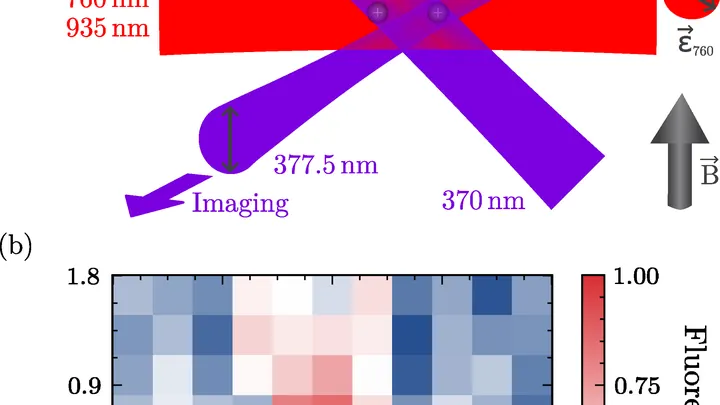
An optical tweezer is a laser beam that holds an atom in place, much like fingers holding a pea. Arrays of these tweezers form the basis of future quantum computers. But there's a catch: not every tweezer catches an atom. Typically, only half of the traps get filled, and for molecules, even fewer. Empty spots break the whole setup.
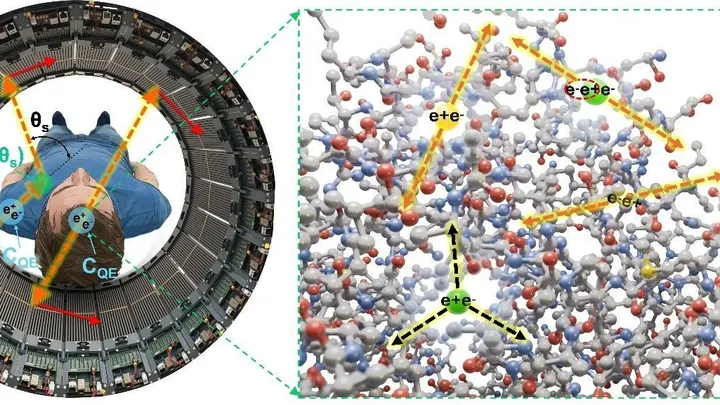
Two photons fly out from a single point in a patient's chest. They are twins: alter one, and you instantly know about the other. This connection is called quantum entanglement. In a PET scan, these pairs are born inside the body when an injected radioactive substance meets electrons in the tissues.
The degree of entanglement is not constant.
Inside every atom lives a proton. For a long time, it was considered as eternal as matter itself. But theories that unify all forces of nature predict that, sooner or later, the proton will decay. The only question is how long we have to wait.
In the Japanese detector Super-Kamiokande — a giant tank of ultra-pure water — physicists searched for signs of such a decay.
An aluminum pot on the stove melts at 660 degrees Celsius — everyone knows that. But what happens if you heat aluminum a hundred times hotter? The liquid starts to boil, and here's the puzzle: at what exact temperature does that happen?
In 2017, the IceCube detector caught a neutrino from the distant galaxy TXS 0506+056. It was like hearing a phone ring from across the ocean: the signal came from where the most energetic particles in the Universe are born. At the same time as the neutrino, astronomers spotted a gamma-ray flare, and two to three years later, radio waves. Why was the radio late?
In 1978, physicists bombarded a target with a beam of ions and measured how quickly they slowed down in matter. Using the Doppler shift of gamma rays, they calculated the lifetimes of excited nuclear states. For iron-58, they obtained a value that did not agree with shell-model calculations.
Inside an atom's nucleus, protons and neutrons stack in layers, like spectators in a packed hall. When a layer is full, the nucleus becomes especially stable — physicists call these 'full rows' magic numbers. One of them, 32, has long been elusive: in nuclei with 32 neutrons, its effect is weak, and in some neighbors it seems absent altogether.
A glowing dot in a vacuum chamber refuses to go out, even though the light source has long been switched off. A single ytterbium ion, held by electric fields, is stuck in an excited state, as if the electron inside it has forgotten how to return to its usual place.
An atomic nucleus usually follows its own rules: its decay doesn't care about temperature, pressure, or molecular neighbors. But the uranium-235m isotope is a striking exception. This nucleus sits in an excited state, like a tightly coiled spring, and sooner or later it releases the extra energy.
At a particle accelerator in Beijing, electrons collide with positrons, and for a fleeting moment, a particle called eta-c is born. It lives for a tiny fraction of a second and then decays into other particles. One of the rarest paths is to split into two photons, particles of light. Until now, no one could say exactly how often this happens.
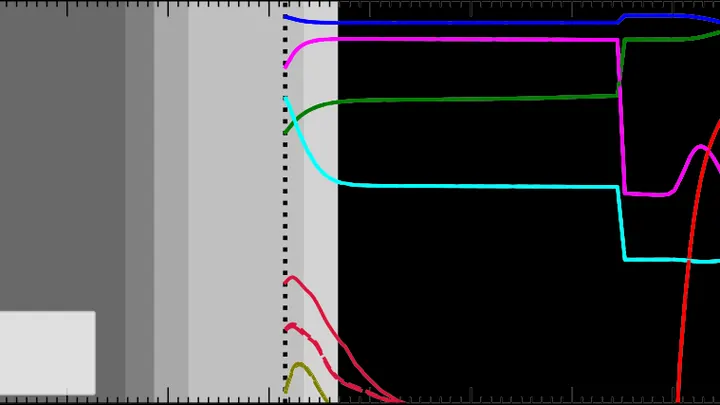
Aluminum-26 is an isotope that doesn't live long by cosmic standards: only about a million years. When a massive star explodes as a supernova, it flings this aluminum into space. Later, it decays, emitting gamma rays that telescopes can catch.
The authors recalculated how much aluminum-26 a star with 20 solar masses should eject.
In a silicon crystal, the stuff of microchips, there sometimes sits a foreign atom, like magnesium. It behaves like a tiny magnet with several 'pointer positions.' If you illuminate such a crystal with a short flash of light, the atom momentarily gets excited, then returns to its ground state.
Conventional atomic clocks are essentially optical counters: they rely on spectroscopy — a method for measuring the frequency of radiation with high precision as electrons jump between energy levels.
A quantum system, once born, does not forget it. Even after dozens of lifetimes, a trace of the initial state remains in its decay: a slowly decreasing power-law tail. For two fluorescent dyes, erythrosine B and eosin Y, this tail has been observed for the first time in two spectral channels simultaneously.
A tuning fork cut from a perfect metal rings at a single frequency. Its sound is as pure as a mathematical formula. But clamp it in a vise or dip it in a viscous liquid, and the tone smears, picks up noise, and loses its sharpness. The nucleus of scandium-45 behaves much the same way when placed in a crystal lattice.