Supernovanucleosynthesis is the process by which the heaviest elements in the universe are forged in the cataclysmic explosion of a massive star. When a star with more than about eight times the mass of the Sun exhausts its nuclear fuel, its core collapses and then rebounds in a violent shockwave that tears the star apart. The extreme temperatures and neutron fluxes during this event allow atomic nuclei to capture neutrons and protons rapidly, building up elements heavier than iron, such as strontium, gold, and uranium. Lighter elements like calcium and iron are also produced in abundance during the explosion, enriching the surrounding interstellar medium.
History
The concept was developed in the 1950s by astrophysicists Margaret and Geoffrey Burbidge, William Fowler, and Fred Hoyle in their seminal 1957 paper on stellar nucleosynthesis, with the r-process specifically attributed to supernovae.
How it works
During the final moments of a massive star's life, the core collapses into a neutron star or black hole, releasing a flood of neutrinos and heating the infalling material. This creates a brief but intense environment where nuclei undergo rapid neutron capture (the r-process) and other nuclear reactions. The newly synthesized elements are then ejected into space at high velocities, where they mix with gas and dust clouds. Over time, these enriched clouds can collapse to form new stars and planets, incorporating the freshly made elements into their composition.
In practice
Understanding supernovanucleosynthesis helps astronomers interpret the chemical abundances in stars and meteorites, and it guides the search for rare isotopes like aluminum-26 that trace recent stellar explosions in our galaxy.
Fun fact
The strontium in your bones and the calcium in your teeth were likely forged in a supernova explosion that occurred billions of years before the Solar System formed.
In a tank holding three tons of liquid xenon, buried deep underground, something stirred one day. Not the xenon itself, but one of its atomic nuclei: it received a kick with an energy of 248 thousand electronvolts and recoiled like a billiard ball struck by an invisible cue ball.
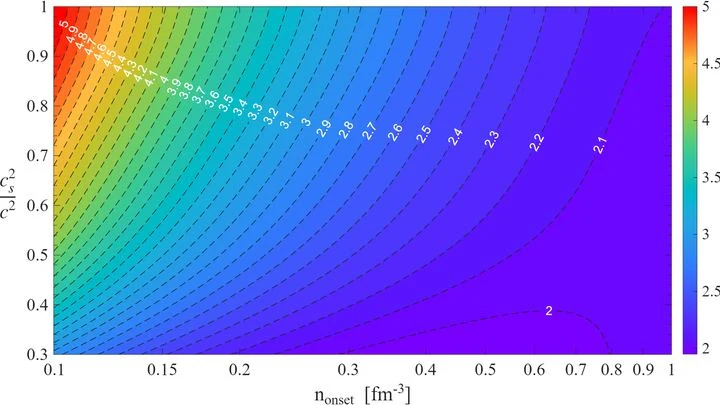
A neutron star is what remains after a massive star explodes. Its matter is compressed so tightly that a teaspoonful would weigh billions of tons. Under such conditions, protons and neutrons can rearrange, and new particles (hyperons, similar to neutrons but containing a 'strange' quark) can appear.
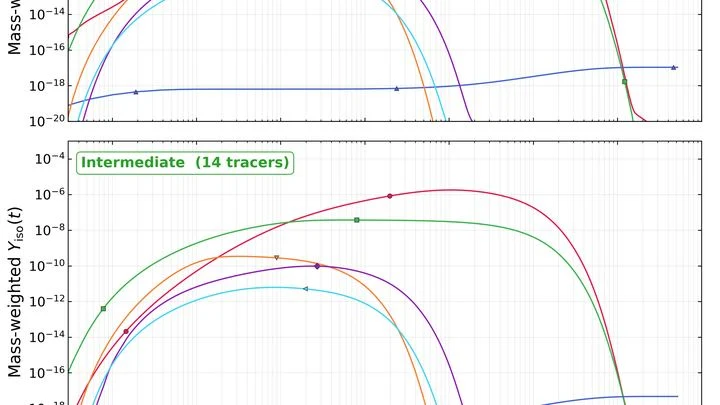
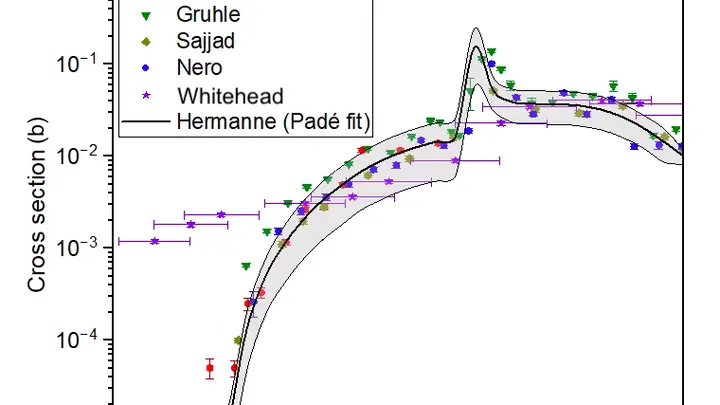
When a massive star explodes as a supernova, heavy nuclei are forged in its interior within seconds. Among them is titanium-44, a radioactive isotope that later glows in gamma rays for years. How much of it remains depends on a single nuclear reaction: a proton is captured by a vanadium-45 nucleus, turning it into chromium-46.
A neutron star is the remnant of an exploded star, compressed so tightly that a teaspoon of its material would weigh as much as a mountain. Inside such an object, protons and neutrons are packed tightly together, and under enormous pressure, hyperons, particles containing a strange quark, can appear.
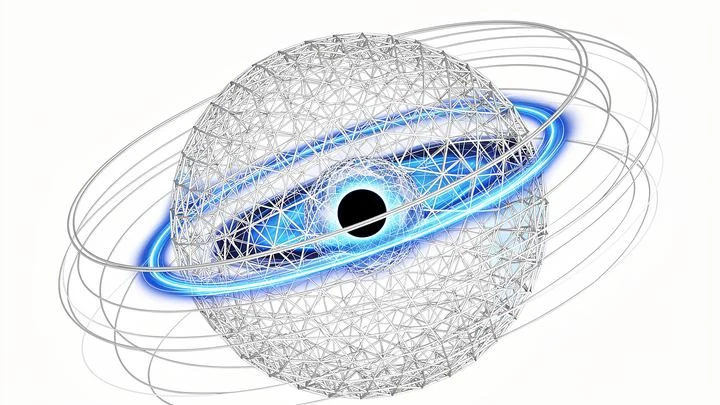
A spinning top whirls so fast that the air around it starts to rotate in unison. A black hole behaves in much the same way: if it spins, it can transfer its energy to particles that happen to be nearby. This process is called superradiance: it's like an echo in the mountains, but instead of sound, new particles are born.
In the distant Cigar Galaxy, there is an unusual beacon. It doesn't shine in the usual sense: its rays are born in a scorching cloud around a black hole that is devouring matter from a companion star. Such objects are called ultraluminous X-ray sources. Their X-ray brilliance is so intense that it outshines entire galaxies.
This cloud, the corona, is like a boiling cauldron.
A massive star exhausts its fuel, and its core collapses in a fraction of a second. A supernova is born, along with a brief but powerful shower of neutrinos. These particles barely interact with matter, so they fly away freely, carrying information about the catastrophe.
A supernova explosion blasts off the outer layers of a dying star. What remains is the core — a neutron star, packed into a sphere the size of a city. The existence of such stars was predicted back in 1934 by Fritz Zwicky.
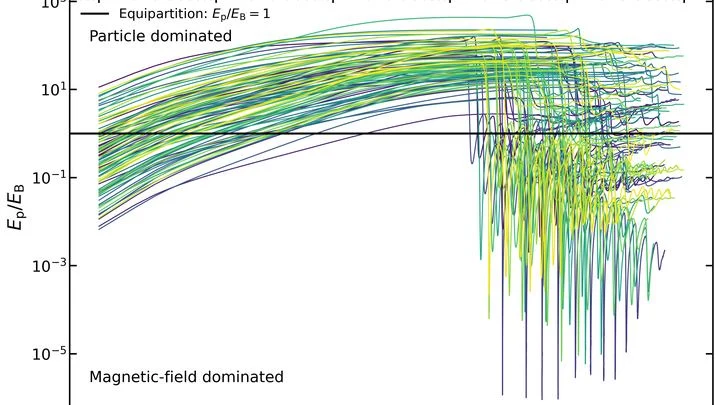
The collapse of a star's core is like compressing a spring: matter falls inward, and a neutron star is born at the center. But the fall is never perfectly smooth. In the boiling outer layers, random eddies transfer angular momentum to the infalling gas, and a disk swirls around the central object.
This disk is no calm river. It pulses, strengthening and fading.
A billiard ball clicks against another in complete darkness. The sound of the impact and the clatter of balls dropping into pockets: that's all you hear. This is roughly how physicists study the interactions of elementary particles at energies that no terrestrial accelerator can reproduce.
In June 2024, the CHIME radio telescope recorded over 700 radio bursts per hour from source FRB 20240114A. Such a hyperactive repeater releases in one hour nearly all the magnetic energy of a typical magnetar (a neutron star with an ultra-strong field).
At the centers of many galaxies, not only supermassive black holes lurk, but also vast clouds of invisible matter. If this matter consists of ultralight particles, it can gather into dense clumps — a kind of 'star' made of dark matter.
At the center of every atom lies a nucleus — a dense ball of protons and neutrons. These particles don't just crowd together randomly; they fill strict energy levels, much like floors in a skyscraper. When a floor is completely filled, the nucleus becomes especially stable — physicists call this a magic number.
An old factory where instead of machines there are atomic nuclei, and neutrino radiation seethes all around. When a massive star exhausts its fuel, its core compresses a hundredfold, and the temperature skyrockets to billions of degrees.
Two ultradense spheres, each the size of a city, whirl in a dance. Their masses are less than the Sun's, but inside them is matter compressed to unimaginable limits. One sphere is a neutron star; the other is a strange star, made entirely of quarks — the elementary particles that build up protons and neutrons.
When two neutron stars, the ultra-dense cores of dead stars, collide, a kilonova is born: an explosion a thousand times brighter than a typical nova. This is the universe's true smelting works. In the scorching cloud racing outward at near-light speeds, a furious flux of neutrons transmutes atomic nuclei into gold, platinum, osmium.
A hot infant and a cold adult — the same neutron star looks different. Just born in a supernova explosion, it is scorching hot at tens of billions of degrees. But as time passes, it cools, contracting like cooling metal. For the star PSR J1012+5307, this transition means an almost twofold reduction in radius.
A collision of two neutron stars is a cosmic forge where the heaviest elements of the periodic table are hammered out in seconds. In 2017, detectors picked up gravitational waves from such a merger, and telescopes saw a flash — a kilonova.
A pot of porridge boiling over a high flame: bubbles carry grains from the bottom to the surface. A similar mechanism works on a neutron star. As it accumulates hydrogen and helium from a companion star, it occasionally triggers a powerful nuclear explosion — an X-ray burst.
Blacksmith's bellows fan the fire by forcefully pushing out air. In space, the shock wave from a supernova, a concept introduced by Fritz Zwicky, acts like such bellows: it catches up with a giant bubble of charged particles and magnetic fields formed around a spinning neutron star…
The universe is full of the invisible. We know about dark matter from galaxy rotation and gravitational lensing, but its nature has eluded us for a century.
A neutron star is a gravitational lens that focuses our attempts to glimpse dark matter. Through its ultra-dense matter, like exotic glass, we search for the axion — an elusive particle that could explain the hidden mass of the universe.
Somewhere in the galactic bulge, a massive star lies dormant, ready to trade quiet burning for collapse. Its core will exhaust its fuel, and in a fraction of a second, a neutron star or black hole will be born, releasing 10⁵⁸ neutrinos — almost all the energy of the explosion.
Two burned-out stars, each about the size of Earth but heavier than the Sun, spiral ever closer until one crashes into the other. The impact triggers a thermonuclear explosion, giving birth to a type Ia supernova. Such flashes serve as cosmic beacons for measuring distances across the universe. Yet the details of their origin remain hotly debated.
A pot of boiling porridge, where instead of grains there are layers of oxygen and silicon, and the fire beneath is about to go out, and the star will collapse in on itself. Until now, astrophysicist cooks have used a simplified recipe: they assumed that bubbles and eddies in the porridge obey one and the same average temperature throughout the depth.
A light bulb that doesn't burn out but flares brighter and brighter until it blows the whole fixture apart. That's roughly how the most massive stars in the universe die. When a star's core heats up to billions of degrees, pairs of particles (electrons and their antimatter counterparts, positrons) begin to form.
Imagine an interpreter at a crucial negotiation suddenly switching to another language, and the meaning of everything changes. That's roughly what neutrinos do in the depths of a dying star. These invisible particles are born in enormous numbers when a star's core compresses into a city-sized lump. But on their way out, neutrinos can change their type — physicists call this flavor transformation.
When the interstellar comet 3I/ATLAS approached the Sun, its tail lit up with a metallic sheen, as if a tin can full of nickel and iron had burst open. By breaking down its light into colors, astronomers detected the lines of these metals using spectral analysis.
A translator halfway across the hall suddenly starts rendering the message backwards. That's roughly how a neutrino, a ghost particle that barely notices matter, might behave if it encounters a cloud of ultralight dark matter.
Stars tens of times heavier than our Sun don't die as thought before. Computer models show that their core often doesn't ignite a supernova, but quickly collapses into a black hole. Imagine a soufflé: the center suddenly sinks, and almost all the batter falls into the funnel, with just a few drops splashing out.
A laser hits a target of thin wires, and within tens of femtoseconds (billionths of a billionth of a second) knocks out a stream of protons. These protons fly into a converter made of lithium and deuterium, where neutrons are born.
An ordinary kitchen knife made of niobium would suddenly start conducting electricity with zero loss at −258 °C. That's how superconductivity works, and you can "switch it on" right at the metal's surface by blasting it with a laser in a nitrogen atmosphere.
A neutron star is the remnant of an exploded star, compressed to the size of a city. On its surface, a thermonuclear fire sometimes erupts: accumulated gas explodes like a giant hydrogen bomb. After the burst, ash remains — a mixture of heavy elements that rises to the surface and forms a hot atmosphere.
A powerful searchlight shines through thick fog. The beam itself is invisible, but the fog begins to glow faintly, and gives away the searchlight's presence.
Colliding two lead nuclei at the Large Hadron Collider is like throwing two hefty bags of marbles at each other. Usually, the marbles scatter in all directions, but sometimes one bag passes so close that the marbles don't collide: they just exchange glances.
The density at the center of a neutron star is so extreme that a teaspoon of its material would weigh as much as a mountain. Physicists have long tried to figure out how massive such a star can get before it collapses into a black hole.
Tiny black holes, born right after the birth of the universe, are supposed to evaporate — shedding mass as invisible particles. This was predicted by Stephen Hawking, and this 'Hawking evaporation' contributed to the expansion of the young cosmos.
Deep inside a massive star, before it explodes, layers sit on top of each other like the layers of an onion. Sometimes two adjacent layers, the carbon and oxygen layers, mix together. It's like how layers of broth and vegetables in a pot of soup blend when you stir them with a spoon.
When a massive star runs out of fuel, its core collapses and a shock wave races outward. But even before the star tears apart, particles that barely interact with ordinary matter may be born in its depths. If they decay into light, that energy leaks into the dense gas around the star.
This gas, like a blanket, wraps the star.
Deep inside a dying star, just before it goes supernova, nuclear reactions determine which chemical elements will be scattered across the cosmos. One such reaction is the collision of an oxygen nucleus with a proton, producing a nitrogen nucleus and an alpha particle (a helium nucleus).