Vibrations at the Edge of Absolute Zero express
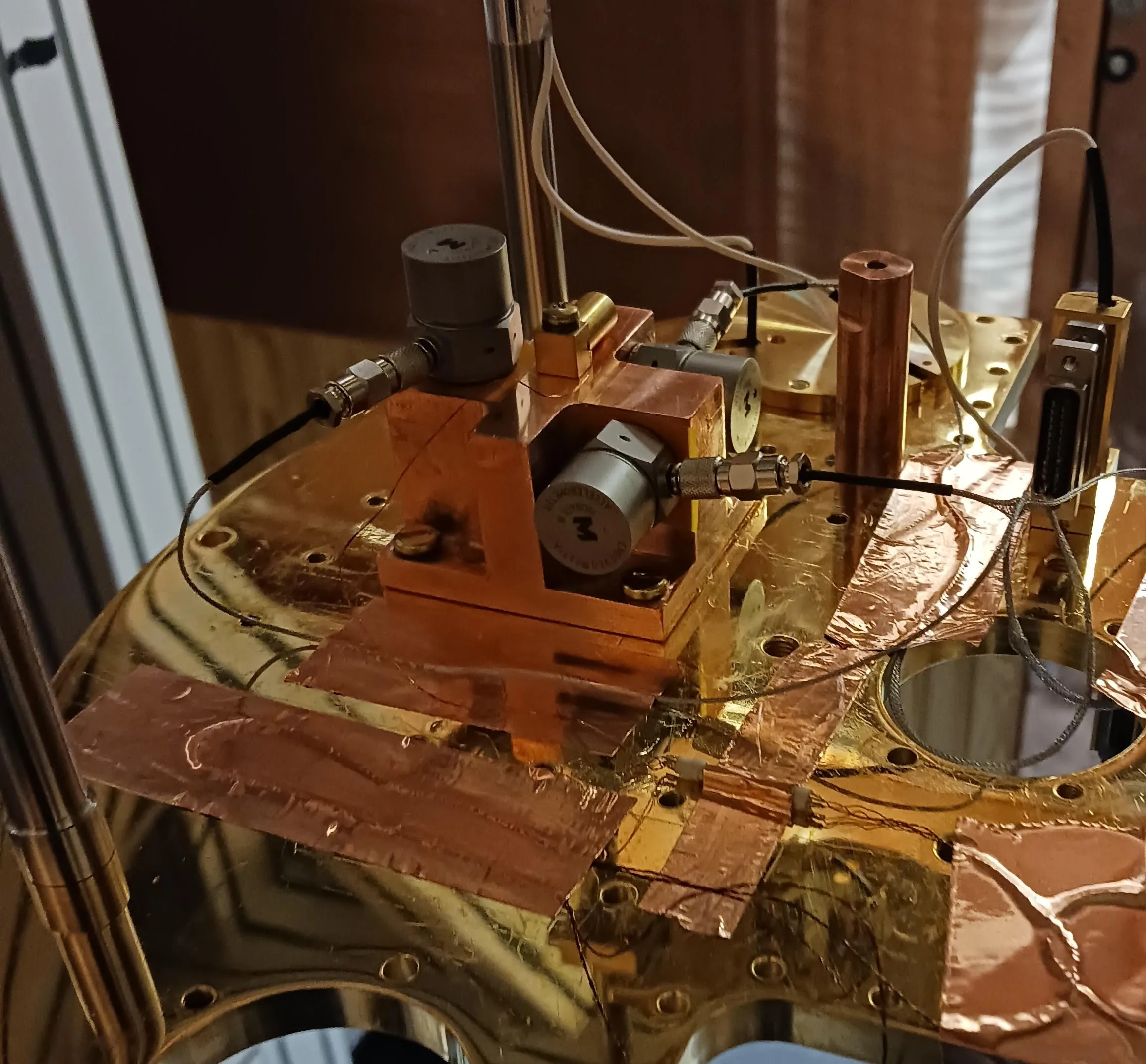
Inside a refrigerator that cools matter to near absolute zero beats a mechanical heart — the pulse tube. It pumps gas and extracts heat, but along with the cold it brings tremors. Each beat of this heart shakes the instruments sitting next to the sample and ruins delicate measurements. Previously, you could only notice this shaking from the outside, while inside, at eight thousandths of a degree above zero, the sensors would fail.
Now they've placed ordinary, off-the-shelf accelerometers in the fridge — the same kind that count steps in your phone or trigger in a car crash. They weren't specially selected or modified. They just mounted them on the coldest stage and switched them on. The sensors came alive and showed: the pulse tube shakes the setup at a frequency of about one hertz, with amplitudes of fractions of a micrometer. It's like a glass of water on the floor giving a barely perceptible shudder once a second, but for a quantum chip or a dark matter detector, such shaking is like an earthquake.
The main benefit isn't that the sensors survived the cold. They let you see the shaking continuously, right during the experiment. If vibrations get stronger, you see it immediately, not after the data is already spoiled. You can apply signal cleaning on the fly, like noise cancellation in headphones: subtract the tremor from the useful signal and keep only what the instrument actually measured. For labs hunting rare events, like a dark matter particle hitting a crystal, such constant vigilance for quiet could become as routine as a smoke detector in an apartment.
So the cold is no longer a blind spot. Scientists knew the fridge vibrated, but they couldn't see exactly how. Now they have eyes inside the coldest point of the setup, and those eyes are made from ordinary parts you can buy at an electronics store.
A temperature of 8 millikelvins is a hundred million times colder than room temperature. At such temperatures, even superconducting magnets operate in a special mode, and liquid helium would have frozen long ago — which is why new refrigerators don't use it at all.