How Saturn Hides Its Magnetic Field express
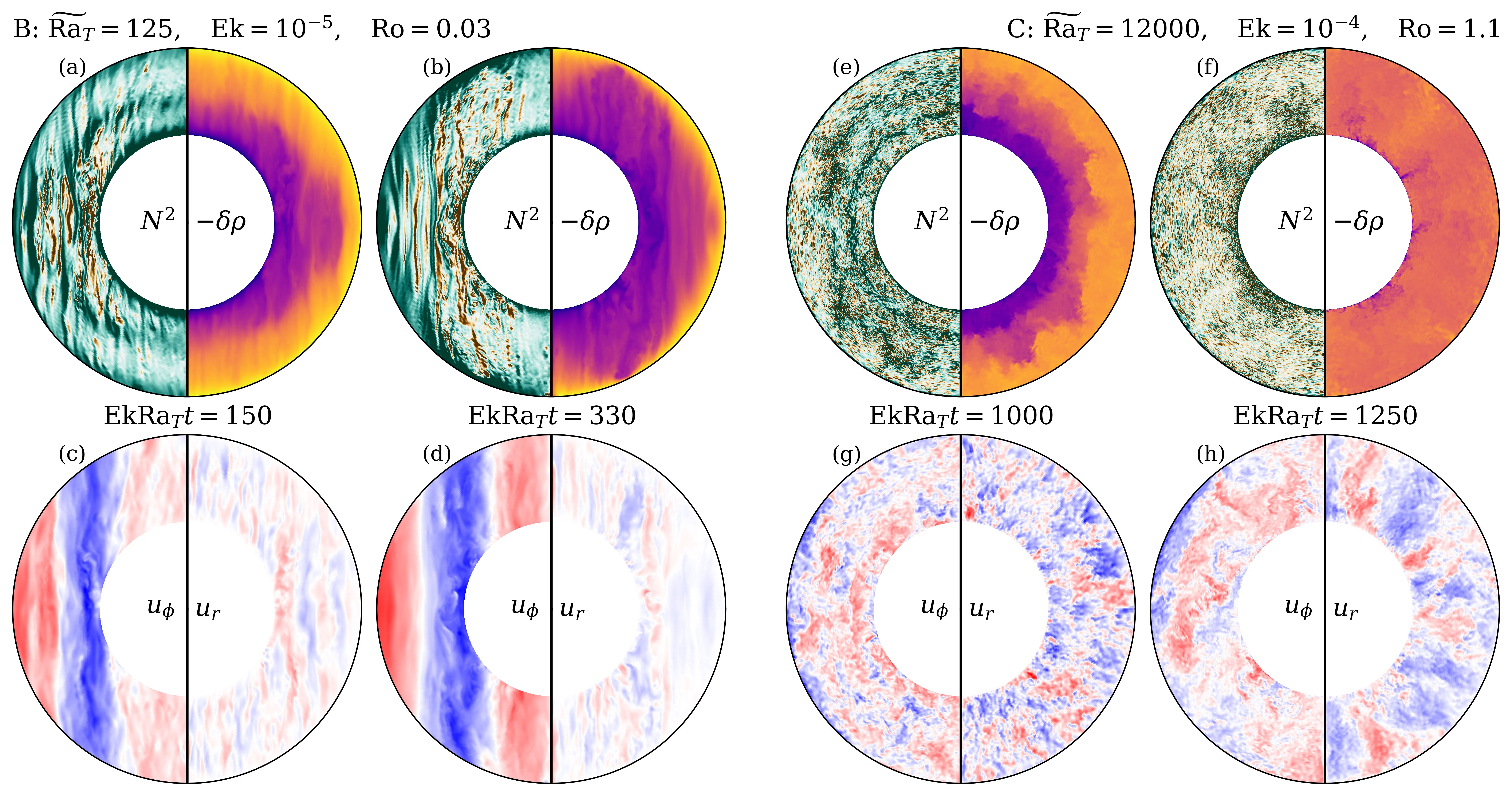
Inside giant planets like Jupiter and Saturn, heat doesn't always rise freely. Heavy elements, which are more abundant in some layers than others, prevent hot fluid from floating up. This creates semiconvection — a type of mixing where heat and composition spread at different rates.
For the first time, scientists simulated this process under conditions close to reality: inside a rotating sphere, like a planet. Initially, the fluid spontaneously separates into density steps — thin layers with sharp boundaries. Then the layers begin to merge. In the end, either a single fully mixed layer remains, or a mixed layer sits beneath a stable layer on top.
When they ran magnetic field calculations in this state, the field came out very smooth and aligned with the rotation axis, just like Saturn's. The stable upper layer acted as a filter, letting through only the simplest and smoothest field lines. This explains why Saturn's magnetic field is so calm compared to Earth's.
Original abstract
as written by the authors arXiv:2601.09358
Large regions of giant planets are thought to possess unstable thermal gradients stabilised by gradients in heavy-element composition. The fluid can then develop semi-convection, a double-diffusive instability driven by the unequal molecular diffusivities of heat and composition. While previous studies have focus mainly on local Cartesian models, we investigate semi-convection in rotating spherical shells, the geometry relevant to planetary interiors, using direct numerical simulations In a first non-linear phase, the flow spontaneously forms concentric density staircases composed of well-mixed layers separated by thin, strongly stratified interfaces. We propose scalings for both the thickness of these layers and their survival time in terms of the rotation rate and stratification. Over longer timescales, layers merge to produce statistically steady states consisting either of a fully convective shell or of a convective layer overlain by a persistent stably stratified layer (SSL), depending on the balance between stratification and rotation. Dynamo simulations show that flow within the convective region can generate a self-sustained magnetic field, which is filtered by zonal flows in the overlying SSL. This results in a strongly dipolar and axisymmetric external field, in encouraging agreement with Saturn's magnetic field. Across the explored parameter range, both the Rossby number and the thickness of the stably stratified layer are governed by a single combination of control parameters. This enables identification of a regime favourable to planetary-like dynamos.
Saturn's magnetic field is almost perfectly uniform: its axis aligns with the planet's rotation axis. Among all planets in the Solar System, this is unique.