How Saturn Hides Its Magnetic Field express
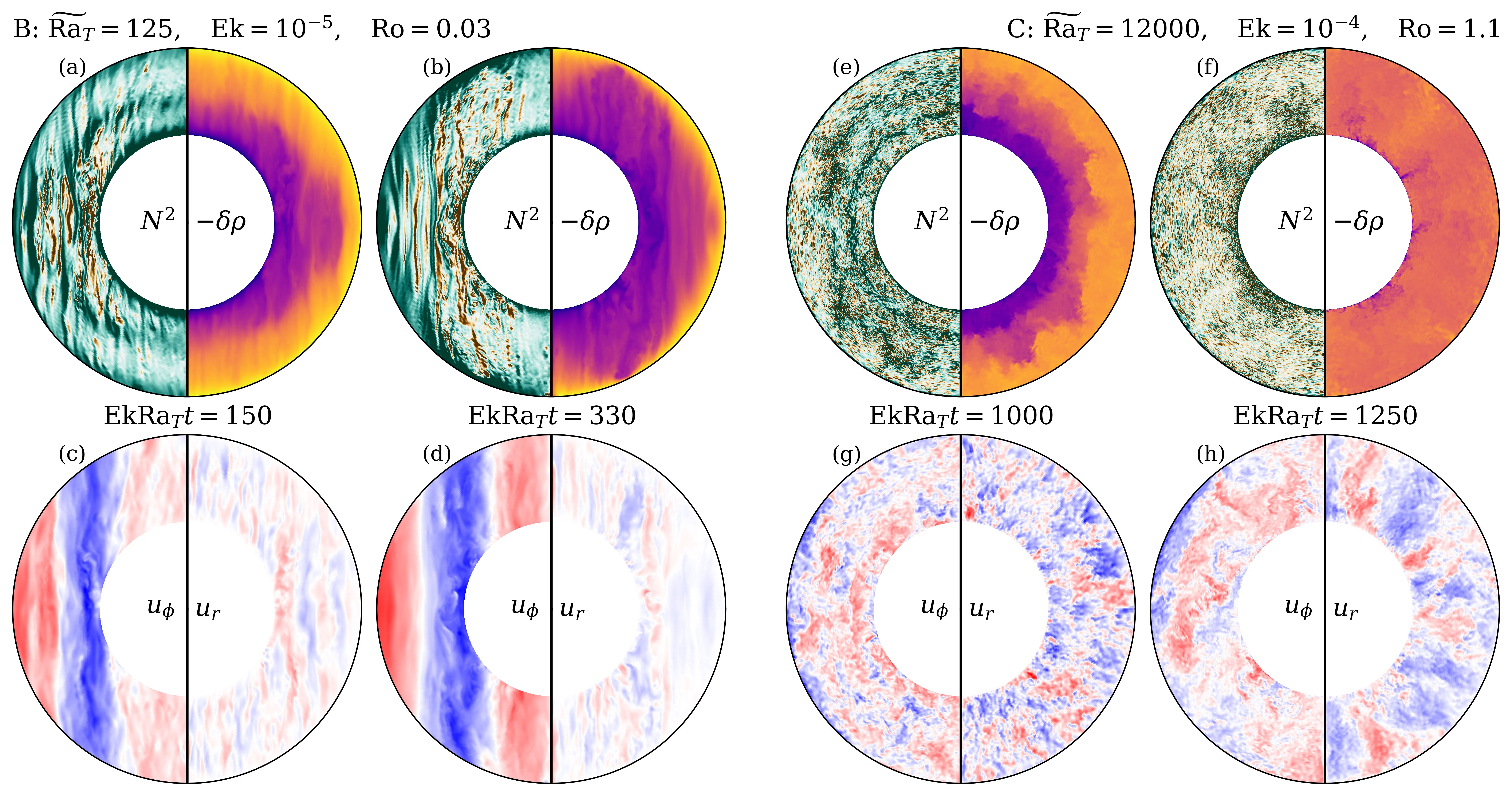
Inside giant planets like Jupiter and Saturn, heat doesn't always rise freely. Heavy elements, which are more abundant in some layers than others, prevent hot fluid from floating up. This creates semiconvection — a type of mixing where heat and composition spread at different rates.
For the first time, scientists simulated this process under conditions close to reality: inside a rotating sphere, like a planet. Initially, the fluid spontaneously separates into density steps — thin layers with sharp boundaries. Then the layers begin to merge. In the end, either a single fully mixed layer remains, or a mixed layer sits beneath a stable layer on top.
When they ran magnetic field calculations in this state, the field came out very smooth and aligned with the rotation axis, just like Saturn's. The stable upper layer acted as a filter, letting through only the simplest and smoothest field lines. This explains why Saturn's magnetic field is so calm compared to Earth's.
Saturn's magnetic field is almost perfectly uniform: its axis aligns with the planet's rotation axis. Among all planets in the Solar System, this is unique.