Laser Beam Controls Superconductivity express
A laser beam, like a fine chisel, burns oxygen out of a superconducting film. Where oxygen becomes scarce, the material stops conducting electricity without resistance. The researchers used this trick to draw patterns on the film that alter its properties.
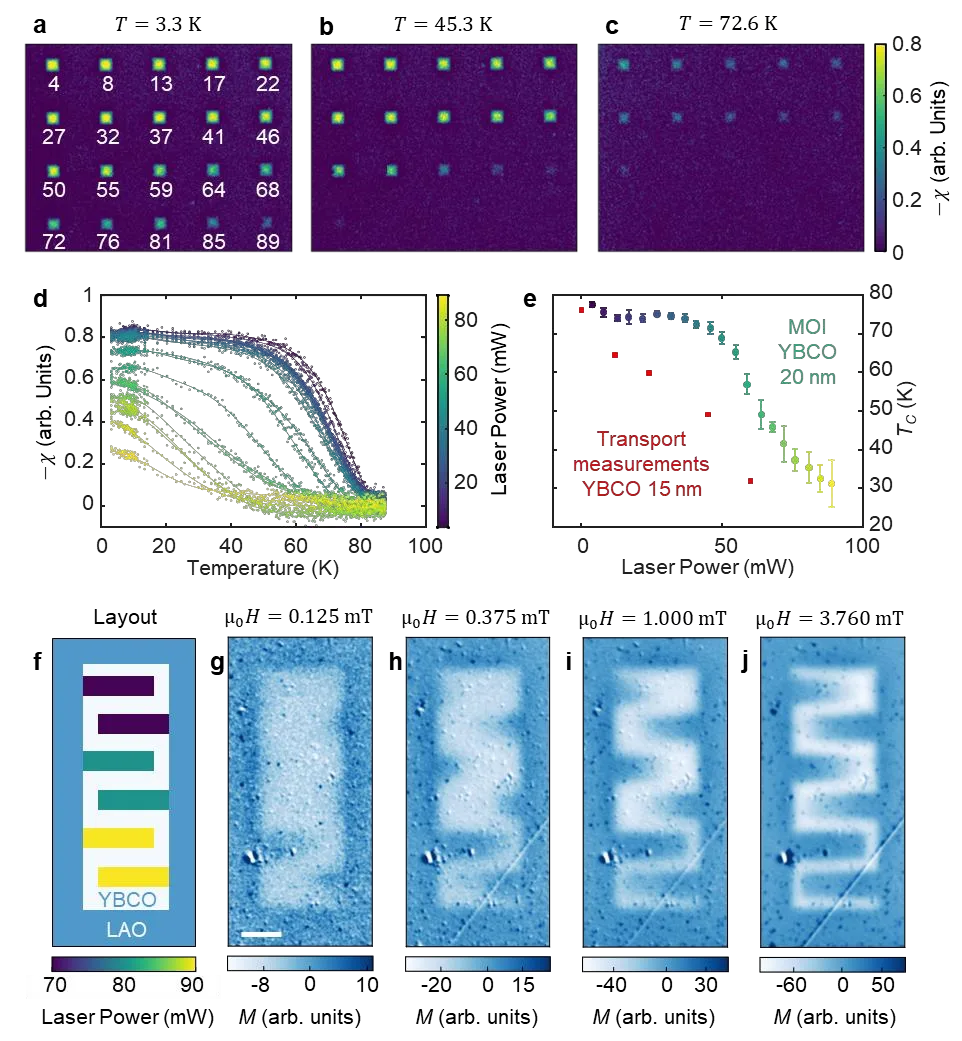
In experiments with yttrium barium copper oxide (YBCO), the team aimed a laser at a thin film and smoothly varied its power. The stronger the beam, the more oxygen is driven out, and the lower the temperature at which the material becomes superconducting. This allowed them to create regions with different properties, like an artist mixing paints to get the desired shade.
This method enables drawing complex circuitry on the film with smooth transitions in properties. Such structures could be useful in quantum sensors and superconducting electronics.
Original abstract
as written by the authors arXiv:2601.09513
Cuprate high-temperature superconductors, such as Yttrium Barium Copper Oxide (YBCO), are extremely promising for emerging technologies such as low-power computing, data storage, quantum sensors and superconducting electronics. However, the realization of high-performance functional nanostructures presents formidable challenges due to the difficulty of applying conventional nanofabrication methods to such sensitive materials, making the search for alternative methods a key enabling factor. Since YBCO's superconducting and normal-state properties are highly dependent on oxygen stoichiometry, precise nanoscale control of the oxygen content represents a highly appealing approach for creating advanced nanoengineered devices. In this work, we demonstrate the precise fabrication of sub-micrometer, grayscale patterns over large areas in epitaxial YBCO thin films, achieving finely tuned optical and superconducting transport properties by locally controlling the stoichiometry through maskless direct laser writing under ambient conditions. Cryogenic magneto-optical imaging and transport measurements in irradiated devices directly demonstrate the spatial tuning of the critical temperature and carrier density with the patterning conditions. Correlated Raman microscopy and reflectometry indicate a laser-power dependent oxygen depletion in the irradiated regions. The proposed laser-controlled stoichiometry approach provides a direct and scalable method to navigate the phase diagram of high-TC superconducting oxides, offering new possibilities for integrating functional nanostructures into superconducting devices.
YBCO is one of the most famous high-temperature superconductors, discovered in 1987. It operates at higher temperatures than traditional superconductors but still requires cooling with liquid nitrogen.