Laser Beam Controls Superconductivity express
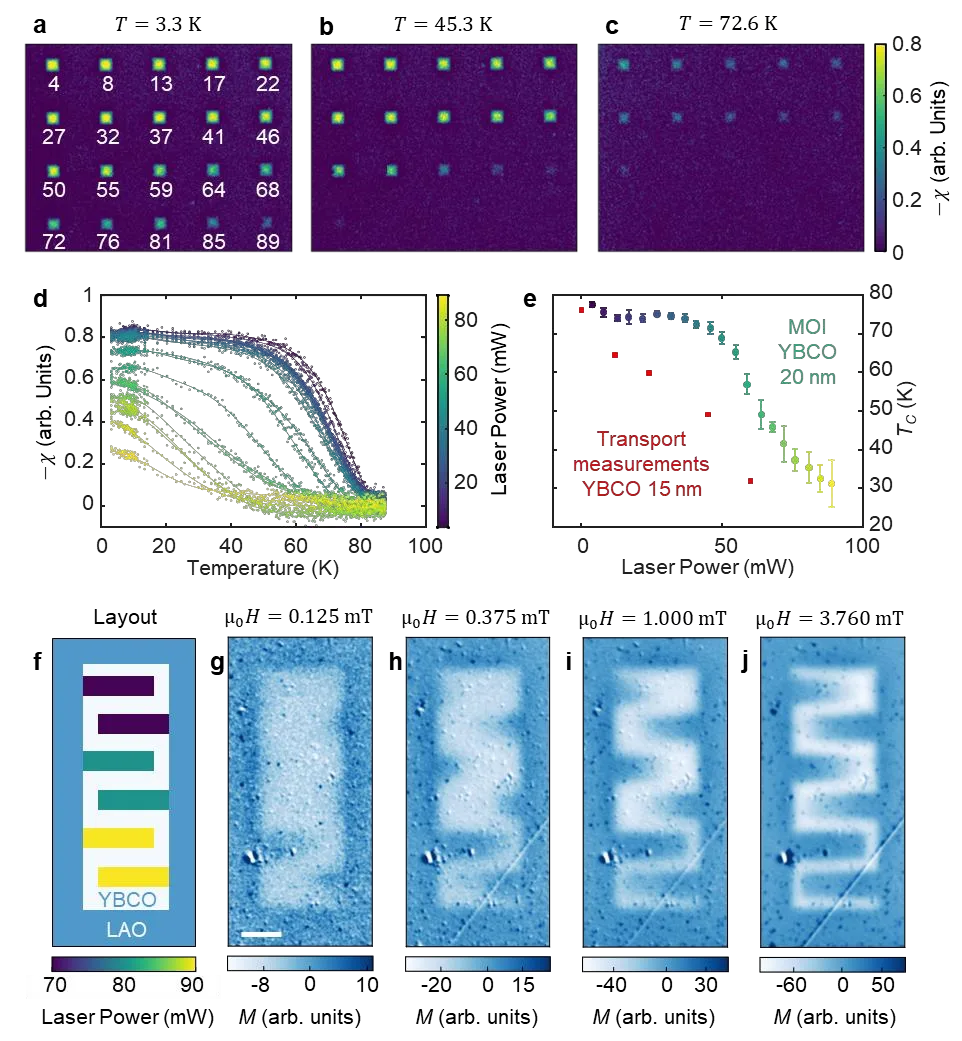
A laser beam, like a fine chisel, burns oxygen out of a superconducting film. Where oxygen becomes scarce, the material stops conducting electricity without resistance. The researchers used this trick to draw patterns on the film that alter its properties.
In experiments with yttrium barium copper oxide (YBCO), the team aimed a laser at a thin film and smoothly varied its power. The stronger the beam, the more oxygen is driven out, and the lower the temperature at which the material becomes superconducting. This allowed them to create regions with different properties, like an artist mixing paints to get the desired shade.
This method enables drawing complex circuitry on the film with smooth transitions in properties. Such structures could be useful in quantum sensors and superconducting electronics.
YBCO is one of the most famous high-temperature superconductors, discovered in 1987. It operates at higher temperatures than traditional superconductors but still requires cooling with liquid nitrogen.