A Lone Rhodium Atom Snaps Up Hydrogen Like a Trap express
Chemistry has two worlds: in one, the catalyst is a solid particle and the reaction happens on its surface; in the other, it's a dissolved molecule where everything occurs around a single metal center. These worlds rarely meet. But in a new study, they collide.
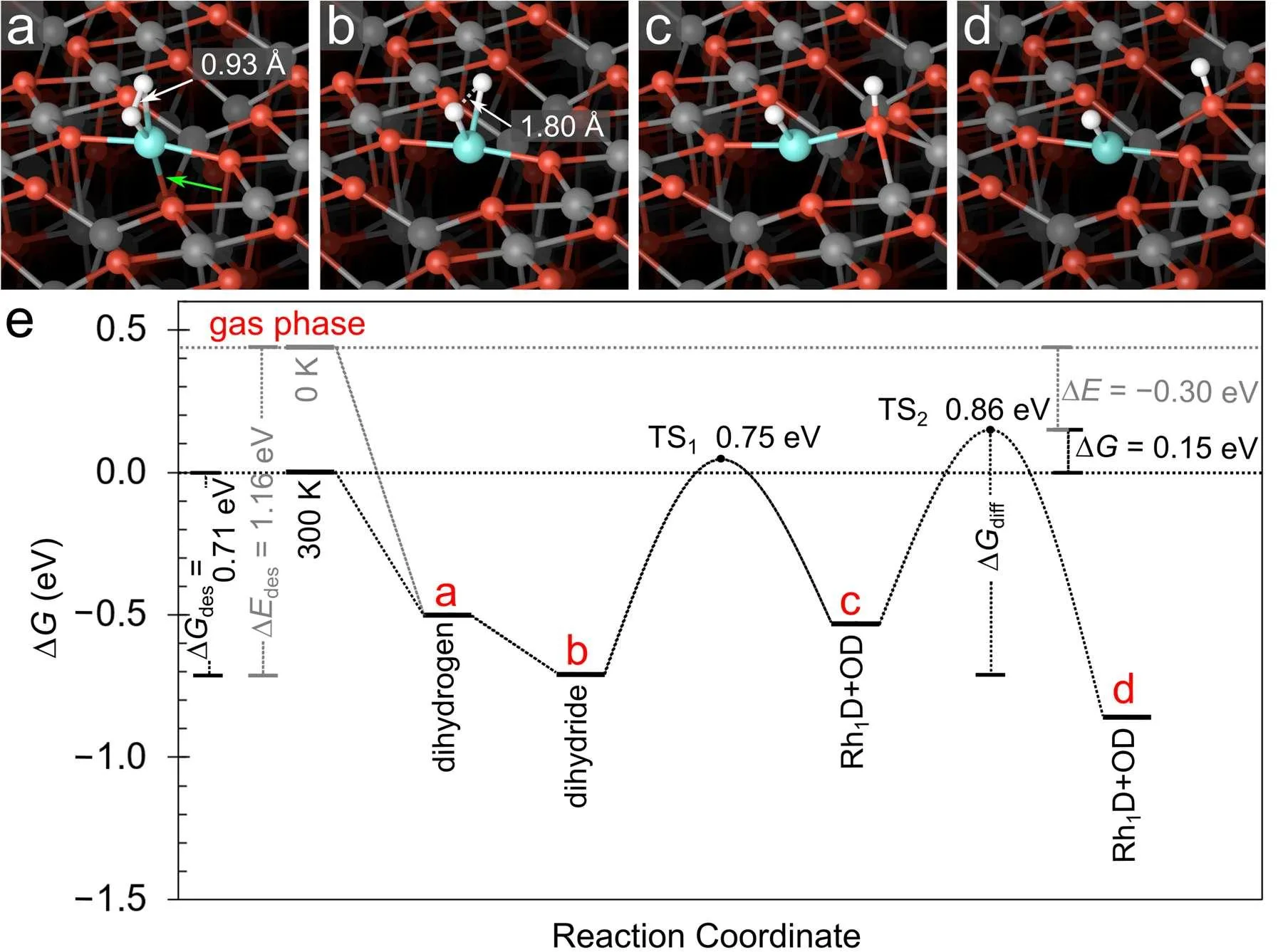
The researchers took iron oxide, a black powder used in magnetic tapes, and scattered single rhodium atoms across its surface. Rhodium is a metal from the same family as platinum. Then they let in hydrogen gas. It turned out that each rhodium atom grabs a hydrogen molecule and tears it into two atoms, but doesn't let them wander off. They stay attached, like two clipped straps on a backpack.
Such behavior had only been seen before in soluble rhodium complexes, where the metal also keeps both hydrogen atoms close. On the surface of metal nanoparticles, hydrogen usually disperses. But here — not a step aside. Calculations confirmed that turning a hydrogen molecule into such a pair happens without an energy barrier, all by itself.
This means that single atoms on an oxide can act as a bridge between two approaches in catalysis. Chemists could transfer recipes from a test tube to a solid catalyst surface, and vice versa. That's a path to more precise and cheaper processes, from oil refining to drug production.
Original abstract
as written by the authors arXiv:2601.14756
Hydrogen activation is a key elementary step in catalytic hydrogenation. In heterogeneous catalysis, it usually proceeds through dissociative adsorption on metal nanoparticles followed by surface diffusion or spillover, whereas homogeneous catalysts activate H2 through dihydride or dihydrogen intermediates at a single metal center. Here, we show that isolated Rh adatoms supported on Fe3O4(001) activate hydrogen through formation of a stable dihydride species without atomic H spillover. Temperature-programmed desorption, X-ray photoelectron spectroscopy, and scanning tunneling microscopy collectively reveal strong (approximately 1 eV) hydrogen adsorption exclusively at isolated Rh1 sites, while isotope-exchange experiments further demonstrate that hydrogen remains localized. Density-functional theory based calculations indicate a barrierless conversion from molecular H2 to the dihydride, and random-phase approximation calculations further confirm the relative stability of the dihydride. Together, these results show that single-atom Rh sites cleave and bind H2 through a dihydride pathway analogous to homogeneous complexes, establishing a mechanistic bridge between homogeneous and heterogeneous catalysis.
Rhodium is one of the most expensive metals on Earth: a gram costs more than gold. So catalysts with single rhodium atoms are a way to make the most of every atom.