A fuel cell is an electrochemical device that directly converts the chemical energy of a fuel, typically hydrogen, and an oxidant, usually oxygen from air, into electricity, with water and heat as byproducts. Unlike a battery, which stores energy internally, a fuel cell requires a continuous supply of fuel and oxidant to produce electricity. Fuel cells are highly efficient compared to combustion engines because they bypass the intermediate steps of heat and mechanical work, converting chemical energy directly to electrical energy. They are a key technology for clean energy, as they produce no harmful emissions when run on pure hydrogen.
History
The principle of the fuel cell was discovered by William Grove in 1839, who demonstrated that combining hydrogen and oxygen in an electrochemical cell could produce electricity. The first practical fuel cell was developed by Francis Thomas Bacon in the 1950s, leading to their use in NASA's Gemini and Apollo space missions.
How it works
A fuel cell consists of an anode, a cathode, and an electrolyte membrane between them. At the anode, hydrogen gas is split into protons and electrons. The protons pass through the electrolyte, while the electrons travel through an external circuit, creating an electric current. At the cathode, oxygen molecules combine with the protons and electrons to form water. The overall reaction is 2H₂ + O₂ → 2H₂O, with electricity and heat released. The efficiency is limited by factors like internal resistance and activation overpotentials, but modern fuel cells can achieve over 60% electrical efficiency.
In practice
Fuel cells are used in transportation (electric vehicles, buses, forklifts), stationary powergeneration for buildings and backup systems, and portable power for electronics and military applications.
Fun fact
The Apollo space missions used fuel cells to provide both electricity and drinking water for the astronauts, as the reaction produces pure water as a byproduct.
A regular battery releases heat smoothly: what you store is what you get. The power is fixed once and for all, like a faucet that pours water in a single stream. But sometimes you don't need a steady flow; you need a short, powerful burst: to instantly heat a part, trigger a reaction, or dump excess heat.
Atomic batteries powered by plutonium decay have been running pacemakers and space probes for over sixty years. But the raw material is scarce: worldwide, only a few kilograms of plutonium-238 are produced each year, barely enough for the most critical missions.
Two pendulums on a shared string trade motion: push one, and the second starts swinging, and a moment later the first gets a push back. In a thorium-229 atom, energy flows nearly loss-free between the electron shell and the nucleus.
Two guitar strings are stretched on the same neck. They are almost identical, but one is slightly shorter — and they sound different. That's roughly how the two isomers of ethanimine work: molecules with the same set of atoms but rotated differently in space. Astronomers spotted this molecule in the dense clouds near the center of our Galaxy.
Atomic nuclei are wrapped in fluffy electron coats — in such attire, they can't get close enough to embrace. But swap the light coat for a heavy one: a muon, a particle from the standard model, shrinks the cloud by nearly 200 times.
The atomic nucleus is a natural spring of colossal power. When the protons and neutrons inside it rearrange, it enters a special long-lived state — a nuclear isomer. It stores energy like a spring compressed to its limit.
An ordinary phone battery breathes — not with air, but with contact. Inside a solid body, where there are no liquids, lithium presses against the electrolyte (the ion-conducting substance) during charging and pulls away during discharging, like a lung on inhale and exhale. This 'breathing' is not poetry but physics: each cycle creates and destroys the contact points through which current flows.
A piece of metal heated at one end produces a weak electric current: this has been known for nearly two hundred years. But what if, instead of a simple metal, you take a layered "sandwich": a superconductor, a thin insulator, and a flat layer of electrons?
An electron beam in an accelerator is like a flock of birds: it flies in a tight group, but over time it spreads out. To keep particles together, heavy magnets are usually used. Here they did without them — the beam squeezed itself.
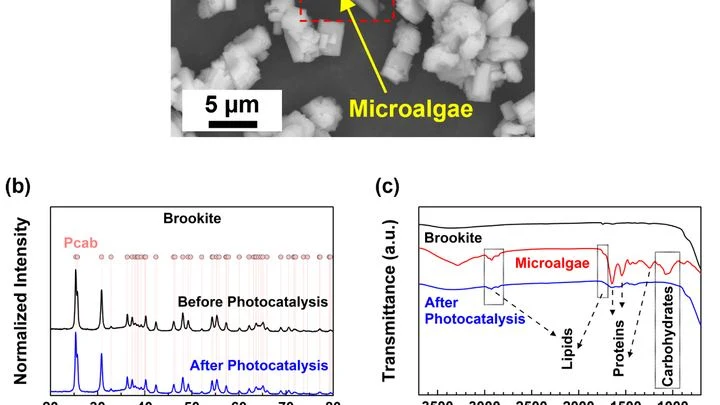
Conventional solar panels convert light into electricity, but here light splits water into hydrogen and oxygen. Hydrogen is a clean fuel, but the process is slow. To speed it up, helper substances that donate electrons are added. Often this is alcohol, but it's a shame to waste it.
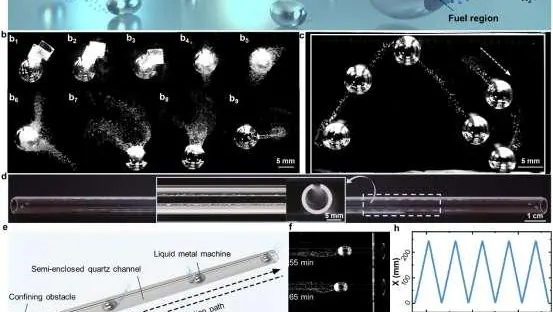
A droplet of liquid metal glides along a narrow channel like mercury from a broken thermometer. It needs no motor — the fuel is a chemical reaction with the surrounding liquid. But what happens when the droplet hits a wall? Previously, such machines were studied in open spaces, and in tight channels they behave differently.
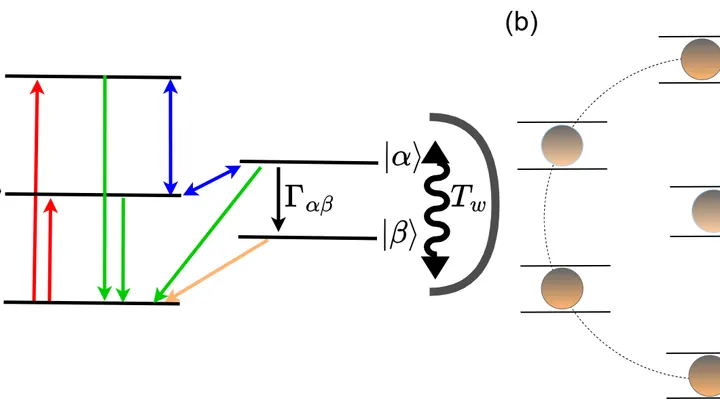
The quantum battery works like a sponge that absorbs light but won't release it without a forced squeeze. The inspiration came from bacteria's natural solar traps: capturing solar photons, they transfer energy almost losslessly, as proven by spectroscopy.
A membrane for water electrolysis is like a sponge soaked with water. Inside it, hydroxide ions, particles that carry electric charge, must move freely. But exactly how they move has long been a mystery: tracking each ion in an experiment is too difficult.
An ordinary heat engine is like a mill between the hot and cold banks of a river: the greater the drop, the stronger the current. Here, the drop is tiny, just one or two degrees, but water can still turn the wheel. The secret is that water is made to boil not by heating but by a sudden drop in pressure, so steam bursts out even from barely warm liquid.
An old T-shirt was dissolved in alkali to produce a gel, and it became the heart of an energy storage device. The second component was made from chitosan, a substance derived from shrimp shells. No metals: just recycled cotton and seafood.
The gel was soaked in ammonium salt, and its conductivity nearly doubled: from 17.1 to 37.8 millisiemens per centimeter.
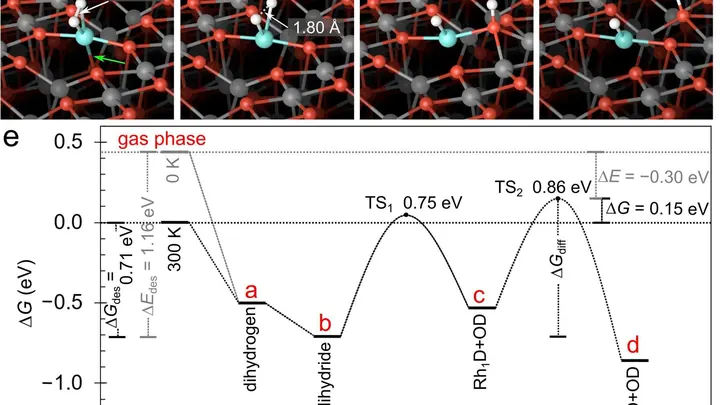
Chemistry has two worlds: in one, the catalyst is a solid particle and the reaction happens on its surface; in the other, it's a dissolved molecule where everything occurs around a single metal center. These worlds rarely meet. But in a new study, they collide.
The researchers took iron oxide, a black powder used in magnetic tapes, and scattered single rhodium atoms across its surface.
A piece of chromium exposed to air gets covered in invisible armor, an oxide film, within a minute. That film protects the metal from rust, but for a battery it's a disaster: the film blocks chromium ions, so no current flows.
Scientists mixed five metals — chromium, bismuth, copper, tin, and nickel.
A regular motor burns fuel and wastes a ton of energy as heat — that's dictated by the laws of thermodynamics. A quantum engine does it differently: its fuel isn’t heat, but a perfect rhythm. Physicists call this rhythmic precision quantum coherence.
In the quantum world, particles can walk through walls: this is quantum tunneling. If you place a detector right in the path of such a 'ghostly' passage, the moment of detection acts like a starting pistol: the particle gets a sharp kick and flies out of the barrier with excess energy, turning into a tiny engine.