Antihydrogen is the antimatter counterpart of hydrogen: instead of a proton and an electron, it consists of an antiproton and a positron. It is electrically neutral, like ordinary hydrogen, and is expected to have nearly identical spectral properties, but with key symmetries reversed. When antihydrogen meets ordinary matter, both annihilate completely, converting their mass into energy — a process that makes storing and studying it extremely challenging.
History
The first antihydrogen atoms were produced at CERN in 1995, but they were fast-moving and annihilated immediately. In 2010, the ALPHA collaboration succeeded in trapping antihydrogen atoms for the first time, and in 2011 they held them for over 15 minutes.
How it works
Antihydrogen is produced by combining antiprotons and positrons in a low-temperature trap. Because antimatter annihilates on contact with normal matter, the particles must be held in a vacuum and confined using magnetic fields — antihydrogen atoms are neutral, but their magnetic moments allow them to be trapped in an inhomogeneous field. Once formed, the atoms can be held for minutes or hours, long enough to probe their internal structure with lasers or microwaves.
In practice
Antihydrogen is used to test fundamental symmetries of physics, particularly CPT symmetry, by comparing the spectral lines of hydrogen and antihydrogen to extreme precision.
Fun fact
A single gram of antihydrogen annihilating with ordinary matter would release energy equivalent to about 43 kilotons of TNT — roughly the yield of the Hiroshima bomb.
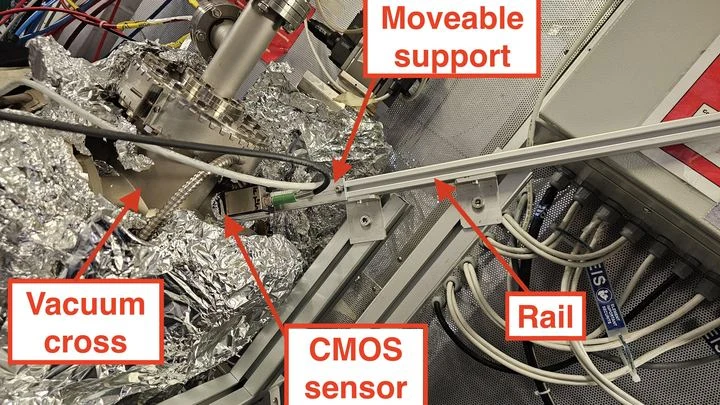
The antiproton beam hits the plate, and each impact bursts into a shower of charged particles. In the GBAR experiment at CERN, this picture is captured not by a sophisticated detector but by an ordinary industrial camera without a lens, pressed against the vacuum window from the outside.
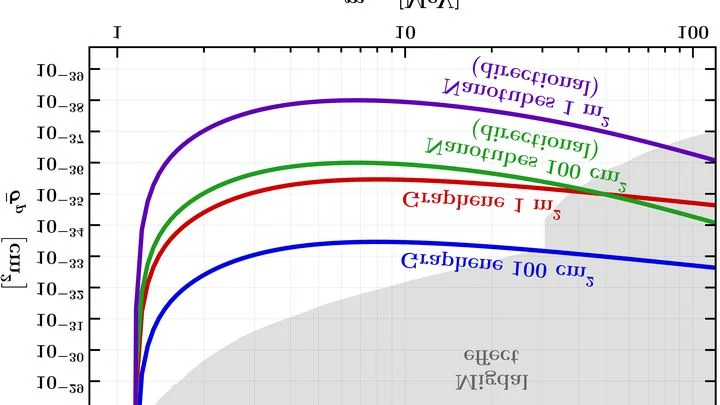
The antiproton is the mirror twin of the proton: same mass, but negative charge. When it hits matter, it usually annihilates instantly — disappearing in a burst of energy upon colliding with an atomic nucleus.
In a quiet room, you can hear the faintest whisper. Likewise, in the hydrogen atom, the lightest of all, an uninvited guest is easier to spot. That guest could be the Z' boson, a mediator particle of a new force predicted by many unification theories. The Standard Model already has its own mediator — the Z boson.
In very dim light, photons arrive one by one, like drops from a leaky faucet — never in pairs. This effect, predicted by Roy Glauber and confirmed by Leonard Mandel, directly proves that light is made of particles.
Hydrogen is the most common element. Its atoms are like antennas: they emit and absorb light at very specific frequencies. Einstein predicted that spacetime can ripple: these are gravitational waves.
A translator halfway across the hall suddenly starts rendering the message backwards. That's roughly how a neutrino, a ghost particle that barely notices matter, might behave if it encounters a cloud of ultralight dark matter.
A stack of magnetic plates, each magnetized opposite to its neighbor, is like a layered sandwich where electrons move as a single organism. The whole material starts mimicking an axion — a ghost particle that physicists suspect might be dark matter.
To uncover the proton's true size, physicists swapped the electron in a hydrogen atom for its heavy copy — the muon. Acting like a magnifying glass with thousandfold power, the muon gets right up against the nucleus and 'probes' the proton with unprecedented precision.
In the first instants after the big bang, the universe was a quantum vacuum where pairs of particles and antiparticles, virtual "guests" from physical nothingness, spontaneously appeared and almost immediately annihilated.
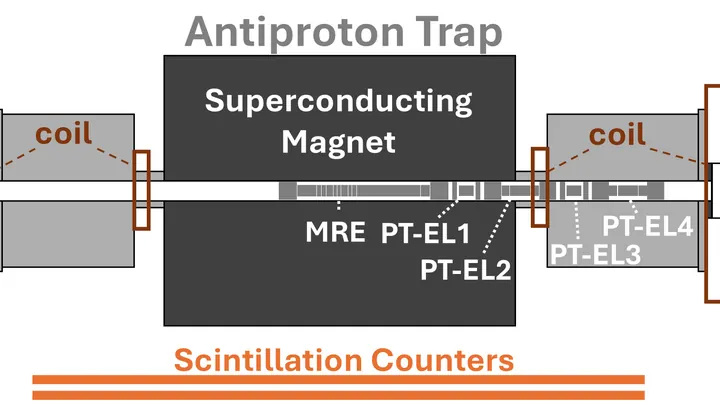
At CERN's antimatter factory, antiprotons are born with the energy of a bullet from a rifle. You can't just put them in a box: they instantly annihilate upon touching ordinary matter. So physicists devised a way to catch them in electromagnetic traps — invisible cages made of fields.
Hydrogen is a champion in energy per kilogram, but storing it is a hassle. As a gas, it takes up a huge volume, and if you compress it or cool it to a liquid, you need heavy tanks and lots of energy. There's a third way: some solid materials absorb hydrogen like a sponge soaks up water and hold it within. Heat it up, hydrogen comes out; cool it down, it gets absorbed back.
The antiproton is the proton's twin, only with a negative charge. When such a twin approaches a nucleus, it doesn't just bounce off: a whole dance of attraction and repulsion unfolds between them.
An old T-shirt was dissolved in alkali to produce a gel, and it became the heart of an energy storage device. The second component was made from chitosan, a substance derived from shrimp shells. No metals: just recycled cotton and seafood.
The gel was soaked in ammonium salt, and its conductivity nearly doubled: from 17.1 to 37.8 millisiemens per centimeter.
Hydrogen is the lightest fuel, and its conversion into electricity on a metal surface resembles a game of ping-pong: hydrogen atoms alternately attach to and detach from the electrode. But the score in this game depends on solution acidity in ways that were unexpected. Classical formulas predict a smooth change, while experiments show jumps and kinks.
Dark matter is invisible, but you can catch it on the rebound. Hydrogen embedded in a carbon film acts like a billiard ball: when a dark matter particle hits it, the proton flies out. That ejection is the signal you're looking for.
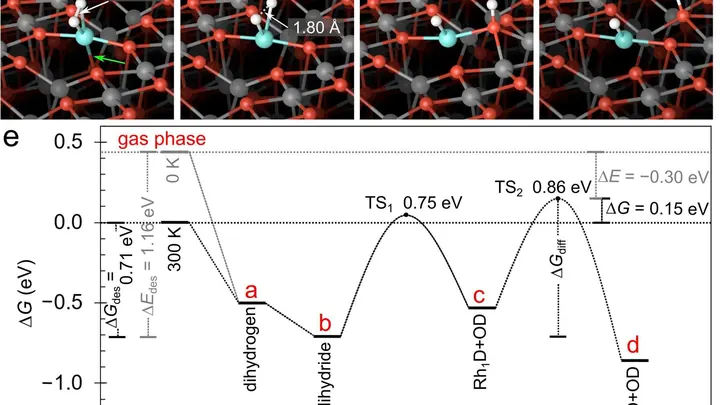
Chemistry has two worlds: in one, the catalyst is a solid particle and the reaction happens on its surface; in the other, it's a dissolved molecule where everything occurs around a single metal center. These worlds rarely meet. But in a new study, they collide.
The researchers took iron oxide, a black powder used in magnetic tapes, and scattered single rhodium atoms across its surface.
The antiproton is a mirror twin of the proton: same mass, but negative charge. When it approaches an atomic nucleus, the particles can annihilate, turning into radiation.
Two water droplets tremble in sync — because they're connected by a straw. So it is with entangled particles: their unity may be held together by a microscopic wormhole.
In 1976, Gerard 't Hooft noticed that the vacuum of a gauge theory is not as simple as it seems: it possesses a topological structure that manifests itself in a nonzero topological susceptibility.
In a dark laboratory where superconducting chips are cooled to thousandths of a kelvin, a qubit spins under the influence of a magnetic field. A regular qubit rotates in one direction. An antiqubit, its mirror twin, rotates in the opposite direction. Together they form a pair that senses the field twice as sharply as any ordinary pair.