Hydrogen production refers to the industrial or chemical processes used to generate hydrogen gas (H2). Hydrogen is a versatile energy carrier and a key feedstock for the chemical industry, used in making ammonia for fertilizers, refining petroleum, and increasingly as a clean fuel for vehicles and power generation. The challenge is that hydrogen does not exist freely in nature in large quantities; it must be extracted from compounds like water or hydrocarbons, which requires energy input.
History
Hydrogen gas was first identified as a distinct element by Henry Cavendish in 1766, and the first electrolysis of water was performed by William Nicholson and Anthony Carlisle in 1800. The industrial-scale production of hydrogen via steam reforming was developed in the early 20th century.
How it works
The most common method is steam methane reforming, where natural gas (methane) reacts with high-temperature steam to produce hydrogen and carbon dioxide. Another major method is electrolysis, which uses an electric current to split water into hydrogen and oxygen. Electrolysis can be powered by renewable energy, making it a 'green' hydrogen pathway. Other methods include coal gasification and biomass conversion. The choice of method depends on cost, availability of feedstocks, and the desired purity of the hydrogen.
In practice
Hydrogen is used in fuel cells to power vehicles and backup power systems, in the production of ammonia for fertilizers, in oil refining to remove sulfur from fuels, and as a reducing agent in metallurgy.
Fun fact
Hydrogen is the most abundant element in the universe, but on Earth it is almost always found bonded to other elements, such as oxygen in water or carbon in hydrocarbons, which is why producing pure hydrogen requires significant energy.
A gas target is like a funnel: the steeper its walls, the stronger the flow. But in this funnel, it is not water that flows, but ultraviolet light, born when a powerful laser pulse passes through a cloud of argon. The efficiency of this conversion is usually minuscule, about 0.001%: out of a thousand laser photons, only one turns into useful ultraviolet.
An ordinary wire heats up when current flows through it — some energy is wasted. A superconductor lacks this flaw: electricity flows through it without loss, like water through a perfectly smooth pipe. The trouble is that most superconductors require either very low temperatures or colossal pressures, like those found in the depths of planets.
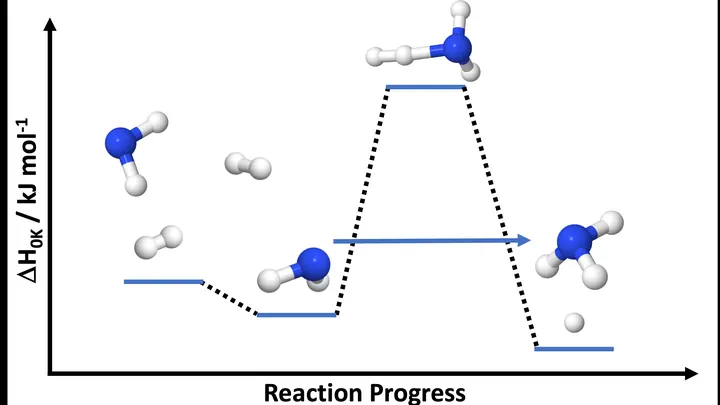
A ball rolls up a hill, but it doesn't have enough energy, so it rolls back down. That's classical mechanics for you. But in the quantum world, a tiny particle can sometimes pass right through the hill, as if the barrier weren't there. This trick, tunneling, is business as usual for a light atom like hydrogen.
The Red Planet is surrounded by the rubble of failed worlds — rocky boulders stuffed with metal. Shipping a kilogram of steel from Earth to Mars costs as much as several cars. It's far cheaper to pick up space junk right in orbit.
A kettle cools on the table. Heat escapes into the air, and is wasted. Yet you could squeeze a bit of electricity out of it. Devices that can do this are called thermomagnetic generators. Inside them, there are no pistons or turbines — only a material that changes its magnetic properties when heated and cooled.
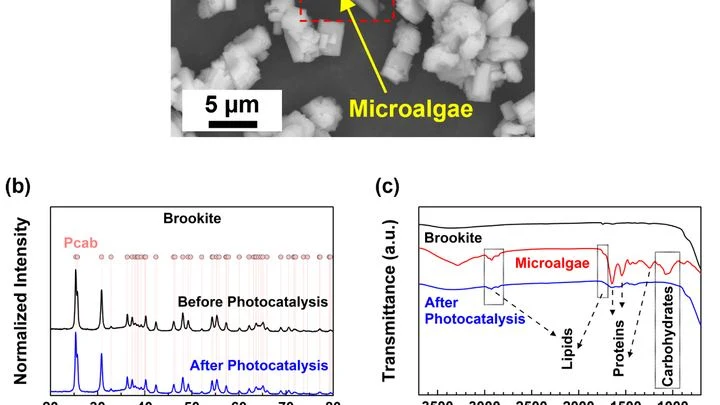
Dirty water laced with antibiotics isn't just waste: it's a hidden energy source. Chemists built a material from two components: titanium oxide nanorods (the white pigment in paints and sunscreens) and carbon nitride nanosheets.
Conventional solar panels convert light into electricity, but here light splits water into hydrogen and oxygen. Hydrogen is a clean fuel, but the process is slow. To speed it up, helper substances that donate electrons are added. Often this is alcohol, but it's a shame to waste it.
When servers in a data center run at full tilt, they get as hot as a forgotten iron. That heat goes to waste, and cooling them eats up even more energy. Engineers in Germany have proposed putting that heat to work: let it drive liquid through thin tubes all by itself, with no motors or pumps.
Their device looks like a flat box with an asymmetric bottom.
A kitchen gas stove burns with a blue flame, but if you heat methane more intensely and without access to air, it decomposes into hydrogen and a black powder — the very soot used to make tires and printer toner.
A membrane for water electrolysis is like a sponge soaked with water. Inside it, hydroxide ions, particles that carry electric charge, must move freely. But exactly how they move has long been a mystery: tracking each ion in an experiment is too difficult.
An ordinary heat engine is like a mill between the hot and cold banks of a river: the greater the drop, the stronger the current. Here, the drop is tiny, just one or two degrees, but water can still turn the wheel. The secret is that water is made to boil not by heating but by a sudden drop in pressure, so steam bursts out even from barely warm liquid.
Today's Martian surface is a cold, nearly airless home. Many dream of a full renovation: warming the planet, filling it with air from carbon dioxide and nitrogen.
Somewhere above our heads, every second, a proton accelerated to energies millions of times greater than those at the Large Hadron Collider slams into the atmosphere. It strikes an air molecule, and a cascade is born — a wide atmospheric shower of thousands of particles.
Hydrogen is the lightest fuel, and its conversion into electricity on a metal surface resembles a game of ping-pong: hydrogen atoms alternately attach to and detach from the electrode. But the score in this game depends on solution acidity in ways that were unexpected. Classical formulas predict a smooth change, while experiments show jumps and kinks.
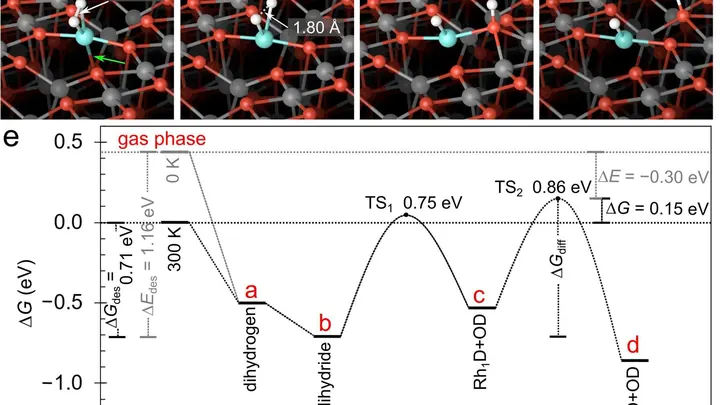
Chemistry has two worlds: in one, the catalyst is a solid particle and the reaction happens on its surface; in the other, it's a dissolved molecule where everything occurs around a single metal center. These worlds rarely meet. But in a new study, they collide.
The researchers took iron oxide, a black powder used in magnetic tapes, and scattered single rhodium atoms across its surface.
A cosmic dust grain is covered in ice, and on this ice, like in a tiny kitchen, molecules are cooked. One of them is methanol, an alcohol that serves as a building block for more complex compounds in space. Previously, it was thought that methanol only forms when hydrogen atoms stick one by one to a carbon monoxide molecule.
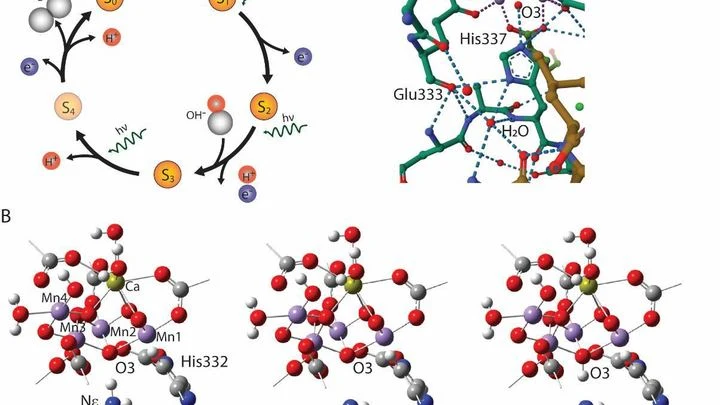
In every leaf, in the light, a factory works that splits water into oxygen and hydrogen. The oxygen goes into the air we breathe, and the plant uses the hydrogen for food. The heart of this factory is a protein complex with four manganese atoms and one calcium atom.