Magnetar Polarizes X-rays Up to 47% express
Neutron stars are ultra-dense remnants of supernovae the size of a city. In the 1930s, Fritz Zwicky hypothesized their existence, and later Jocelyn Bell Burnell discovered pulsars — rapidly rotating neutron stars. Magnetars are the rarest variety, with magnetic fields billions of times stronger than Earth's. It can influence the void itself.
Recently, the IXPE X-ray telescope captured emission from the magnetar 1E 1547.0‑5408 and found an unusual property: almost half the light oscillated strictly in one plane, like after passing through polarizing sunglasses. But while in everyday life polarization is created by a filter, here space itself played that role. The star's magnetic field turned the vacuum into a kind of crystal, aligning the X-ray waves. This 'cosmic crystal' helped refine the tilt of the star's magnetic axis: it turns out it rotates at nearly a right angle.
Original abstract
as written by the authors arXiv:2601.15452
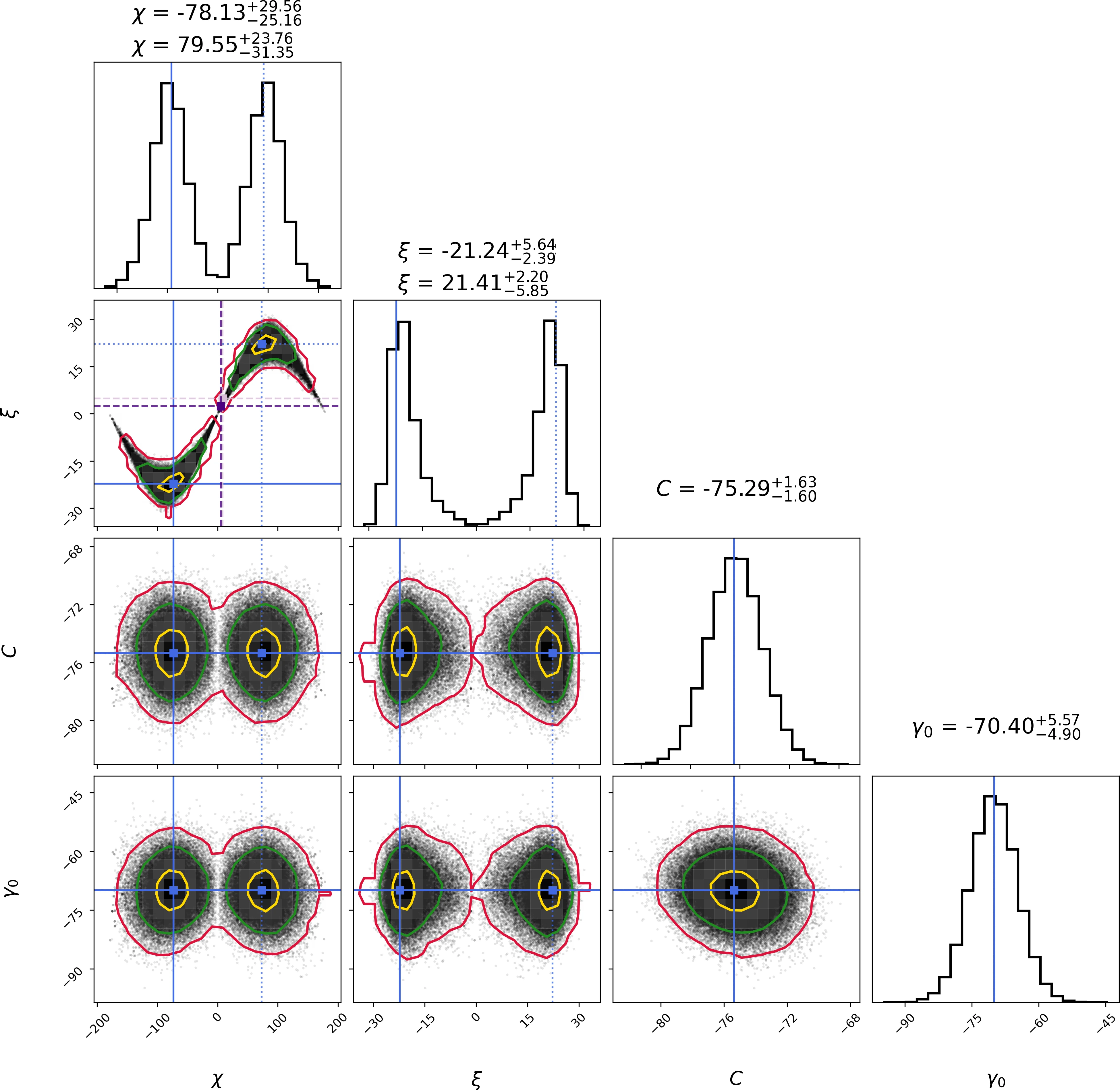
Magnetars are now known to be among the most strongly polarized celestial sources in X-rays. Here we report on the $$500\,\mathrm{ks}$$ observation of the magnetar 1E 1547.0-5408 performed by the Imaging X-ray Polarimetry Explorer (IXPE) in March 2025. The IXPE spectrum is well reproduced by a single thermal component with blackbody temperature $$kT_\mathrm{BB}\sim 0.67\,\mathrm{keV}$$ and emission radius $$R_\mathrm{BB}\sim 1.2\,\mathrm{km}$$. The source exhibits a high linear polarization degree in the $$2$$--$$6\,\mathrm{keV}$$ band ($$\mathrm{PD}=47.7\pm2.9\%$$) with polarization angle $$\mathrm{PA}=75^\circ.8 \pm 1.^\circ8$$, measured West of celestial North. While $$\mathrm{PA}$$ does not appear to vary with energy, there is some evidence (at the $$1\sigma$$ confidence level) of a minimum in $$\mathrm{PD}$$ between $$3$$ and $$4\,\mathrm{keV}$$, compatible with what is expected by partial mode conversion at the vacuum resonance in a magnetized atmosphere. Phase-resolved spectral and polarimetric analyses reveal that X-ray thermal radiation likely originates from a single, fairly small hot spot with a non-uniform temperature distribution. Fitting the phase-dependent $$\mathrm{PA}$$ measured by IXPE with a rotating vector model (RVM) constrains the source geometry and indicates that both the dipole axis and line-of-sight are misaligned with respect to the spin axis. Under these conditions, the high polarization of the source cannot be regarded as compelling evidence for the presence of vacuum birefringence in the star magnetosphere. Nevertheless, the fact that the RVM successfully reproduces the modulation of the X-ray polarization angle and the behavior of $$\mathrm{PD}$$ with the energy hint once more to the presence of QED effects in magnetars.
A city-sized magnetar carries a hot spot heated to millions of degrees — hotter than the Sun's core.
In sci-fi, magnetars are fearsome guardians of the deep: their invisible radiation can disable a starship millions of kilometers away.