Cosmic Light Changes Polarization
Light from the hottest stage of the universe has been traveling toward us for nearly 14 billion years. This is the cosmic microwave background — a faint glow filling the entire sky.
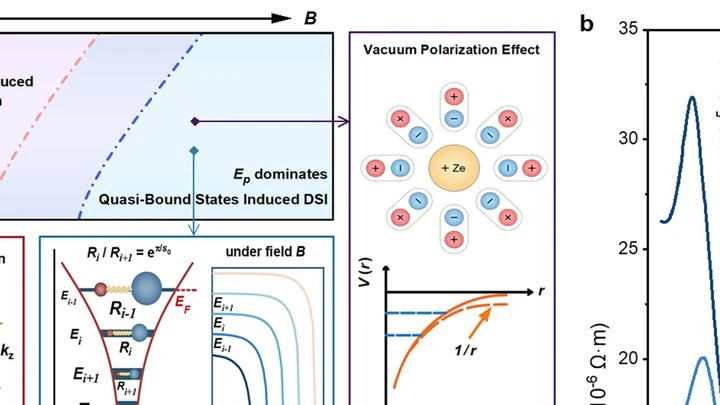
Vacuum birefringence is a quantum electrodynamic effect where polarized light splits in a strong magnetic field.Vacuum birefringence is a quantum electrodynamic effect where the vacuum itself becomes optically anisotropic in the presence of a strong magnetic field, causing polarized light to split into two components with different speeds. In classical physics, a vacuum is empty space with no properties, but quantum electrodynamics predicts that it is filled with virtual particle-antiparticle pairs that can be polarized by an external field. This effect is extremely weak, requiring magnetic fields of billions of tesla to be observable, which are found only near magnetars—highly magnetized neutron stars.
The prediction of vacuum birefringence was made by Werner Heisenberg and Hans Euler in 1936, and independently by Victor Weisskopf, based on early quantum electrodynamics. It remained unobserved for decades due to the enormous field strengths required.
In a strong magnetic field, virtual electron-positron pairs in the vacuum align their dipoles, making the vacuum behave like a birefringent crystal. Light polarized parallel to the magnetic field travels at a slightly different speed than light polarized perpendicular to it. This causes a linearly polarized beam to split into two orthogonal components that accumulate a phase difference, effectively rotating the polarization angle. The effect scales with the square of the magnetic field strength, so it becomes measurable only in extreme astrophysical environments.
Astronomers use observations of X-ray polarization from magnetars to test quantum electrodynamics under extreme conditions, and the effect is also considered in the design of future high-intensity laser experiments.
The magnetic field of a magnetar is so strong that the vacuum birefringence effect can rotate X-ray polarization by up to 47 degrees, as observed in recent measurements.