The Cosmic Web: How a Supernova Explosion Left Its Mark express
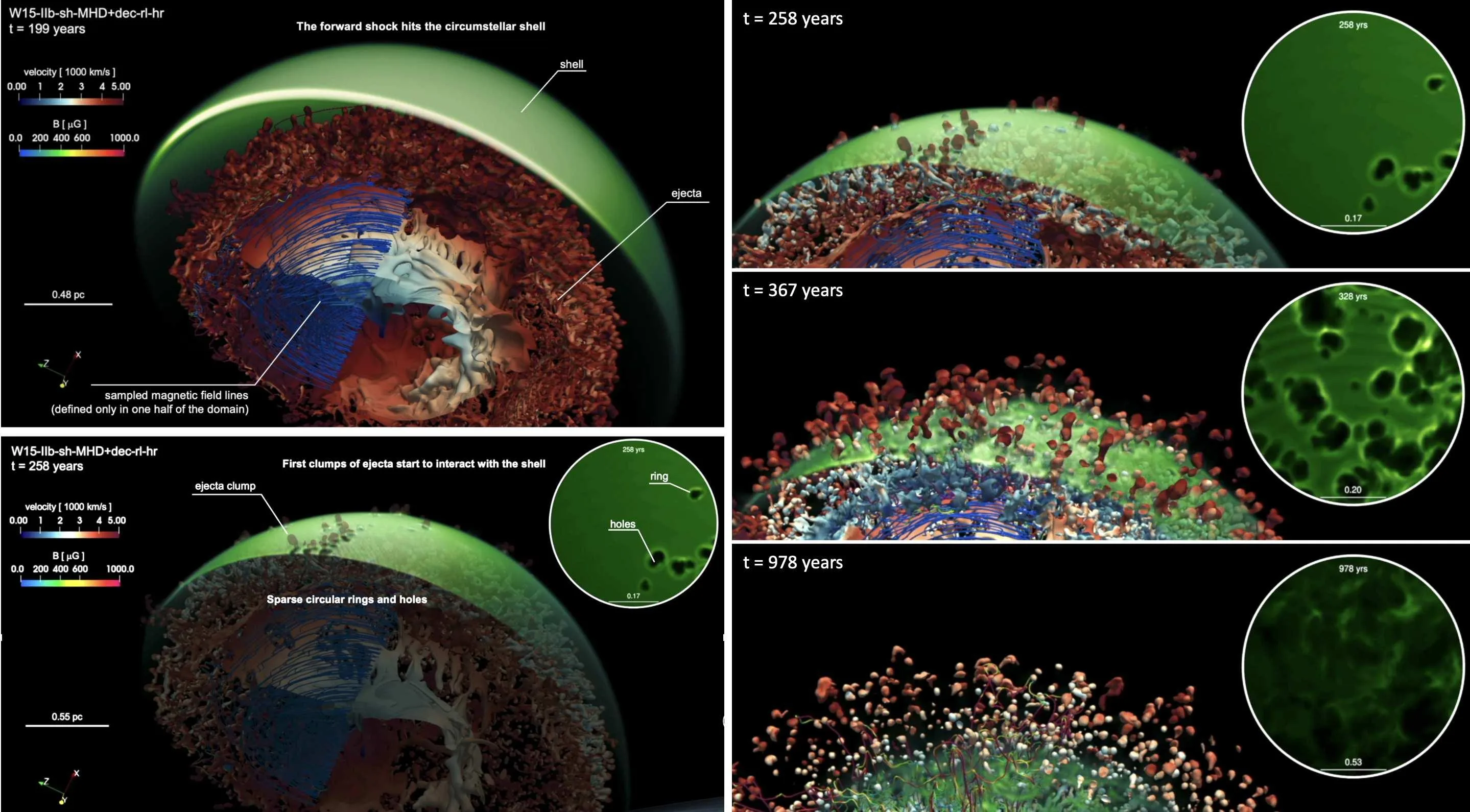
The James Webb Space Telescope peered into the remnant of the supernova Cassiopeia A — a cloud of gas left behind after a massive star exploded. There, it spotted an intricate web of glowing filaments and a mysterious structure dubbed the 'Green Monster,' featuring nearly circular holes and rings. To figure out where this pattern came from, scientists recreated the explosion on a supercomputer, from core collapse to an age of a thousand years.
In the first seconds after the explosion, neutrinos, tiny particles that barely interact with matter, heat the gas and create enormous bubbles, much like bubbles in boiling porridge. These bubbles collide, mix the material, and stretch it into filaments. That's how the web we see today was born. The model showed that the filaments retain a 'memory' of the explosion's initial conditions, even though they were later reshaped by a reverse shock wave heading back toward the center.
The 'Green Monster,' however, appeared later. When the material ejected by the star caught up with gas that the star had shed before the explosion, dense clumps slammed into this shell. Due to intense cooling, the shell became brittle and cracked into rings and holes, like ice that fractures when you throw a stone onto it. Thus, a single explosion left two distinct traces: the web from the explosion itself and the pattern from the collision with surrounding gas.
In this way, the supernova remnant has become something like an archaeological layer: from it, we can reconstruct both the explosion itself and what surrounded the star before it. Each pattern is a record of an event that lasted but a moment yet left a mark for a thousand years.
Original abstract
as written by the authors arXiv:2601.17499
(Abridged) Recent JWST observations of Cassiopeia A (Cas A) reveal unprecedented ejecta substructure, including a web of filaments and the enigmatic "Green Monster" (GM), characterized by nearly circular holes and rings. These features provide new constraints on supernova (SN) explosion physics and ejecta-circumstellar medium (CSM) interactions. We present high-resolution three-dimensional hydrodynamic and magnetohydrodynamic simulations of a neutrino-driven SN explosion tailored to Cas A, following the system from core collapse to an age of $$\sim 1000$$ yr. The models include key physical processes such as hydrodynamic instabilities, Ni-bubble effects, radiative cooling, non-equilibrium ionization, and electron-ion temperature equilibration. Our results show that the filamentary ejecta network naturally forms during the early explosion due to the interaction of neutrino-driven bubbles and instabilities, retaining a memory of the initial conditions before being progressively modified by the reverse shock. The GM morphology is reproduced by the interaction of dense ejecta clumps with an asymmetric, forward-shocked CSM shell, with radiative cooling enhancing fragmentation and generating the observed holes and rings. Overall, our study demonstrates that Cas A's complex morphology reflects both the imprint of the explosion mechanism and subsequent ejecta-CSM interactions.
The web of filaments in the Cassiopeia A remnant is so thin that its thickness is less than the distance from Earth to the Sun, even though the remnant itself spans tens of light-years.
In Arthur C. Clarke's novel 'The Fountains of Paradise,' the protagonists build a space elevator but face an obstacle, a supernova remnant that threatens their structure.