Invisible Black Holes Give Themselves Away by Torn-Apart Stars express
You can't see a black hole until a star wanders too close. Then tidal forces stretch the star like a cook rolling out dough, and some of the material falls into the hole, flaring up as a final goodbye. Such events, called tidal disruptions, are a rare chance to weigh a black hole that would otherwise remain invisible.
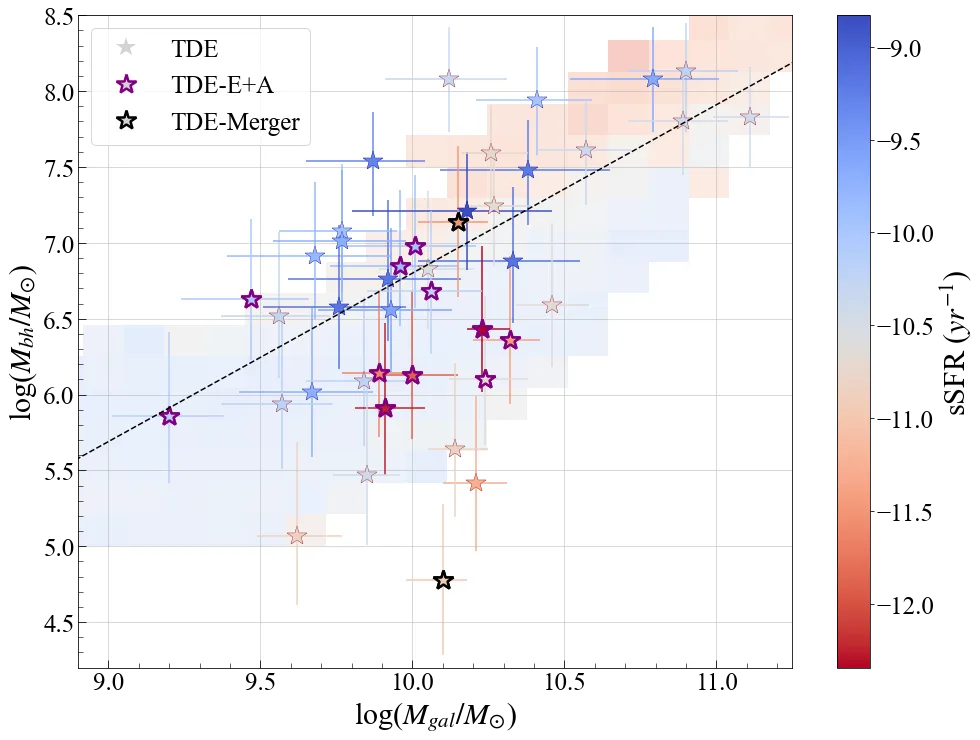
Astronomers studied 42 such flares and compared them with ordinary galaxies. It turned out that in large galaxies where stars no longer form, black holes are heavier than in galaxies with fresh stars. This has been known for a while: the idea is that the black hole 'blows away' gas and stops star formation.
But among the galaxies with tidal disruptions, there was a surprise. In small galaxies, about a billion times the Sun's mass, it's the opposite: 'sleeping' galaxies host lighter black holes than their star-forming neighbors of the same size. Such a black hole weighs only a few million Suns, while in the neighbors it's tens of times more massive.
Perhaps these galaxies lost their gas due to external influences — for example, passing through a cluster where hot gas 'blows away' cold gas, like wind blowing leaves. Then stars stopped forming, and the black hole was left on short rations. If such cases aren't rare, we may need to rethink the role of black holes in galaxy evolution: sometimes they're not conductors but spectators.
Original abstract
as written by the authors arXiv:2601.20519
Restricted by event horizon suppression, tidal disruption events (TDEs) provide a unique window into otherwise hidden supermassive black holes (SMBHs) at the lower end of the mass spectrum, allowing the connection between star formation and SMBH mass to be explored across a broad stellar mass range. We derive stellar masses and specific star formation rates using Prospector fits to UV-MIR broadband spectral energy distributions (SEDs) for 42 TDE hosts, together with a high-mass comparison sample, and combine these with SMBH mass estimates from the literature. We first verify our approach by reproducing the established result that quenched galaxies host more massive SMBHs than star-forming systems at fixed stellar mass, a result widely interpreted as evidence for SMBH growth driving the blue-to-red sequence transition. However, examining the TDE sample in isolation reveals a trend reversal at lower masses, uncovering a surprising population of low-mass ($$10^{9.6} \lesssim M_{\rm gal} \lesssim 10^{10.5}$$ M$$_\odot$$), quenched galaxies hosting SMBHs systematically less massive ($$M_{\rm BH} \lesssim 10^{6.5}$$ M$$_\odot$$) than those in star-forming galaxies of comparable stellar mass. After ruling out degeneracies in our SED fits, we conclude that this reflects a physical difference in the quenching mechanism between these TDE hosts and the more massive galaxies. This is unlikely to be driven by AGN feedback, and could instead result from environmental processes, which can end star formation and hinder SMBH growth. We also show that the quenched and post-starburst population within the TDE sample is likely under-represented due to selection biases, suggesting the true fraction could be even higher than observed.
A tidal disruption of a star by a black hole lasts only a few months, but the flare can outshine an entire galaxy.
In the movie 'Interstellar,' the heroes fly near a black hole but don't see it — only the distortion of light. That's roughly how astronomers find black holes, by indirect signs, like the flare of a shredded star.