How Stars Kick Out Their Guests express
Interstellar wanderers are rocks and icy chunks that have broken free from their home planetary systems and now drift through the Galaxy. The first such visitor, 'Oumuamua, zipped past the Sun in 2017, followed by Comet Borisov and the ATLAS object. Where do they come from? Most often, they are flung out by the gravity of giant planets, like a stone from a sling if you spin it too fast.
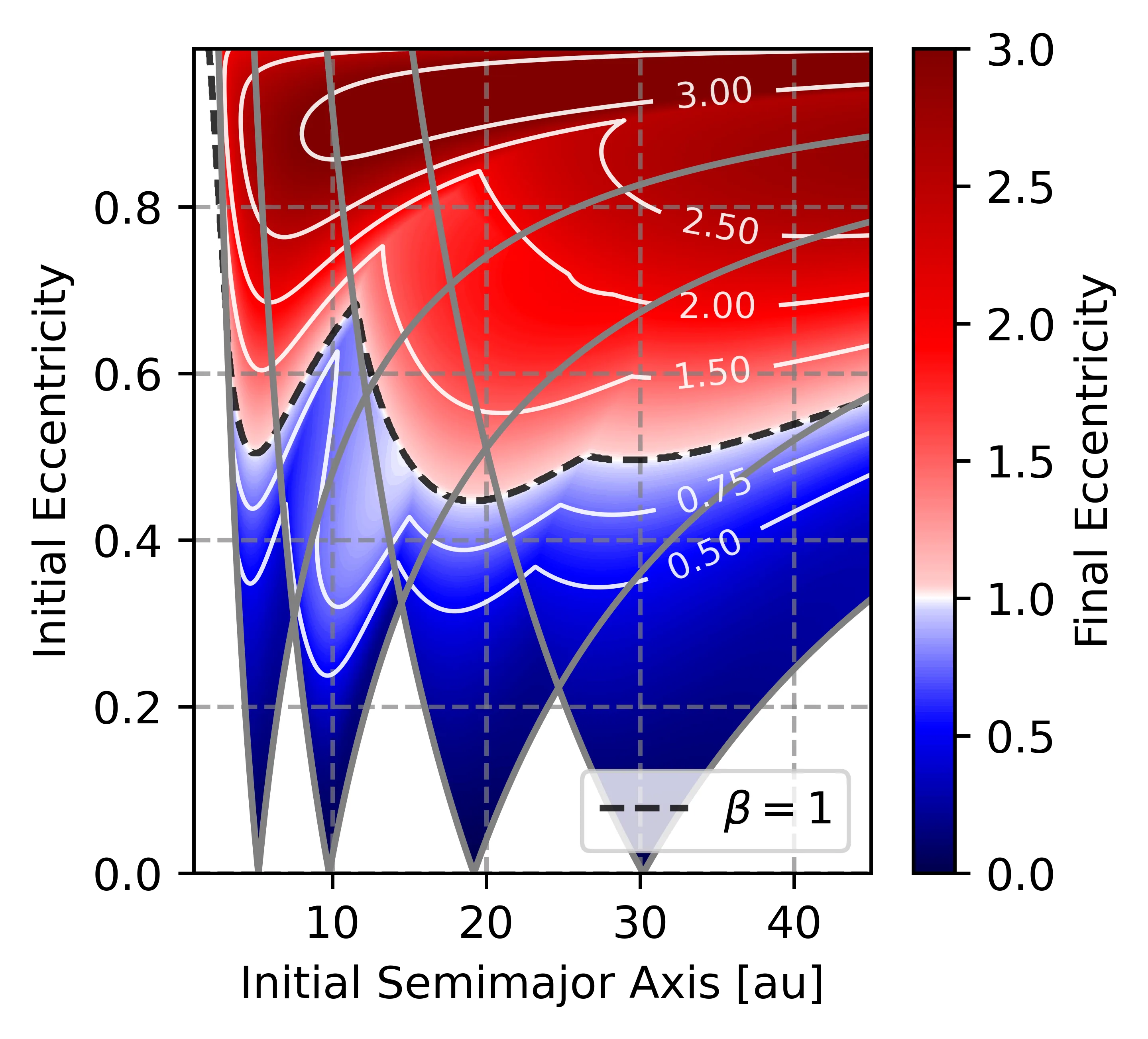
The authors of the study considered a simplified problem: a star, one massive planet, and a small body. They derived formulas linking the body's orbit before and after its encounter with the planet. The main conclusion: escape requires an elongated orbit — eccentricity at least 0.4. This means the body alternately swoops close to the star and then recedes far away. When it passes near the giant planet, the planet can give it enough speed to leave the system forever.
The formulas were tested against numerical simulations: they predict the behavior of bodies well, though precise details require full simulations. Then the method was applied to the Solar System, the Beta Pictoris system, and HR 8799. It turned out that each has zones from which bodies are ejected especially easily. It's like finding the spot on a sling where the stone releases at maximum speed.
Now astronomers can more quickly assess which planetary systems supply interstellar objects. The next visitor from another star system won't catch us off guard: we'll know where it came from.
Original abstract
as written by the authors arXiv:2602.04806
The discovery of interstellar interlopers such as 1I/`Oumuamua, 2I/Borisov, and 3I/ATLAS have highlighted the necessity of understanding the dynamical pathways that eject small bodies from planetary systems into hyperbolic trajectories. In this paper we examine the orbital elements of particles in the restricted three-body problem prior to and post scattering onto hyperbolic trajectories by massive perturbers. Building on previous work, we calculate closed-form -- but approximate -- analytic criteria that map pre- to post-encounter orbital elements. An application of these equations demonstrates that ejection occurs most efficiently when the orbital eccentricity of the massless test particle exceeds a minimum threshold, $$e\gtrsim0.4$$. The primary driver of the final eccentricity is the component of the perturber-centric velocity projected along the direction of motion of the perturber. These analytic criteria are then benchmarked and validated against numerical simulations which demonstrate that they provide a reasonably good zeroth-order approximation for ejection behavior. However, system-specific cases will generally require numerical simulations in addition to this analytic construction. The methodology is applied to (i) the solar system and exoplanetary systems (ii) $$\beta$$ Pictoris and (iii) HR 8799 to evaluate the pre-scattering orbits of ejected particles. This method provides a transparent and computationally efficient tool for identifying orbits within a given system from which interstellar objects are efficiently ejected via a single scattering event from a massive perturber.
'Oumuamua was moving so fast that even the Sun's gravity couldn't hold it: it left our system forever.
In Arthur C. Clarke's novel "Rendezvous with Rama," an interstellar object turns out to be an artificial spacecraft, just as some scientists suspected about 'Oumuamua.