An impact is a high-energy collision between two bodies, ranging from microscopic dust grains hitting a spacecraft to planet-sized objects smashing into each other. In planetary science, impacts are the primary mechanism for building planets from smaller bodies and for reshaping their surfaces after formation. The energy released in a large impact can melt rock, eject debris into space, and even strip a planet of its atmosphere.
History
The role of impacts in planetary formation was established in the 1960s–70s through the work of George Wetherill and others, who showed that the observedmass distribution of planets could be explained by a sequence of giant impacts.
How it works
When two bodies collide, kinetic energy is converted into shock waves that propagate through both objects. This energy can fracture, melt, or vaporize material, depending on the impact speed and composition. In the early solar system, repeated impacts accreted dust and pebbles into planetesimals and then into full planets. Later, giant impacts can knock planets off their orbits or strip their moons, as modeled in studies of planetary migration and satellite formation.
In practice
Impact physics is used to design spacecraft shielding against micrometeoroids and to interpret cratering records on planetary surfaces, which reveal the history of the solar system.
Fun fact
A single giant impact can eject enough water vapor and rock into orbit to form a temporary ring around a planet, which later coalesces into a moon.
The birth of a moon is a cosmic car crash. Two young planets collide, and a cloud of scorching debris swirls around the surviving world. From this disk, like clay on a potter's wheel, a satellite gradually takes shape. That's probably how our Moon came to be.
A speed of 7,5 kilometers per second is the threshold beyond which a cosmic collision turns dust grains into a chemical reactor. In the interstellar medium drift tiny cosmic dust grains — the legacy of dying stars.
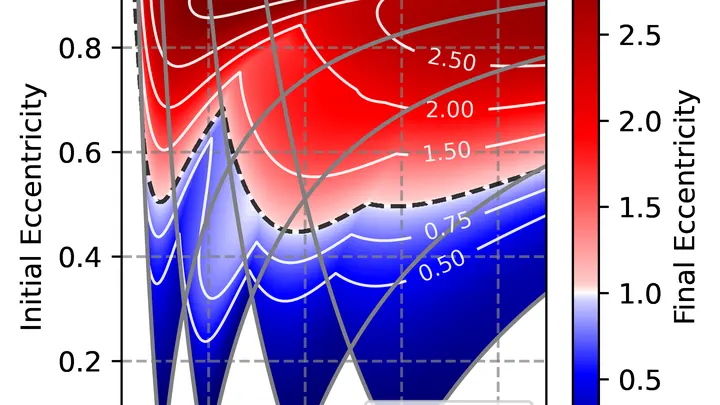
In a single star system, two teams of planets orbit. Some follow neat paths, like figure skaters on an ice rink, avoiding collisions. Others crowd together, their trajectories cross, and sooner or later a cosmic accident occurs — a giant impact.
Around some young stars where star formation has recently ended, there swirl not just dust rings but actual planetary battlefields — extreme debris disks.
Every civilization is born with a gravitational debt. The home planet's mass determines the loan amount, and the Tsiolkovsky equation is the interest rate applied to each kilogram of payload. To send a probe to the stars, you have to pay with fuel, and the debt grows exponentially.
The birth of planets resembles the workings of a cosmic forge. Rocky blocks collide and fuse together. A powerful impact strikes a spark — material heats to white-hot and glows like cooling metal. Computer simulations show: the flash is visible from days to years, peaking at a tenth of the sun's light.
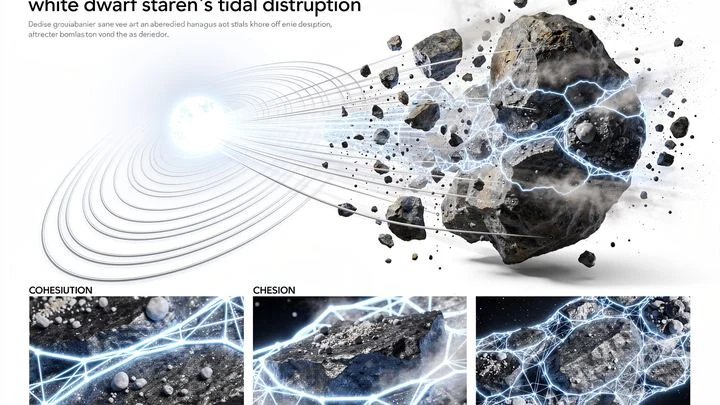
When a telescope catches the light of a distant white dwarf, the spectrograph sometimes fishes out heavy elements — calcium, iron, magnesium. These metals could not have stayed in the thin atmosphere of the stellar remnant; they are the traces of recently fallen planetary debris.
A stone falls into a pond — ripples spread across the water. If the stone doesn't fall but whizzes over the surface at tremendous speed, a straight wave runs along the water. When it hits a floating log, ripples spread out from the point of impact. That's roughly how gravity works in the new study.
A raindrop falling to the ground strikes with a certain force. But what if the drop isn't round but elongated like a cigar or flattened like a pancake? It turns out that shape is everything: the impact force can vary by more than a factor of ten just because of how the drop looks at the moment of impact.
The Sun drives the water cycle, and rain returns it to the ground. But now, every drop is a tiny hammer striking the surface. Floating plastic particles (microplastics, mostly carbon) upon impact jump up like popcorn kernels on a hot skillet. But instead of popping, they get wrapped in a thin water film and turn into weightless beads.
Interstellar wanderers are rocks and icy chunks that have broken free from their home planetary systems and now drift through the Galaxy. The first such visitor, 'Oumuamua, zipped past the Sun in 2017, followed by Comet Borisov and the ATLAS object. Where do they come from?