Gravitationalorbital dynamics studies the motion of bodies under gravity, focusing on periodic orbits and chaotic behavior in multi-body systems. While the two-body problem has a simple solution, adding a third body leads to rich complexity: most trajectories are chaotic, but a surprising number of stable periodic orbits exist. These solutions are crucial for understanding everything from planetary systems to stellar clusters and galactic interactions.
History
The three-body problem was first formulated by Newton, but its chaotic nature was only fully appreciated in the late 19th century through Poincaré's work. Systematic searches for periodic orbits began with numerical methods in the 20th century.
How it works
The dynamics are governed by Newton's laws and general relativity, but solving them analytically is impossible for more than two bodies. Instead, researchers use numerical simulations and search for periodic solutions by varying initial conditions. Chaotic orbits are sensitive to tiny perturbations, while periodic orbits repeat exactly, providing stable 'skeletons' around which other trajectories organize.
In practice
Used to plan spacecraft trajectories, predict the stability of exoplanet systems, and understand the long-term evolution of star clusters and galactic nuclei.
Fun fact
There are infinitely many periodic three-body orbits, but they are extremely rare among all possible initial conditions—most lead to chaos or ejection.
Two massive bodies frozen in a quantum superposition resemble a pair of dancers trying to keep a single rhythm while an orchestra blares around them. Each gravitational wave is a musician throwing them off beat.
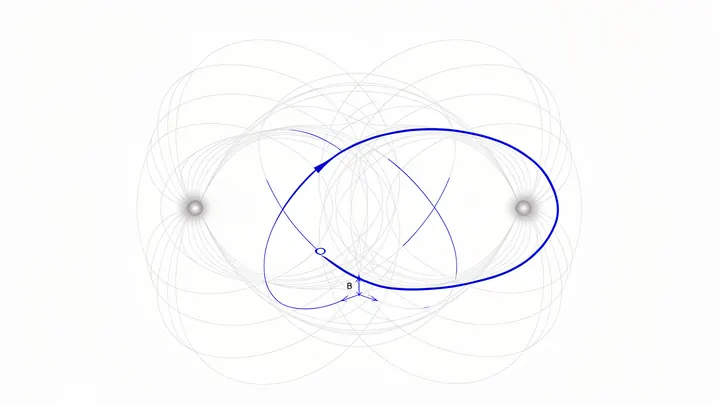
The three-body problem is the eternal stumbling block of celestial mechanics. Even Poincaré realized in the late 19th century that its chaos defies general analytical solutions. In this gravitational madness, islands of regularity appear only rarely — periodic orbits.
When two neutron stars circle each other, they don't remain rigid spheres. The partner's gravity stretches each star, creating tidal bulges — much like the Moon raises ocean tides on Earth. But unlike water, here it's superdense matter that deforms: a teaspoon of this stuff weighs billions of tons.
A neuron resembles an electrical circuit with batteries and variable resistors. The resistors are played by ion channels — protein pores in the membrane that open and close, letting charged particles through. Whether a nerve impulse fires depends on how fast and at what voltage these pores operate.
In the world of atoms and particles, everything tends toward rest: particles lose energy, just as a swing slows down due to energy loss (friction). But many devices — from hydrogen masers to atomic clocks — live by repetitive cycles.
In the dense core of a star cluster, three black holes converge in a dangerous dance. The motion is chaotic — trajectories tangle like balls of yarn. Then one hole is ejected, while the other two remain on an elongated orbit. Such a pair continues to spiral inward and eventually merges, producing a burst of gravitational waves.
Toss a handful of coins on a table: each one lands heads or tails on its own. Now imagine the coins start flipping over, nudging each other. That's roughly how neutrinos behave in a very dense environment.
Sound travels through a medium at a certain speed. If the medium moves faster, the sound gets swept along by the flow — like a wood chip pulled into a whirlpool. In superfluid helium — a frictionless liquid — rapid rotation spawns vortex funnels. Inside them, an acoustic black hole forms: a region from which sound cannot return.
A pinch of salt falls into water, and sodium and chlorine ions scatter, surrounded by water molecules. Now, instead of an ion, a positron (an antiparticle, the electron's twin but with a plus instead of a minus) joins the molecular crowd.
Strike a bell, and it hums at a single pitch. But if you place a second clapper inside, and they ring without touching each other, the sound becomes more complex. That's roughly how the neutron star from the new study is built. It's not just a hot sphere: inside, two immiscible fluids can flow — for instance, superfluid neutrons and ordinary plasma.
Sugar dissolves in tea, and then with a single motion gathers back into the spoon. In an ordinary kitchen, you won't see that — viscosity and disorder get in the way. But in the world of ultra-slow motions, where inertia vanishes, such tricks become reality.
A flock of birds or a school of fish sometimes swirls into a vortex, even though no individual commands 'spin.' Such collective rotation helps the group stay together and mix better. It is usually explained by the individuals being asymmetric, like a screw, or pushing each other with a twist. But a new study finds another route.
A comet hurtling through space is a mountain of ice and dust that carries itself across the Solar System. If you mount small engines on such a mountain, it becomes a ship with its own fuel: gas from the interior can be vented through nozzles to change course.
A lizard falling from a branch doesn't just tumble: it catches the air with its body and turns the fall into a glide. Engineers have long borrowed tricks from such feats, but until now there was no common language to compare the gliding of a snake, a lizard, and a man-made wing. The new study introduces such a language: a three-dimensional map of velocities that shows where any motion inevitably ends up.
Wide binary stars are like two dancers holding hands but standing at opposite ends of the hall. Their bond is weak, and any passerby can break them apart. Astronomers found 26 such pairs and tested how tightly they hold on.
It turned out that 12 pairs dance by Newton's rules: their orbits can be calculated like those of planets around the Sun. But three pairs move too fast.
Interstellar wanderers are rocks and icy chunks that have broken free from their home planetary systems and now drift through the Galaxy. The first such visitor, 'Oumuamua, zipped past the Sun in 2017, followed by Comet Borisov and the ATLAS object. Where do they come from?
A sheet of paper released from a window flutters, tumbles, and sometimes pauses flat for a second. Until now, to honestly predict such behavior, you had to run millions of equations on supercomputers for every drop of air. That's like simulating every atom of a cash register to count change at a store.
The new approach is smarter.
Ice cubes in a glass melt, and the water mixes on its own. Many quantum systems behave this way: particles exchange energy, and after a while, order disappears. But if you add a spoonful of honey to the glass, mixing slows down, and in intense cold, the water freezes into glass — without a crystal lattice, but also without flow.
Vortons are invisible cosmic hoops, closed loops of curved spacetime. Thinner than an atom but heavier than stars, these Big Bang relics spin like giant carousels, churning everything around them. Einstein's equations describe how particles dance near such a hoop: paths twist into spirals or dart chaotically.
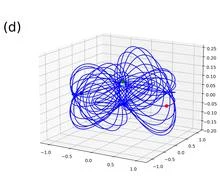
Three bodies attracting each other by universal gravitation: a problem that has stumped mathematics for three centuries. After Poincaré, it became clear that no general solution exists and trajectories are chaotic. But within this chaos there are islands of order: periodic orbits where motion repeats.
A traveler in the desert sees a lake. It shimmers, beckons with coolness, but as you approach, the water recedes. So it is in mathematics: the computer draws chaos, lines dart across the screen, and it seems we are witnessing a real storm. But if you wait long enough, the storm subsides, and the trajectory settles into a simple equilibrium.