Interstellar objectejection is the process by which stars, throughgravitational interactions, fling comets, asteroids, or even planets out of their home system and into the vast space between stars. These objects become 'interstellar wanderers' or 'rogue bodies,' traveling for millions or billions of years before possibly encountering another star system. The study of this phenomenon gained urgency with the discovery of 'Oumuamua and 2I/Borisov, the first confirmed interstellar visitors to our solar system, which hinted that such ejections are common across the galaxy.
History
The concept was theorized in the 1970s and 1980s by astronomers studying the dynamics of the Oort cloud, but it became a hot topic after the 2017 discovery of 'Oumuamua, the first confirmed interstellar object passing through our solar system.
How it works
The mechanism is essentially a gravitational billiard game. When a small body like a comet passes near a giant planet, it can gain energy from the planet's orbital motion and be slingshotted outward. If the body's speed exceeds the star's escape velocity, it leaves the system entirely. In dense stellar environments, close encounters between stars can also directly eject bodies. The process is most efficient in young star clusters where stars are packed tightly and planetary systems are still forming.
In practice
Understanding ejection rates helps astronomers estimate the population of free-floating planets and interstellar objects, which informs models of planetary system formation and evolution. It also guides missions like the proposed Comet Interceptor, designed to study such visitors.
Twenty thousand years ago, the star that would become supernova 1987A put on a ring. Not one — three. The two outer ones, like lampshades, tilted relative to the equatorial ring, and the star's light, struggling through them, barely reached an observer who happened to be in the plane of the equatorial ring.
A balloon that lets out air in bursts zips around the room — the jet blasts first one way, then another. A dying star behaves the same way as it sheds its bloated shell. Only instead of air, it's superheated gas, and instead of a balloon, it's a future white dwarf (the dense stellar remnant about the size of Earth).
The collapse of a star's core is like compressing a spring: matter falls inward, and a neutron star is born at the center. But the fall is never perfectly smooth. In the boiling outer layers, random eddies transfer angular momentum to the infalling gas, and a disk swirls around the central object.
This disk is no calm river. It pulses, strengthening and fading.
The hunter of ancient light, the James Webb Telescope, aimed its mirrors at a tiny patch of sky and caught a strange beacon. The object, with the working name beacon_1420-$$5253_{4770}$$, flashed and faded. At first, it was logged as a candidate for the most distant galaxy, as if we were seeing it just 300 million years after the big bang.
A quarter-century ago, Michel Mayor and Didier Queloz discovered the first hot Jupiter, and shattered all the rules of planet formation. A gas giant on a days-long orbit couldn't have formed next to the star: it's far too hot and lacks building material. So, it must have been born far away and then migrated.
Tiny seeds of life can cross the black void on icy wanderers like comet 3I/ATLAS. The James Webb Space Telescope found water and methane on it for the first time, and light analysis revealed an unusual gas composition.
The James Webb Space Telescope JWST has peered into the heart of supernova remnant SNR 0540-69.3 — what remains after a massive star died in a neighboring galaxy. Inside, amid the flying debris, astronomers saw a clear pattern: glowing clumps and voids arranged in a symmetric design.
The birth of planets resembles the workings of a cosmic forge. Rocky blocks collide and fuse together. A powerful impact strikes a spark — material heats to white-hot and glows like cooling metal. Computer simulations show: the flash is visible from days to years, peaking at a tenth of the sun's light.
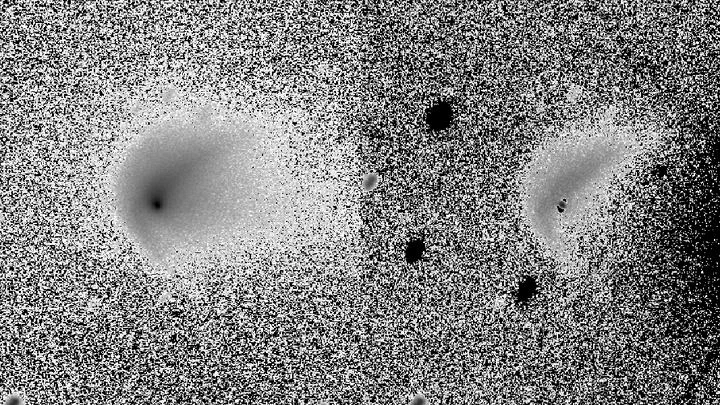
In the summer of 2021, comet 7P/Pons-Winnecke put on quite a show. A network of telescopes, the Las Cumbres Observatory, tracked it for nearly three months and counted eight sudden outbursts.
A planet the size of Neptune wandered too close to its star. The star begins to pull the planet's outer layers onto itself — gas streams off the planet like water from an overflowing bucket. This process is called Roche-lobe overflow (astronomers use this term for the boundary beyond which a star can tear material away from a planet).
Eight hundred million years ago, in the main asteroid belt, a giant inkwell shattered. The parent body, over a hundred kilometers in diameter, made of primitive carbonaceous chondrites, suddenly broke apart near the J3:1 resonance with Jupiter.
Interstellar space is not a cosmic desert, but a super-fast highway. Trillions of asteroids and comets from other systems race past us, yet camera-telescopes only catch a few. Imagine a night highway: the headlights of a distant car flash brightly, but if it zooms by too fast, the camera shutter can't click in time.
A black hole rips apart a star, and we see a dazzling flare. Then, a couple of years later, when everyone has forgotten about it, radio telescopes suddenly pick up a new signal, like an echo from the past.
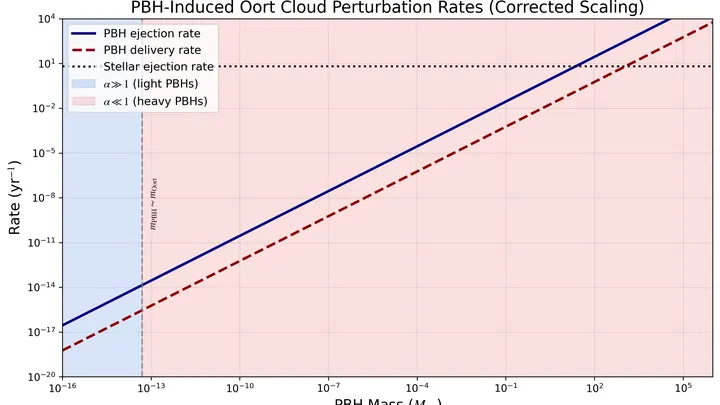
The Oort Cloud is a spherical swarm of trillions of icy bodies at the very edge of the Solar System, about a light-year from the Sun. These objects are almost motionless relative to one another until some gravitational disturbance breaks their calm.
Be stars are rapidly rotating luminaries with bright gas disks. Usually, a companion star spins them up: mass flowing from the neighbor whirls the star like a bullet in a rifled barrel. But there are also lone Be stars without a partner: their origin long remained a mystery.
New research shows that solitaries can be born from a supernova explosion.
A handful of coins accelerates to one-fifth the speed of light. That's what Coracle interstellar probes will be like — tiny spacecraft weighing just a few grams, each with an ultrathin sail film. A powerful laser beam pushes them forward: light presses on the sail like wind fills a yacht's sails, except instead of air, it's a stream of photons.
After the Big Bang, the Universe was filled with cold gas — mostly neutral hydrogen and helium. It enveloped the cosmos like a morning fog, impenetrable to light. The Dark Ages began.
When the first galaxies ignited, their radiation, like a searchlight beam, started knocking electrons out of atoms.
At night, a distant streetlamp seems motionless, but if you walk closer and look carefully, you might notice it swaying slightly in the wind. That's roughly how astronomers hunt for planets around other stars: they measure how a star shifts ever so slightly under the gravitational tug of its invisible companions.
The Gaia space telescope measures star positions with an accuracy of a microarcsecond, like spotting a coin on the Moon from Earth. In 2022, it noticed that the bright star HD 12800 was wobbling slightly, as if tugged by an invisible companion. Astronomers hypothesized that a planet orbits the star.
But a wobble can be deceiving.
An icy rock is flying through the Solar System on an open trajectory — coming in from interstellar space, swinging around the Sun, and heading back into the dark.
A comet hurtling through space is a mountain of ice and dust that carries itself across the Solar System. If you mount small engines on such a mountain, it becomes a ship with its own fuel: gas from the interior can be vented through nozzles to change course.
A sugar cube sits on a saucer next to a cup of hot tea. Drop it in, and it dissolves within minutes. But if you lower it slowly, the sugar melts gradually, releasing its sweetness into the drink. Something similar is happening in two newly discovered stellar pairs, except the sugar is a brown dwarf and the tea is a star.
Around certain close binary stars, where a white dwarf siphons matter from its companion, astronomers have seen a glowing arc. They took it for a shock wave — the place where a fast stellar wind slams into interstellar gas. But new observations show: there's more than one arc.
A distant galaxy, similar to our Milky Way, is blowing gas into space like a hair dryer blowing dust off a table. Seven beams of light from an even more distant object pierced this gas cloud, and astronomers saw that the gas flow is narrow, like a jet from a hose, not wide like a fan.
Deep in the Galaxy, runaway stars are sometimes born. A monstrous force, a supernova explosion, flings them from their usual place. One such wanderer has recently been found: a star of the LP 40-365 class, a fragment of a white dwarf that survived an incomplete explosion.
A planet hugging its star is like an ice cube forgotten on a scorching skillet. The ice melts and evaporates, except instead of water, it's hydrogen and helium from the planet's upper layers.
Blue giant stars are usually born in tight stellar nurseries — open clusters within the thin disk of our Galaxy. But sometimes such stars are found high above the disk, as if thrown out of their home. How did they get there?
The young star B335, which hasn't grown up yet, suddenly sneezed, and that sneeze is still going on. Astronomers spotted the outburst in the scattered light from its outflow cavity, and it offered a rare chance to see how such an energy release affects a jet — a stream of gas shooting out…
The center of a galaxy is a bustling metropolis where a giant black hole often snatches inattentive stars. But telescopes caught a flare in a quiet suburb, tens of thousands of light-years from the core. This gave away a wandering black hole — an invisible predator, flung out of the center after an ancient galaxy collision.
Interstellar wanderers are rocks and icy chunks that have broken free from their home planetary systems and now drift through the Galaxy. The first such visitor, 'Oumuamua, zipped past the Sun in 2017, followed by Comet Borisov and the ATLAS object. Where do they come from?
In stellar nurseries, massive stars are not born alone but in pairs. Two stars orbit a common center, and the more massive one expands first and begins to shed its outer layers. Some of this material doesn't escape into space but flows onto the companion, like water from an overflowing cup into a cup held beneath.
Space works like a billiard table. Massive outer planets, like heavy balls, transfer their energy to light inner worlds. Such a gravitational kick can fling a small planet out of the stellar system. It turns into a free-floating wanderer — a rogue exoplanet without a star.
Detecting these invisible bodies is hard: they neither emit nor reflect light.
An ordinary lump of coal left under the blazing sun just heats up. But if you take it into space and bring it twenty times closer to the Sun than Earth is, it won't survive for more than a few minutes. That's roughly how dark, carbon-rich asteroids behave. They are rarely found on orbits that dive deep inside Mercury's orbit.
Spinning a sling, we whirl a stone. Its speed builds, and if released at the lowest point, it flies farthest. In space, the gravity of the Sun acts as the strap: the probe dives as close to the star as possible, and at the moment of maximum speed, a brief engine thrust, like a yank of the hand, gives it a huge boost.
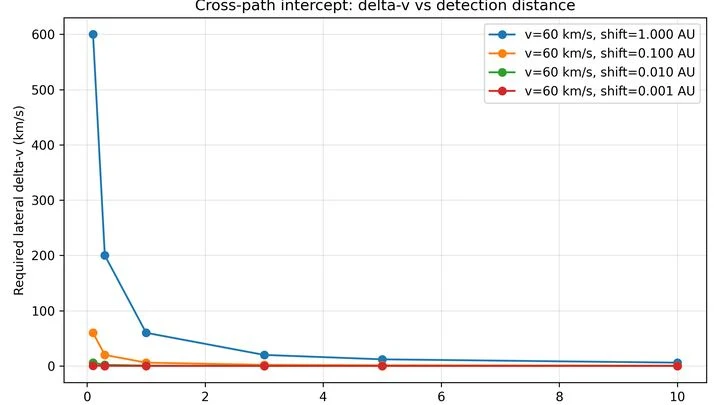
The Comet Interceptor mission launches without a target. The spacecraft freezes at a point of space equilibrium, like a fighter jet on combat standby: engine warmed up, but takeoff only on alert.