Blazar Flares: How to Tell Particle Accelerators Apart express
A blazar is a distant galaxy with a plasma jet shooting from its center, aimed almost directly at us. Inside this jet, particles are accelerated to near-light speeds and emit powerful radiation. When a blazar flares, its brightness can change by tens of times within hours or days, and the shape of the flare tells us what accelerated the particles.
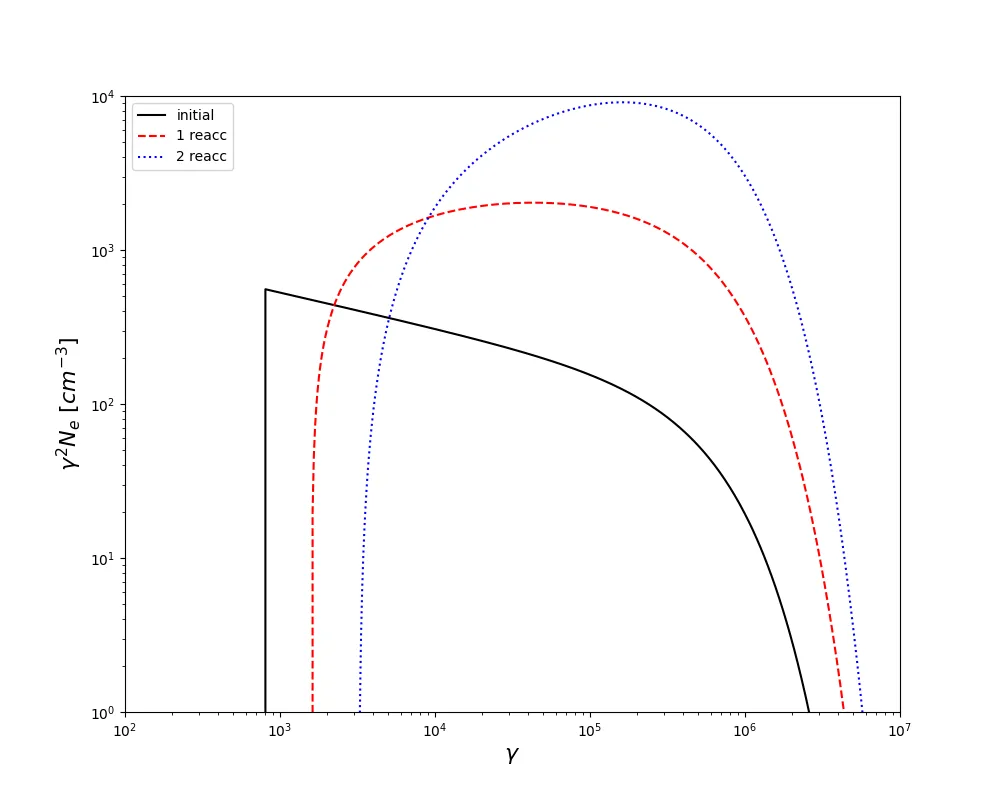
The authors built a simple model where the entire flare occurs in a single compact "cauldron" within the jet. They tested various scenarios: particles could be injected all at once, accelerated by a shock wave or random kicks, lose energy through radiation, or escape the region. Each scenario leaves its mark on how brightness varies across wavelengths — from radio to gamma rays.
The rise shape of the flare is especially telling: a sharp rise indicates rapid injection, while a smooth rise points to prolonged acceleration. Testing the method on a real flare from the blazar Mrk 421, the authors showed that even with current data, the main scenarios can be distinguished. It's like diagnosing a car problem by the sound of the engine: different failures make different noises.
Original abstract
as written by the authors arXiv:2602.05601
The study of multiwavelength flux and spectral variations during rapid flares from blazars provides strong constraints on the physical parameters of the compact emission regions responsible for these still poorly understood events. Although a full description of the continuous and transient emission from blazars seems to require more sophisticated scenarios, particle acceleration and loss mechanisms can be approximately described within the simple leptonic one-zone framework, enabling a systematic study of their impact on the observable properties of multiwavelength flare light curves. Our goal is to identify characteristic signatures in these light curve profiles that permit one to discriminate between the main physical processes situated inside the relativistic jet and commonly invoked to explain blazar flares. The present study exclusively focuses on modeling rapid flares from BL Lac type objects, which can be described within the synchrotron self-Compton (SSC) emission scenario. Combinations of several commonly employed mechanisms to describe the gain and loss of energetic particles in onezone models during flaring events are studied in a systematic way: particle injection; diffusive shock and stochastic acceleration and reacceleration; particle escape; adiabatic losses; radiative losses through synchrotron and inverse-Compton radiation. The current study is limited to the case of "hard-sphere" scattering. A large variety of light curve shapes arises from the different scenarios under study. Characteristic signatures, in particular energy-dependent time delays and differences in the shapes of the rising part of the flare, should allow the distinction to be made between different injection and acceleration scenarios, given the availability of sufficiently high-quality multiwavelength data sets. This is illustrated with a simplified application to a flare event from the blazar Mrk 421.
The blazar Mrk 421 lies in the constellation Ursa Major at a distance of about 400 million light-years, and its flares are visible even with amateur telescopes.
In the series "Star Trek: Voyager," blazars are mentioned as natural beacons aiding navigation in deep space.