Blazar monitoring is the practice of continuously observing blazars — active galactic nuclei whose relativistic jets point almost directly at Earth — across multiple wavelengths, from radio to gamma rays. Because their emission is dominated by a jet seen nearly head-on, blazars appear as extremely bright, rapidly variable point sources that can change dramatically on timescales from minutes to years. Monitoring campaigns track these variations to probe the physics of particle acceleration, magnetic fields, and the geometry of the jet, effectively using the blazar as a natural laboratory for extreme conditions.
History
Blazar monitoring began in earnest in the 1970s with coordinated optical and radio campaigns, but it became a major discipline with the launch of the Compton Gamma Ray Observatory in 1991, which discovered that blazars dominate the extragalactic gamma-ray sky. The Fermi satellite, launched in 2008, has since provided continuous all-sky monitoring, making blazar variability a central tool in high-energy astrophysics.
How it works
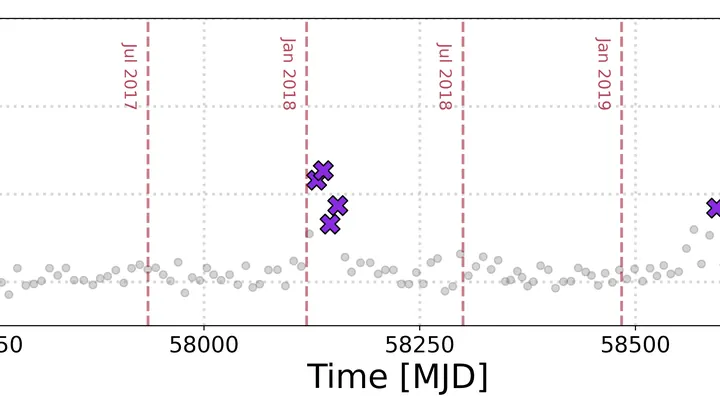
Telescopes on the ground and in space repeatedly image or measure the flux of a blazar in different bands, often coordinated across observatories to catch simultaneous flares. The light curves — plots of brightness over time — are then analyzed for patterns: correlated flares in different wavelengths, time delays between bands, or periodicities. These patterns reveal where in the jet the emission originates, how fast particles are accelerated, and how the jet's magnetic field and bulk motion evolve. Modern monitoring also employs automated alerts and machine learning to catch transient events in real time.
In practice
Blazar monitoring is used to study particle acceleration in relativistic jets, to probe the intergalactic medium via absorption of gamma rays, and to identify candidate sources for neutrino and cosmic-ray follow-ups, as well as to test theories of jet physics and black hole accretion.
Fun fact
Some blazars exhibit quasi-periodic oscillations in their light curves, hinting at possible binary supermassive black holes at their centers.
In the first few hundred million years after the Big Bang, the universe was a dark ocean in which the first stars and black holes ignited. Some of those black holes shot out narrow jets of plasma traveling at nearly the speed of light. If such a jet points straight at Earth, we see it as a bright spot: a blazar.
A beacon at the edge of the galaxy blinks without a schedule: sometimes silent for years, sometimes emitting hundreds of flares in a single day. Such a beacon needs a watchman who never sleeps and never gets distracted.
A particle with an energy of $$10^{18}$$ eV hitting Earth's atmosphere is like a tennis ball traveling at 200 km/h slamming into a wall. Astrophysicists have debated for decades where such projectiles come from. Gamma-ray bursts, brief and powerful explosions of gamma radiation, have long been suspected as accelerators.
A bright lantern in thick fog seems dim, while a weak flame in clear air can be seen a kilometer away. A similar oddity baffled astrophysicists almost half a century ago.
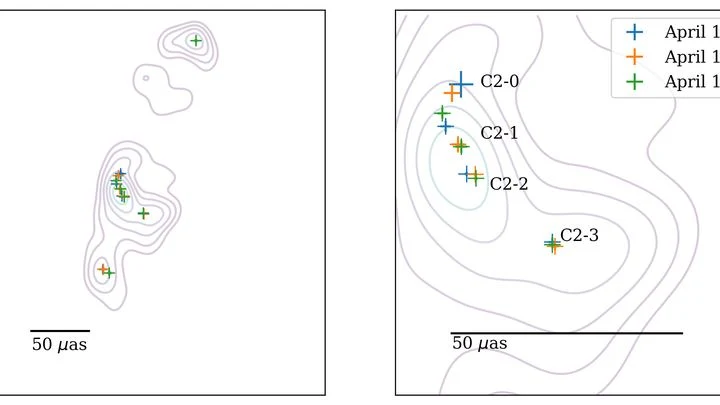
In April 2021, the antennas of the Event Horizon Telescope (EHT)—a global network of millimeter-wave radio telescopes — zeroed in on a tiny spot in the constellation Virgo.
Blazars are long-lasting beams from black holes at the centers of galaxies. Gamma-ray bursts are the briefest flashes from supernova explosions or neutron star mergers. The former act like eternal spotlights, the latter like camera flashes.
A spotlight shines ever brighter, but at some limit the bulb suddenly burns out, and no more light comes through. Astrophysicists have seen something similar in the distant blazar Markarian 421. This is an active galaxy whose jet of superheated plasma points almost straight at Earth, like the beam of a cosmic lighthouse.
A zebra grazes in the African savanna, surrounded by a cloud of flies — horseflies, tsetse flies, and mosquitoes. But instead of landing calmly, the insects jerk, miss their target, and crash into the hide. The reason is not camouflage but the structure of the fly's eye.
The horsefly's eye is a mosaic of thousands of tiny tubes, ommatidia, each pointing in a different direction.
For decades, the search for extraterrestrial intelligence has waited for quiet, coherent signals from space — a kind of 'whistle' in the radio silence. However, our own technosphere has created a continuous radio background — the hum of a vast metropolis, emitted by all communications, radars, and broadcasting stations.
The plasma jet from the center of a distant galaxy is like a river that flows from its source and gradually becomes clear. Near the black hole, the flow is dense and opaque to radio waves, like muddy water.
The Fermi telescope spent 17 years recording gamma rays from the active nuclei of galaxies with giant black holes at their centers. The glow of their jets resembles a chaotic cacophony: it constantly changes.
The night sky is full of beacons that blink on schedule. Pulsars are fast-spinning neutron stars whose radio pulses arrive with clockwork precision. But there are other beacons too: they stay silent for minutes or hours, then suddenly emit a single pulse, and go quiet again.
At the center of our Galaxy lurks the supermassive black hole Sagittarius A* — a heavyweight that holds stars in its grip. Astronomers dream of finding pulsars near it: these cosmic lighthouses emit radio pulses with the precision of atomic clocks.
For three years straight, every night, telescopes have stared at one point in the sky. There lies the galaxy Mrk 421, whose core shoots a jet of particles aimed almost exactly at Earth. Such objects are called blazars. A black hole at the galaxy's center spins matter into a disk, and some of it is ejected outward in two narrow beams.
A blazar is a distant galaxy with a plasma jet shooting from its center, aimed almost directly at us. Inside this jet, particles are accelerated to near-light speeds and emit powerful radiation.
For twelve years, astronomers at the LPA radio telescope in Pushchino have been listening to the same patch of sky — the direction of the galaxy 3C 33. In that time, they caught just six short radio signals, each lasting from one to four minutes.
Four cesium atoms hang in vacuum, held by laser tweezers like beads on an invisible thread. Around them is a ring resonator, a closed loop of mirrors where light circulates without obstacles. When a probe beam strikes this tiny chain, something strange happens: the atoms scatter light not uniformly in all directions, but predominantly in one direction.