Time-of-flight is a measurement technique that identifies a particle by how long it takes to travel a known distance. In particle physics, when a particle passes through a detector, its speed can be deduced from the time it takes to move between two points. Combined with its momentum (measured by how much it bends in a magnetic field), the speed reveals the particle's mass, and therefore its identity. This is a fundamental tool in experiments that study cosmic rays, nuclear reactions, and particles produced in accelerators.
History
The technique became practical with the development of fast photomultiplier tubes and electronics in the mid-20th century, and it has been a standard part of particle detectors since the 1960s.
How it works
Two detector layers are placed a known distance apart. When a particle hits the first layer, a clock starts; when it hits the second, the clock stops. The time difference, divided by the distance, gives the particle's velocity. Since particles of different masses but the same momentum travel at different speeds (lighter ones are faster), the velocity measurement distinguishes them. The technique is especially effective for particles moving at a significantfraction of the speed of light, where time differences of nanoseconds or picoseconds must be resolved.
In a typical particle physics detector, time-of-flight systems measure arrival times with a precision of about 100 picoseconds — the time it takes light to travel just 3 centimeters.
If you accelerate an observer to near-light speed, the emptiness around them stops being cold. A thermal glow emerges — an effect predicted in 1976 and named after William Unruh. For earthly accelerations, this glow is vanishingly faint, like a whisper at a rock concert.
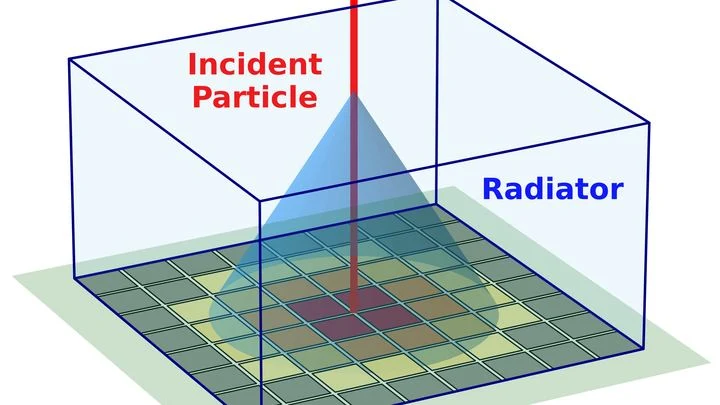
In giant accelerators, particles zip through detectors in billionths of a second, and telling one from another requires a stopwatch of incredible precision. The new µRWELL-PICOSEC detector acts as such a stopwatch: it captures the moment a particle passes with a precision of 48 picoseconds: that's 48 trillionths of a second.
In turbulent air, droplets don't fly in straight lines: they get tossed around like dust motes in a beam of light. Physicists have built a setup that tracks each droplet, which is about a tenth of the thickness of a human hair. A camera captures their motion, and a computer reconstructs their trajectories.
When a particle zips through a transparent material faster than light can travel through it, it leaves behind a faint blue flash, just as a jet breaking the sound barrier creates a shock wave. This Cherenkov radiation fires instantly, with no delay, making it perfect for ultra-precise timing in the world of elementary particles.
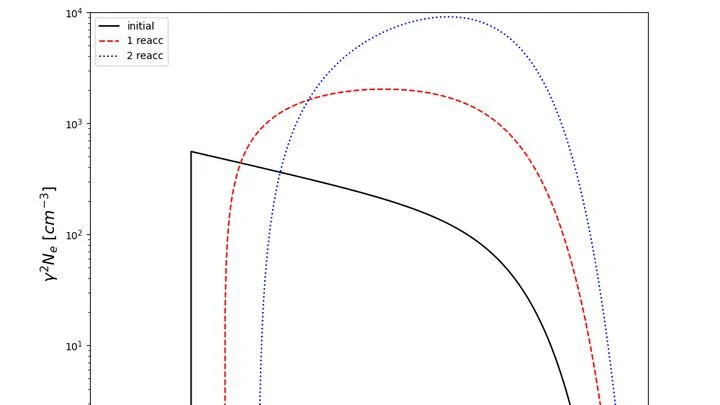
A blazar is a distant galaxy with a plasma jet shooting from its center, aimed almost directly at us. Inside this jet, particles are accelerated to near-light speeds and emit powerful radiation.
At the Large Hadron Collider, protons smash into each other like two trucks full of confetti. The debris, dozens of new particles, scatters in all directions. The detector records their tracks, and then the real work begins: piecing together a complete picture of the collision from those tracks.
Previously, this was done by a set of rules devised by physicists.
Paraglider, hang glider, and glider — three different wings, but in the sky they behave the same. Pilots catch invisible warm air currents, rise on them, then glide to the next. Such flight is like a game of hopscotch: a jump upward, then a glide forward, and again a search for a place to jump.
Scientists analyzed thousands of real routes and found a common law.