Blazar Flares: How to Tell Particle Accelerators Apart express
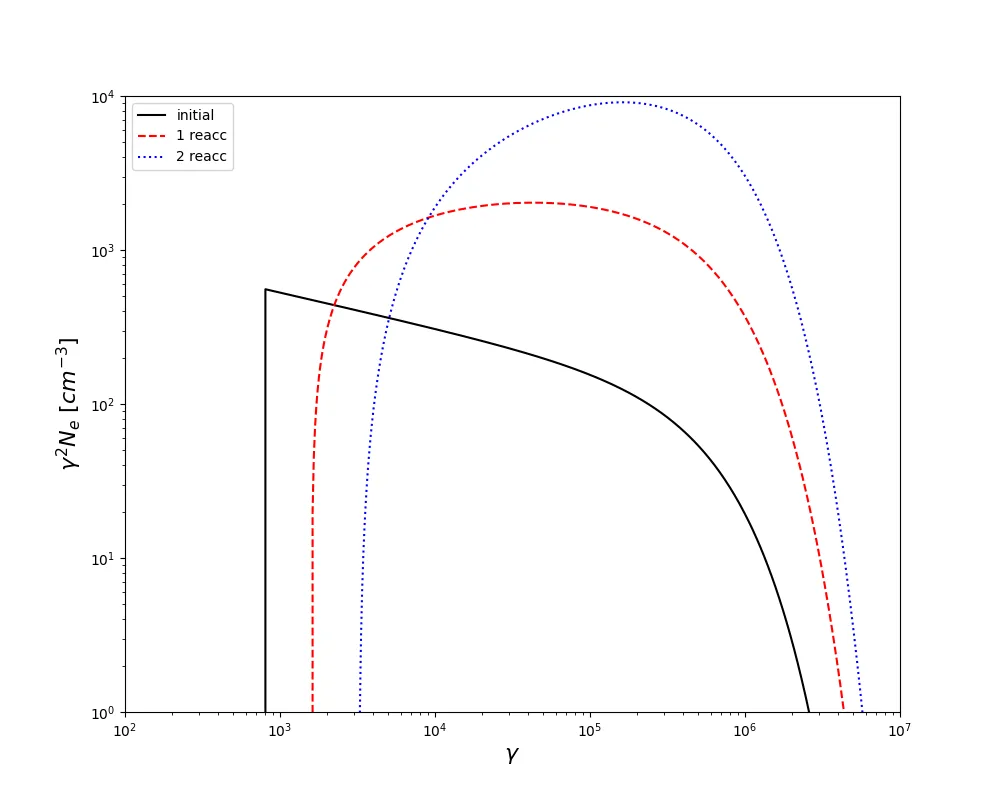
A blazar is a distant galaxy with a plasma jet shooting from its center, aimed almost directly at us. Inside this jet, particles are accelerated to near-light speeds and emit powerful radiation. When a blazar flares, its brightness can change by tens of times within hours or days, and the shape of the flare tells us what accelerated the particles.
The authors built a simple model where the entire flare occurs in a single compact "cauldron" within the jet. They tested various scenarios: particles could be injected all at once, accelerated by a shock wave or random kicks, lose energy through radiation, or escape the region. Each scenario leaves its mark on how brightness varies across wavelengths — from radio to gamma rays.
The rise shape of the flare is especially telling: a sharp rise indicates rapid injection, while a smooth rise points to prolonged acceleration. Testing the method on a real flare from the blazar Mrk 421, the authors showed that even with current data, the main scenarios can be distinguished. It's like diagnosing a car problem by the sound of the engine: different failures make different noises.
The blazar Mrk 421 lies in the constellation Ursa Major at a distance of about 400 million light-years, and its flares are visible even with amateur telescopes.
In the series "Star Trek: Voyager," blazars are mentioned as natural beacons aiding navigation in deep space.