Velcro Cells Build the Body express
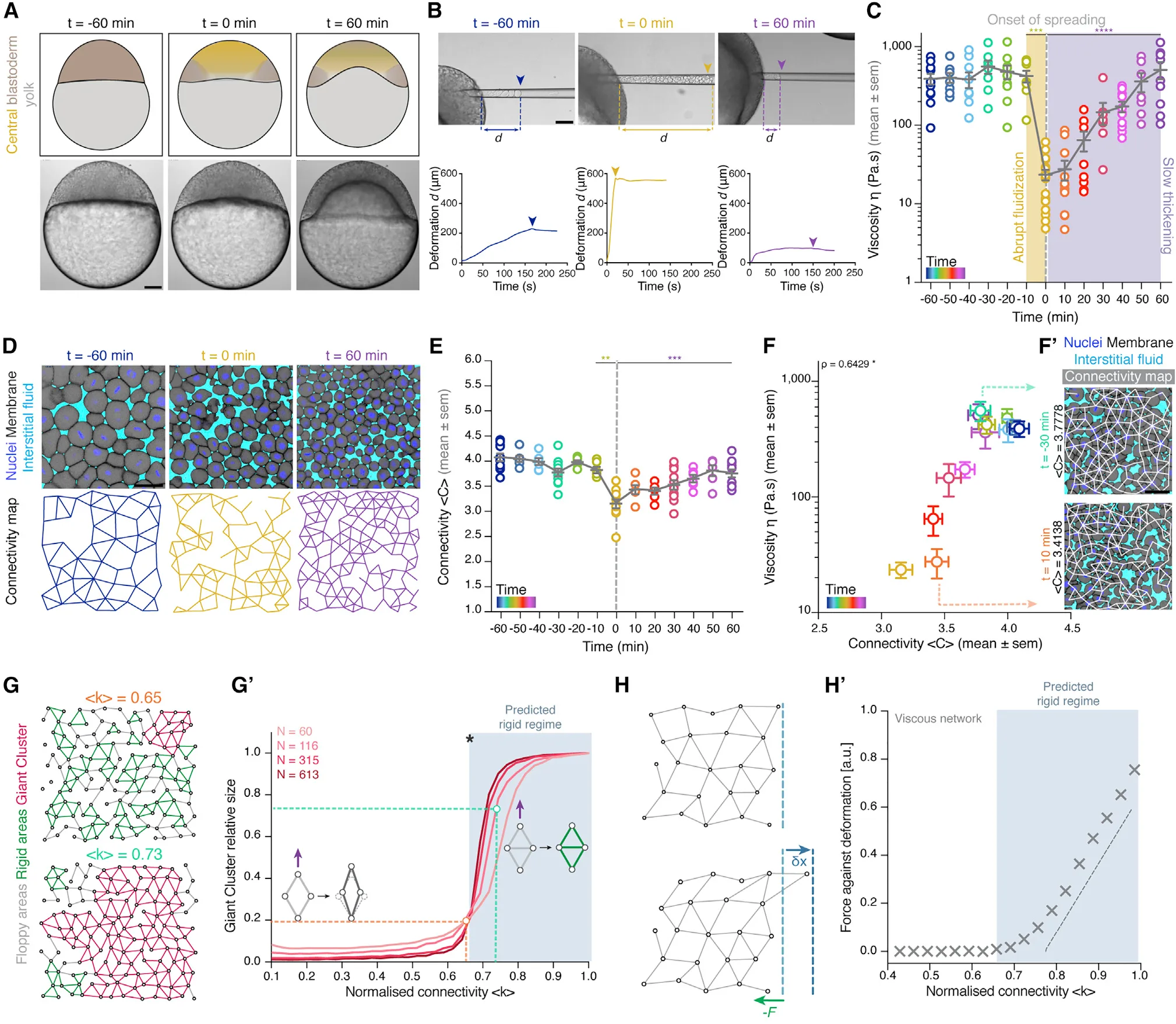
As an embryo grows, its cells don't just divide: they constantly touch their neighbors, like people in a crowded bus. The strength of these contacts determines where a cell moves and what shape the tissue takes. Scientists studied how cell 'stickiness' changes during the earliest stages of development. It turns out that even a slight change in the contact points between cells rearranges the entire tissue, as if the assembly scheme of a puzzle had changed.
Cells hold onto each other through special proteins on their surfaces: they work like Velcro fasteners on clothing. If there are more Velcro patches or they grip tighter, the tissue becomes stiffer and denser. If fewer, cells slide and rearrange more easily. This balance is what allows the embryo to form the tubes, folds, and cavities of future organs.
This knowledge not only helps us understand how an embryo develops, but also why development sometimes goes wrong. If the 'Velcro' works too weakly or too strongly, organs may not take their proper shape. Perhaps in the future, doctors will be able to correct such failures before birth.
Original abstract
as written by the authors arXiv:2602.09867
During the development of an organism, cells must coordinate and organize to generate the correct shape, structure, and spatial patterns of tissues and organs, a process known as morphogenesis. The morphogenesis of embryonic tissues is supported by multiple processes that induce the precise physical deformations required for tissues to ultimately form organs with complex geometries. Among the most active players shaping the morphogenetic path are fine-tuned changes in cell adhesion. We review here recent advances showing that changes on cell adhesion, a local, pair-wise property defined at the cell-cell contact level has important global consequences for embryonic tissue topology, being determinant in defining both the geometric and material properties of early embryo tissues.
In a zebrafish embryo, the cells destined to become the eye first assemble into a flat sheet, and then that sheet folds into a cup — simply because the cells in the middle of the sheet start sticking to each other more strongly.
In the movie Jurassic Park, scientists grow dinosaurs from DNA, but they don't mention that you need to precisely tune cell 'stickiness'—otherwise the embryo simply won't assemble.