How Ice on a Dust Grain Gives Birth to Alcohol express
In a dark, cold cloud between the stars, a dust grain a thousandth of a millimeter across catches light molecules. Carbon monoxide and hydrogen stick to its surface like raindrops to glass and react. After a few steps, methanol is produced — the same alcohol found in windshield washer fluid. This is how complex molecules appear in space, from which planets and even life may later assemble.
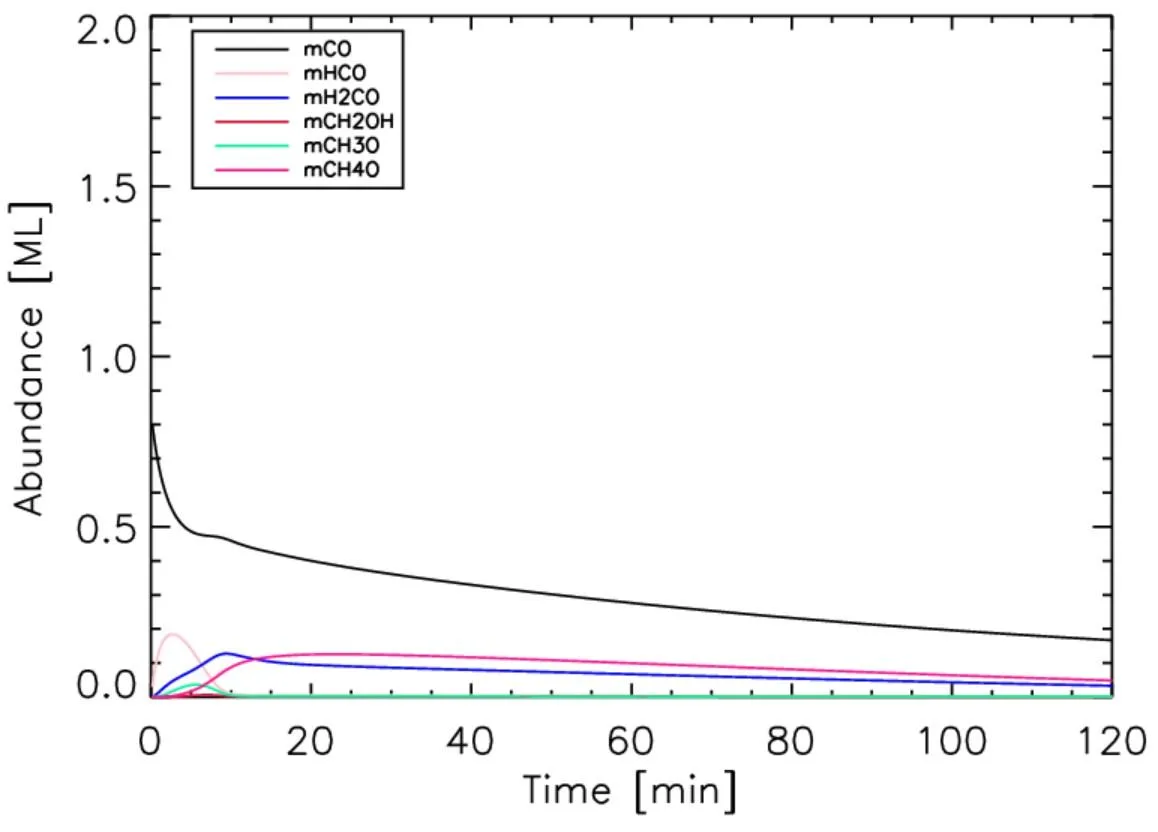
Computer models describe the chemistry on dust grains. They were built for interstellar clouds, where conditions are quite different from those in the lab. So scientists decided to test whether these models could apply to experiments on Earth. They took three programs (NAUTILUS, pyRate, and MONACO) and nine experiments. In each, they varied the temperature and the amount of gas supplied. It turned out that the models reproduce the experimental results fairly well, though they sometimes err in details.
The discrepancy between models and experiments may arise from an incomplete list of reactions or from how the models describe molecular movement on the surface. But the key point is that models can now be "trained" on laboratory data. This means predictions about which molecules are born in space will become more reliable.
Original abstract
as written by the authors arXiv:2602.11347
The development of molecular complexity during stellar and planetary formation owes much to the interaction of gas and dust. When the first astrochemical models including solid-state chemistry were developed more than forty years ago, data from dedicated laboratory experiments were limited. Since then, many groups have developed specific experimental setups to address this issue, but astrochemical models have rarely been directly confronted with these new results. We want to demonstrate whether it is possible to use rate-equation-type astrochemical models developed in the context of the Interstellar Medium to compare them with laboratory astrophysics experiments. In this work, we use the case of low-temperature hydrogenation of CO, which is known to lead to methanol, among other molecules. We carried out 9 experiments, varying the experimental parameters such as temperature and dose. We give quantitative results and take care of detailing the vocabulary used in the experiments. We use astrochemical codes, NAUTILUS, pyRate and MONACO, to reproduce our experimental conditions, which requires good control of the change of vocabulary and scales, especially for fluxes and time scales. This work demonstrates that it is possible to use different astrochemical codes to compare modelling results directly with the output of experiments. There are discrepancies between models and experiments, as well as between models, but a fair agreement is achieved. We discuss the possible origin of the differences, which could originate from the chemical network or the difference in the description of physical processes.
Methanol is one of the most abundant organic molecules in interstellar clouds. It is even found in comets, and it could have reached the young Earth along with icy planetesimals.