Astrochemical molecular formation refers to the processes by which complex molecules are created in space, from simple diatomic species to large organic compounds. These molecules form in a variety of environments, including interstellar clouds, circumstellar envelopes, and planetary atmospheres. The chemistry is driven by gas-phase reactions, grain-surface reactions, and shock-induced chemistry, often involving icy mantles on dust grains.
History
The field began in the 1930s with the detection of simple molecules like CH and CN in interstellar space, but the importance of grain-surface chemistry was recognized later, in the 1970s and 1980s.
How it works
In cold interstellar clouds, atoms and simple molecules stick to dust grains, forming icy layers. Ultraviolet radiation and cosmic rays can drive reactions within these ices, producing more complex molecules. When a shock wave passes through the cloud, it can sputter or evaporate the ices, releasing the newly formed molecules into the gas phase, where they can be detected by their rotational emission lines. Grain-surface reactions are particularly efficient for hydrogenation and other simple additions.
In practice
Understanding molecular formation is crucial for interpreting astronomical observations, studying star formation, and investigating the origins of prebiotic molecules in space.
Fun fact
More than 200 different molecules have been detected in the interstellar medium, including complex organic species like ethyl formate, which smells like raspberries.
In the first moments, the Universe expanded at an enormous rate. This process is called inflation, and its driving force is the inflaton field. Its energy pushed space apart, like yeast raising dough. But physicists suspect that the dough might have left 'bubbles'—superheavy particles born from the expansion itself.
The star AB Aur is young, about 4 million years old. Around it swirls a dense disk of gas and dust. Recently, a long gas stream, a flow of material from the surrounding cloud, crashed into it.
In the dense gaseous cocoon around a young massive star, streams of matter collide as if in a giant chemical flask. One stream moves relative to us at about 11 kilometers per second, the other at about 5. The telescope at Onsala (Sweden) caught their radio voices and resolved them into hundreds of spectral lines — molecular fingerprints.
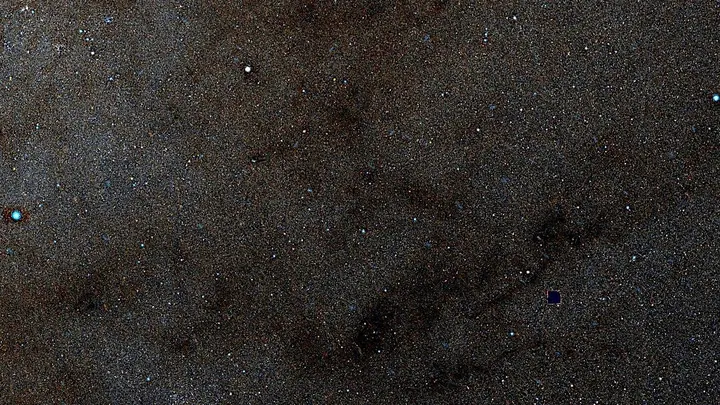
A giant cloud of gas and dust, so cold that its warmth barely flickers, just a few degrees above absolute zero. This is TMC-1 in the constellation Taurus, one of the darkest and densest cradles of molecules in our Galaxy. In recent years, it has become a true treasure trove for astrochemists: the number of substances found there has more than doubled.
In dark, cold clouds of interstellar gas, astronomers have for several years been spotting aromatic molecules — compounds built around a benzene ring (a hexagon of carbon atoms), like the benzene we know. One such substance, benzonitrile (benzene with a cyano group attached), had only been found in very calm and cold places, like the Taurus cloud.
A balloon inflates on its own, even though no one is blowing it up. That's roughly how the accelerated expansion of the universe looks, and to explain it, scientists usually invoke dark energy, an invisible and poorly understood force. But what if the balloon expands because new air molecules are continuously appearing inside it?
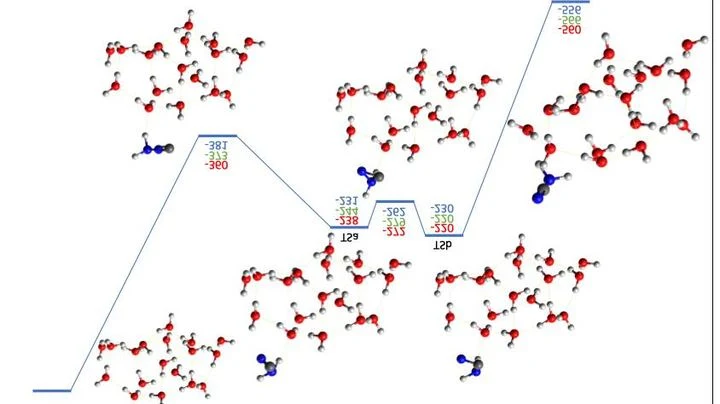
In cold clouds between the stars, dust grains are coated with ice, like windows covered with frost in winter. On this icy crust, chemical reactions take place that do not occur in gas. One such reaction is the encounter between a carbon atom and a nitrogen molecule.
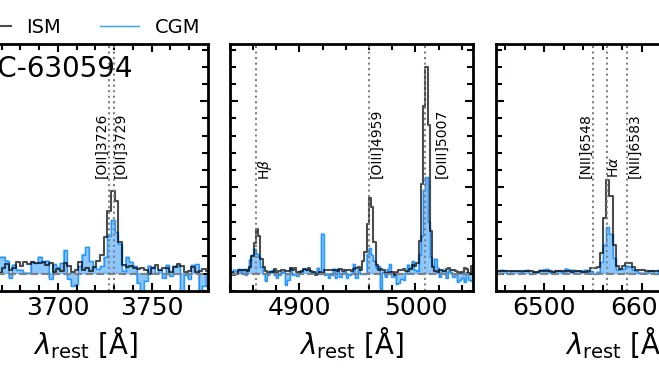
The kitchen of a distant galaxy isn't limited to its bright disk. Around every star system, there's an invisible cloud of gas, like steam above a pot of soup. Astronomers peeked into this steam around galaxies that appear as they were just one and a half billion years after the Big Bang.
When a young star ejects jets of gas, they slam into the surrounding cloud like a fist into a pillow. At the impact site, the gas is compressed and heated — creating a shock wave. In this hot zone, atoms and simple molecules collide and assemble into larger compounds, known as complex organic molecules.
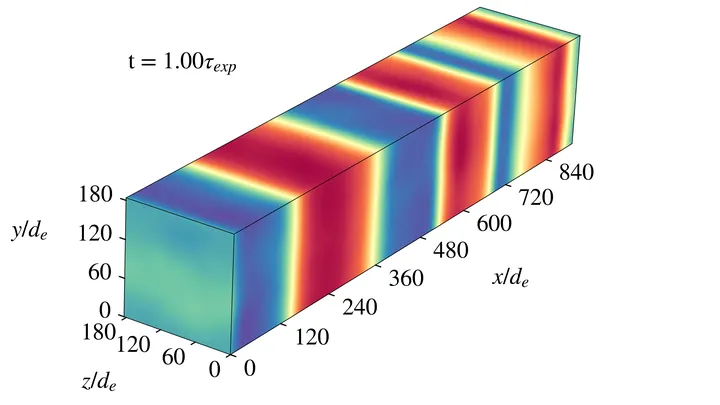
Plasma is a gas in which electrons are stripped from atoms, and it conducts electricity. In space, such gas is often so rarefied that particles rarely collide, and its behavior is described by the equations of motion for each particle. The computer method Particle-in-Cell (PIC) does exactly that: it tracks millions of particles and the electric fields they create.
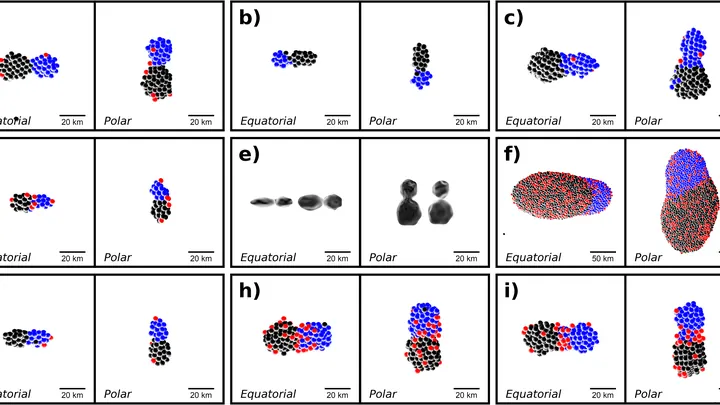
The icy body Arrokoth looks like a snowman: two spheres pressed together. Many such two-headed objects exist beyond Neptune's orbit, in the Kuiper Belt. For a long time, it was thought they formed from the slow collision of two separate bodies.
New simulations show a different path. A cloud of small pebbles around the young Sun collapses under its own gravity.
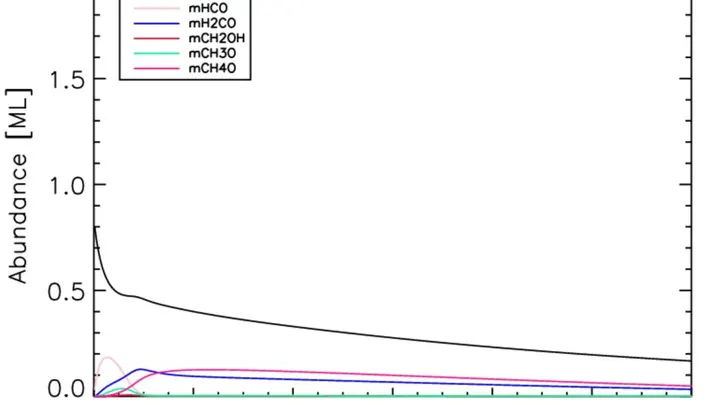
In a dark, cold cloud between the stars, a dust grain a thousandth of a millimeter across catches light molecules. Carbon monoxide and hydrogen stick to its surface like raindrops to glass and react. After a few steps, methanol is produced — the same alcohol found in windshield washer fluid.
In a cloud where massive stars are being born, there is a hot, dense core. Like a crowded kitchen where the heat of the stove makes smells evaporate, here the warmth from young stars evaporates molecules from the surface of cosmic dust grains.
In a jeweler's workshop, gold is never mixed with ruthenium: one is soft and shiny, the other refractory and brittle. But at the nanometer scale, these metals merge into a single alloy that, when heated, begins to separate like oil and water in a cooling broth.
An ordinary chemical reaction is like a ball rolling down a hill: it has one natural path. But if you place molecules in a tiny mirrored box, an optical microresonator, the light inside starts to interfere with the ball's motion. It can nudge it, hold it back, or even split its trajectory.
In a new study, physicists traced exactly how this happens.
In cold clouds of interstellar gas, carbon hides inside carbon monoxide (CO) molecules, like sugar dissolved in tea. But near hot, massive stars, this 'tea' boils: harsh radiation tears the molecules apart, and carbon escapes as lone atoms or ions.