Cosmic dust analysis is the study of tiny solid particles—typically less than a micrometer in size—that permeate interstellar and interplanetary space. These grains, composed of silicates, carbon compounds, and ices, are not just passive obstacles; they are active participants in the cosmic cycle, absorbing and scattering starlight, catalyzing chemical reactions, and serving as the building blocks for planets and complex molecules. By analyzing dust, astronomers can trace the life cycles of stars, the chemistry of molecular clouds, and even the conditions in the early universe.
History
The existence of interstellar dust was inferred in the 1930s by Robert Trumpler, who noticed that distant star clusters appeared dimmer and redder than expected, indicating intervening absorption. The field advanced significantly with infrared astronomy in the 1980s and 1990s.
How it works
Dust grains are detected and analyzed through their interaction with light: they absorb ultraviolet and visible radiation and re-emit it in the infrared, producing characteristic spectral features. Astronomers also study dust through extinction—the dimming and reddening of background starlight—and through polarization. Laboratory experiments and theoretical models help interpret these observations, linking specific spectral signatures to grain composition, size, and structure. In situ measurements by spacecraft, such as those that have sampled cometary dust, provide ground-truth data.
In practice
Dust analysis is crucial for correcting astronomical observations, understanding star formation, and interpreting the composition of planetary systems, including the search for prebiotic molecules in space.
Fun fact
Interstellar dust grains are the sites where molecular hydrogen—the most abundant molecule in the universe—forms, as hydrogen atoms meet and combine on the cold grain surfaces.
A telescope stares at a star for many nights in a row. Somewhere in the stream of light hides a tiny dip in brightness — an Earth-sized planet briefly blocking part of the star. Such a dip lasts a few hours and repeats once a year or less. Catching it is like hearing a single quiet click in a noisy hall.
In the dark kitchen of the Taurus molecular cloud, 450 light-years away, dozens of planetary systems are being prepared. Each young star is a chef, and its protoplanetary disk is a counter piled with flour-like dust and steam-like gas.
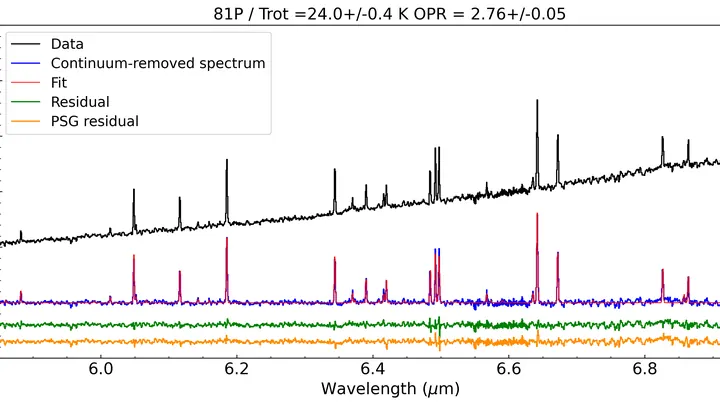
In March 2023, the James Webb Space Telescope pointed its instruments at the short-period comet 81P/Wild 2. This celestial body, about the size of a small town (nucleus radius around 1.77 km), is already familiar to scientists: in 2006, the Stardust probe flew through its tail and collected dust samples that were later studied in Earth laboratories.
A speed of 7,5 kilometers per second is the threshold beyond which a cosmic collision turns dust grains into a chemical reactor. In the interstellar medium drift tiny cosmic dust grains — the legacy of dying stars.
In 2019, an unusual visitor, comet 3I/ATLAS, zoomed into the Solar System. It came from another star, and for the first time, astronomers were able to see what its dusty tail is made of.
Light from a distant galaxy travels across the universe, passing through vast clumps of dark and ordinary matter. Their gravity slightly bends the path of the rays, like a river's current flowing around invisible boulders. In images, this shows up as a barely noticeable elongation of galaxy shapes, as if they were stretched on an invisible frame.
The young super-Jupiter TWA5B, a scorching ball 25 times Jupiter's mass, floats just fifty light-years away. Its faint infrared glow long hid its chemical makeup. Now, high-resolution spectroscopy with CRIRES+ has registered the ghostly trace of SiO — silicon monoxide.
A research probe is planned for the nearest black hole — a region of spacetime whose gravity traps even light. After a hundred years of flight, the spacecraft will enter orbit around the mysterious object to answer a key question: are we looking at a black hole or a neutron star — the ultra-dense remnant of a massive star, compressed to nuclear…
Seven snapshots of the sky after the eruption of Mount Pinatubo. Each snapshot is a map of concentrations for dozens of substances. The question is simple: which substance turns into which? But how do you infer a causal chain from seven frames when you have more variables than time points?
M-CaStLe looks at the map differently.
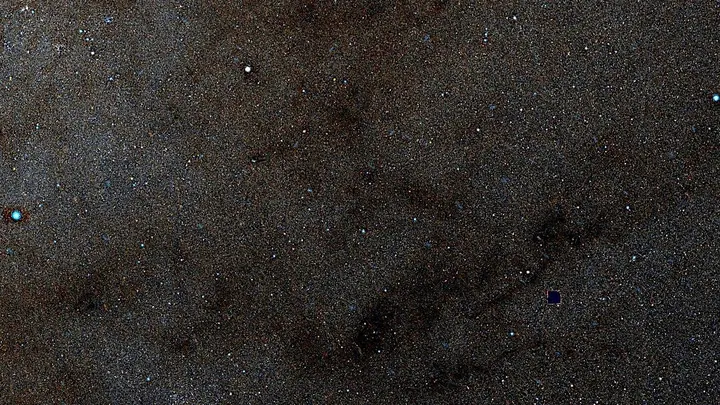
A giant cloud of gas and dust, so cold that its warmth barely flickers, just a few degrees above absolute zero. This is TMC-1 in the constellation Taurus, one of the darkest and densest cradles of molecules in our Galaxy. In recent years, it has become a true treasure trove for astrochemists: the number of substances found there has more than doubled.
Radio telescopes detected emissions from the celestial object G358.93-0.03 MM1 — a hot cocoon inside which a massive star is igniting. Within that glow, lines of glycolamide appeared, a delicate carbon molecule.
In turbulent air, droplets don't fly in straight lines: they get tossed around like dust motes in a beam of light. Physicists have built a setup that tracks each droplet, which is about a tenth of the thickness of a human hair. A camera captures their motion, and a computer reconstructs their trajectories.
A distant galaxy birthing hundreds of stars should glow in oxygen. That's what astronomers thought: hot young stars heat the gas, which then emits a characteristic infrared glow at a wavelength of 63 microns. It's like steam rising from a boiling pot — a sure sign of vigorous activity.
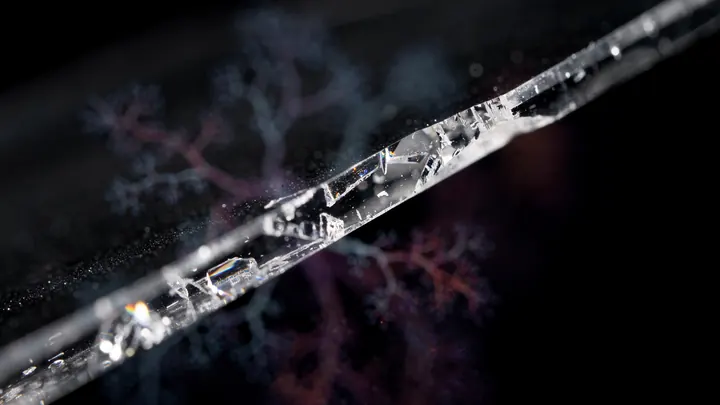
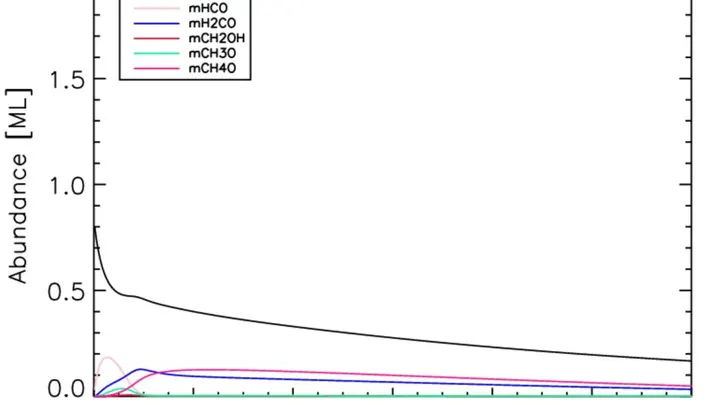
In a dark, cold cloud between the stars, a dust grain a thousandth of a millimeter across catches light molecules. Carbon monoxide and hydrogen stick to its surface like raindrops to glass and react. After a few steps, methanol is produced — the same alcohol found in windshield washer fluid.
In the Andromeda galaxy, our Milky Way's nearest large neighbor, astronomers have spotted giant cold clouds where stars are born. These clouds are made of gas and dust, but seeing them directly is tricky: they barely shine.
The night sky glows not only with stars. Between them lies a faint microwave radiance that astronomers have noticed for three decades but couldn't explain. One idea: the culprits are polycyclic aromatic hydrocarbons — molecules like tiny soot flakes that spin in space and, like miniature antennas, emit radio waves.
In cold clouds of interstellar gas, carbon hides inside carbon monoxide (CO) molecules, like sugar dissolved in tea. But near hot, massive stars, this 'tea' boils: harsh radiation tears the molecules apart, and carbon escapes as lone atoms or ions.
Eavesdropping on a distant planet's atmosphere is hampered by the star's noise. In the TRAPPIST-1 system, astronomers used a planet-"bug": TRAPPIST-1 b — an airless neighbor that records only the interference.