Stellar hydrogen formation encompasses the various processes by which hydrogen — the most abundant element in the universe — is created, processed, and cycled in the context of star formation and interstellar chemistry. While hydrogen was primarily formed in the Big Bang nucleosynthesis, its journey through the cosmos involves complex interactions: it exists in atomic, molecular, and ionized forms, and its transitions between these states drive the cooling and collapse of gas clouds, the birth of stars, and the chemical reactions that build more complex molecules. In the interstellar medium, hydrogen is the raw material for star formation, and its distribution and dynamics are key to understanding galactic evolution.
History
The understanding of hydrogen's role in star formation developed throughout the 20th century, with key contributions from Bart Bok (Bok globules), who studied dense hydrogen clouds, and from the discovery of the 21-cm line by Hendrik van de Hulst in 1944. The chemistry of hydrogen on dust grains was pioneered by researchers like William Watson and Ewine van Dishoeck in the 1970s-80s.
How it works
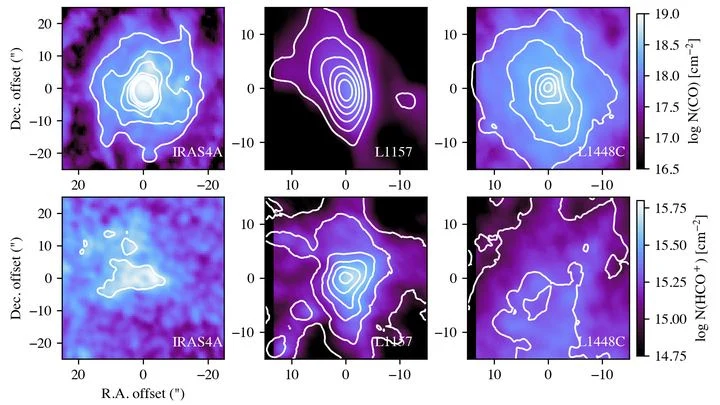
In star-forming regions, hydrogen gas cools and condenses under gravity. Atomic hydrogen (HI) emits at 21 cm, allowing astronomers to map its distribution. When gas becomes dense and cold, hydrogen atoms combine into molecules (H2) on the surfaces of dust grains, a process that is inefficient in the gas phase alone. Molecular hydrogen is the primary fuel for star formation, but it is difficult to observe directly; instead, astronomers trace it using carbon monoxide (CO). Once a star forms, it fuses hydrogen into helium in its core, but in the surrounding disk, hydrogen participates in a rich chemistry: it can be ionized by ultraviolet radiation, forming H+ regions, or it can react with other atoms and molecules on icy grain surfaces to form water, methanol, and even complex organic molecules like sugars. The hydrogen in these processes is not just a passive backdrop; its chemical activity is essential for the formation of the building blocks of life.
In practice
This knowledge is used to interpret radio and infrared observations of star-forming regions, to model the chemical evolution of galaxies, and to understand the origins of water and organic molecules in planetary systems.
Fun fact
Molecular hydrogen (H2) is so light that it can escape Earth's atmosphere, but in the cold, dense cores of interstellar clouds, it acts as a critical coolant, allowing gas to collapse into stars.
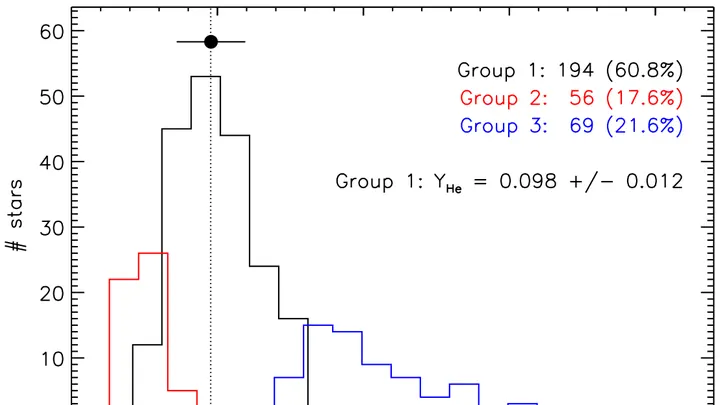
Two spinning tops whirl so close they nearly touch. One is scorching blue, the other dim white. Together they complete a full orbit in twenty hours. This is the pair Feige 64: a blue star with a mass of just a third of the Sun's, and a white dwarf, the cooled core of a former star, one and a half times heavier than our Sun.
The blue star seems too hot for its mass.
When stars are born in a galaxy, they make hydrogen glow, like a neon sign, but on a cosmic scale. This light could tell us a lot about how many stars are forming, but on its way to us, it passes through cosmic dust. Dust is like a fogged-up window: it dims the glow and alters its color.
In a dense molecular cloud, at the edge of glowing gas, an invisible assembly line is at work. It takes simple scraps — single atoms and light pairs — and glues them together step by step into long carbon chains and rings. The first piece of this assembly line has long eluded our eyes. Now it has been found.
In dark interstellar clouds where new stars are born, chemistry starts with a tiny particle — the trihydrogen ion (H₃⁺). It collides with other atoms and sets off a cascade of reactions that build ever more complex molecules. For a long time, it was thought that the main reaction producing it, H₂⁺ colliding with H₂, only happens in the gas phase.
For a long time, astronomers searched for the 'factories' of the most energetic cosmic rays — particles that carry the macrocosm compressed to the size of an atomic nucleus. Colossal star-forming regions like Cygnus OB2, where winds from young giants collide, were prime suspects.
In the crowded center of the galaxy, two stars orbit so close together that one strips the outer layers off the other, like wind blowing off a coat. What remains is a hot helium core, a star without a hydrogen envelope.
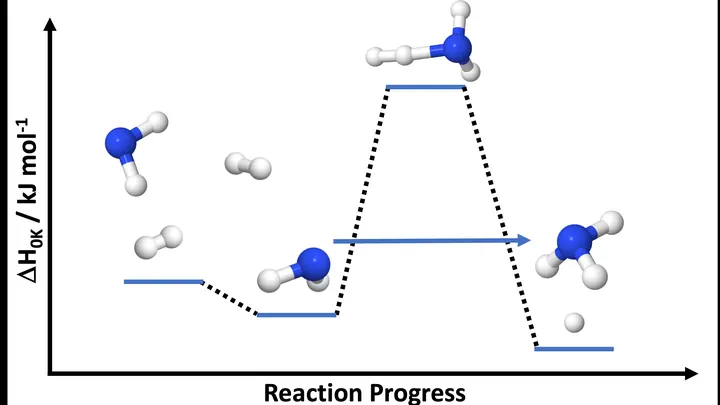
A ball rolls up a hill, but it doesn't have enough energy, so it rolls back down. That's classical mechanics for you. But in the quantum world, a tiny particle can sometimes pass right through the hill, as if the barrier weren't there. This trick, tunneling, is business as usual for a light atom like hydrogen.
A baker adds more sugar to the dough, and the pie turns out different. So it is with a star: the composition of its "dough"—the cloud of gas and dust from which planets are born — determines what worlds will form around it.
In the cold gas cloud where a star is born, chemistry sleeps. Molecules barely collide, reactions stall. But when a charged particle zips through the cloud, it knocks electrons off atoms — ionizing them. That's how active ions appear in a dormant cloud, ready to build new molecules.
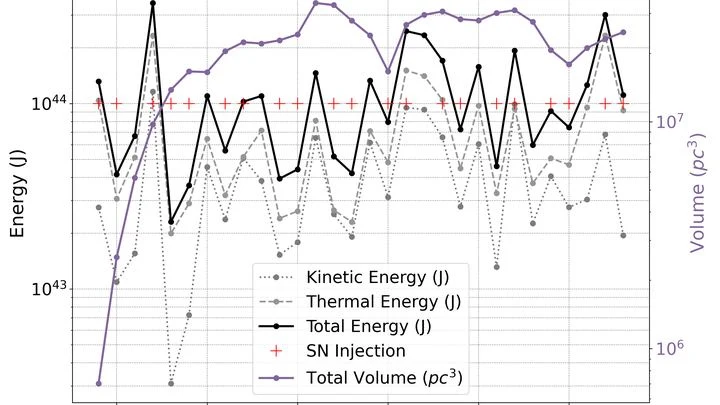
Superbubbles are cosmic giants, akin to soap bubbles, but instead of soap film, they contain rarefied interstellar gas, and they're inflated not by a breath but by a series of supernova explosions. In computer simulations, they behave like living things: they grow, cool, and move. But until now, we couldn't precisely trace their boundaries.
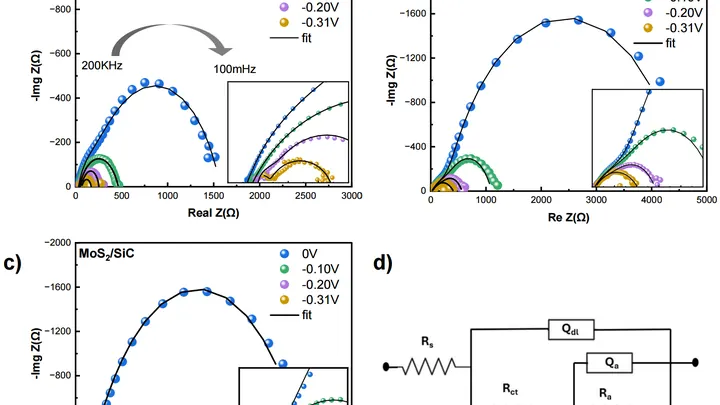
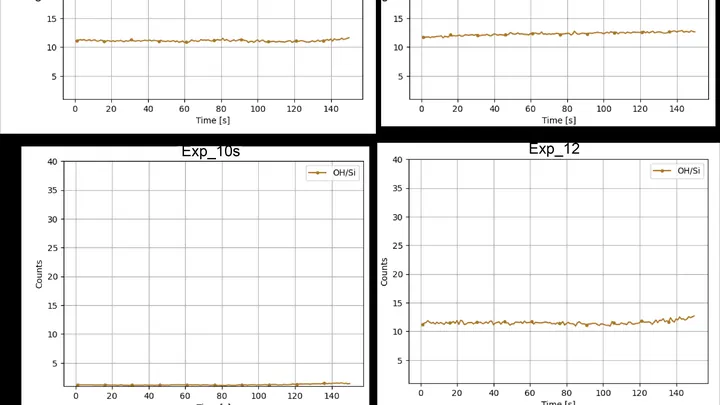
Hydrogen is a clean fuel: when it burns, it produces only water. But to extract it from water, you need to break the strong bond between hydrogen and oxygen. This is usually done with platinum, an expensive metal.
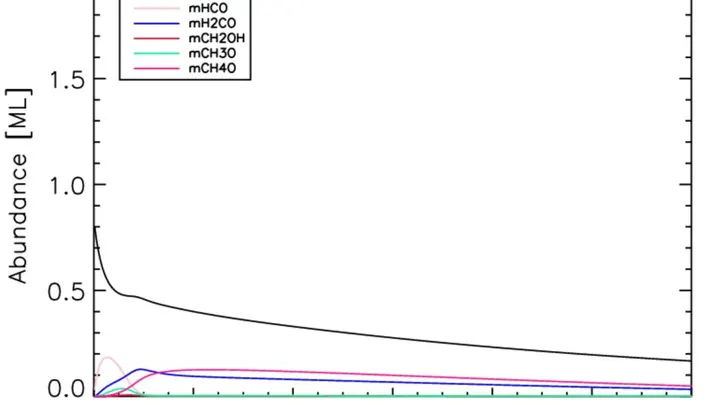
In a dark, cold cloud between the stars, a dust grain a thousandth of a millimeter across catches light molecules. Carbon monoxide and hydrogen stick to its surface like raindrops to glass and react. After a few steps, methanol is produced — the same alcohol found in windshield washer fluid.
In the dark, cold clouds where stars are born, dust grains are covered with an icy crust. Across this crust, like on a winter road, individual atoms wander slowly. Calculations show that it is precisely these wandering oxygen and nitrogen atoms that kick off the assembly of the HNSO molecule — a compound of hydrogen, nitrogen, sulfur, and oxygen.
Astronomers using James Webb and spectroscopy (splitting light into colors) peered through dust into the center of galaxy IRAS 07251-0248. There they discovered benzene, acetylene, methane — the same hydrocarbons found in gasoline and plastics.
In stellar nurseries, massive stars are not born alone but in pairs. Two stars orbit a common center, and the more massive one expands first and begins to shed its outer layers. Some of this material doesn't escape into space but flows onto the companion, like water from an overflowing cup into a cup held beneath.
In a cold gas cloud right at the center of our Galaxy, designated G+0.693-0.027, hides a true chemical laboratory. There, far from stars, on the surfaces of tiny dust grains, about the size of smoke particles, atoms stick together into molecules, like dough on a kitchen counter.
A cosmic dust grain is covered in ice, and on this ice, like in a tiny kitchen, molecules are cooked. One of them is methanol, an alcohol that serves as a building block for more complex compounds in space. Previously, it was thought that methanol only forms when hydrogen atoms stick one by one to a carbon monoxide molecule.
A few hundred million years after the Big Bang, the universe resembled an endless dark ocean, shrouded in a thick fog of neutral (non-ionized) hydrogen. Then something dispersed the gloom: ultraviolet radiation knocked electrons out of atoms, making the gas as transparent as pure water.
The most common type of planet in our Galaxy — rocky worlds around other stars, or exoplanets, shrouded in the simplest gas hydrogen. Their innards remained a mystery until scientists recreated the conditions of the interior in the lab.
In 2017, the LIGO and Virgo detectors caught gravitational waves from the merger of two neutron stars. A kilonova flared: a brilliant cosmic explosion thought to forge the heaviest elements in the periodic table. Gold in jewelry, platinum in catalysts, europium in smartphone screens: all of it, according to a beautiful legend, came to us from such catastrophes.