
Paola Caselli

5 articles · 30 co-authors · latest: 2026-07-21
156 citations · h-index 5 · 19 papersData: Semantic Scholar

We have retold 5 papers by this author. most often about: exomoon, Moon, exoplanet atmosphere. 30 co-authors across our retellings.

Links in the knowledge graph
Exoplanets2026-02-051 minarXiv:2602.05378express
Rogue Moons: Warmth Without a Star
Rogue planets, ejected from star systems, may harbor life on their moons. A moon of such a planet can preserve heat and liquid water for billions of years. The whole secret lies in a reliable "blanket" and an internal "stove." The stove is tidal forces: they squeeze and stretch the moon's interior, heating it up like kneading clay.
Galaxies2026-02-111 minarXiv:2602.11347express
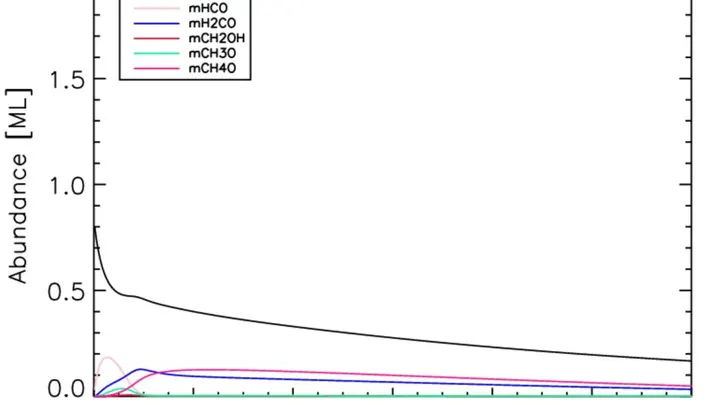
How Ice on a Dust Grain Gives Birth to Alcohol
In a dark, cold cloud between the stars, a dust grain a thousandth of a millimeter across catches light molecules. Carbon monoxide and hydrogen stick to its surface like raindrops to glass and react. After a few steps, methanol is produced — the same alcohol found in windshield washer fluid.
Galaxies2026-05-072 minarXiv:2605.06767express
Cosmic Rays as Chefs of Complex Organic Chemistry
In the dense gaseous cocoon around a young massive star, streams of matter collide as if in a giant chemical flask. One stream moves relative to us at about 11 kilometers per second, the other at about 5. The telescope at Onsala (Sweden) caught their radio voices and resolved them into hundreds of spectral lines — molecular fingerprints.
Galaxies2026-05-302 minarXiv:2606.00569express
Invisible Sulfur: Rechecking a Cosmic 'Discovery'
Imagine a packed orchestra, each musician playing their own part, while you try to pick out the quiet voice of a rare flute: its melody drowns in the sound of violins and trumpets. That's what hunting for molecules in interstellar clouds is like: telescopes pick up the 'radio voices' of countless substances, and picking out the signal you want from the noise is no easy task.
Exoplanets2026-07-212 minarXiv:2607.19579express
Heavy Water on a Hot Jupiter: WASP-39 b Surprises Astronomers
Water comes in different varieties. Not just fresh or salty, but also "heavy"—when one of its hydrogen atoms is replaced by deuterium, its heavier cousin. Such water is called HDO, and it's a true cosmic passport: the amount of deuterium in water reveals where and when that water was born.
