Black Hole Did Not Destroy Quantum Entanglement express
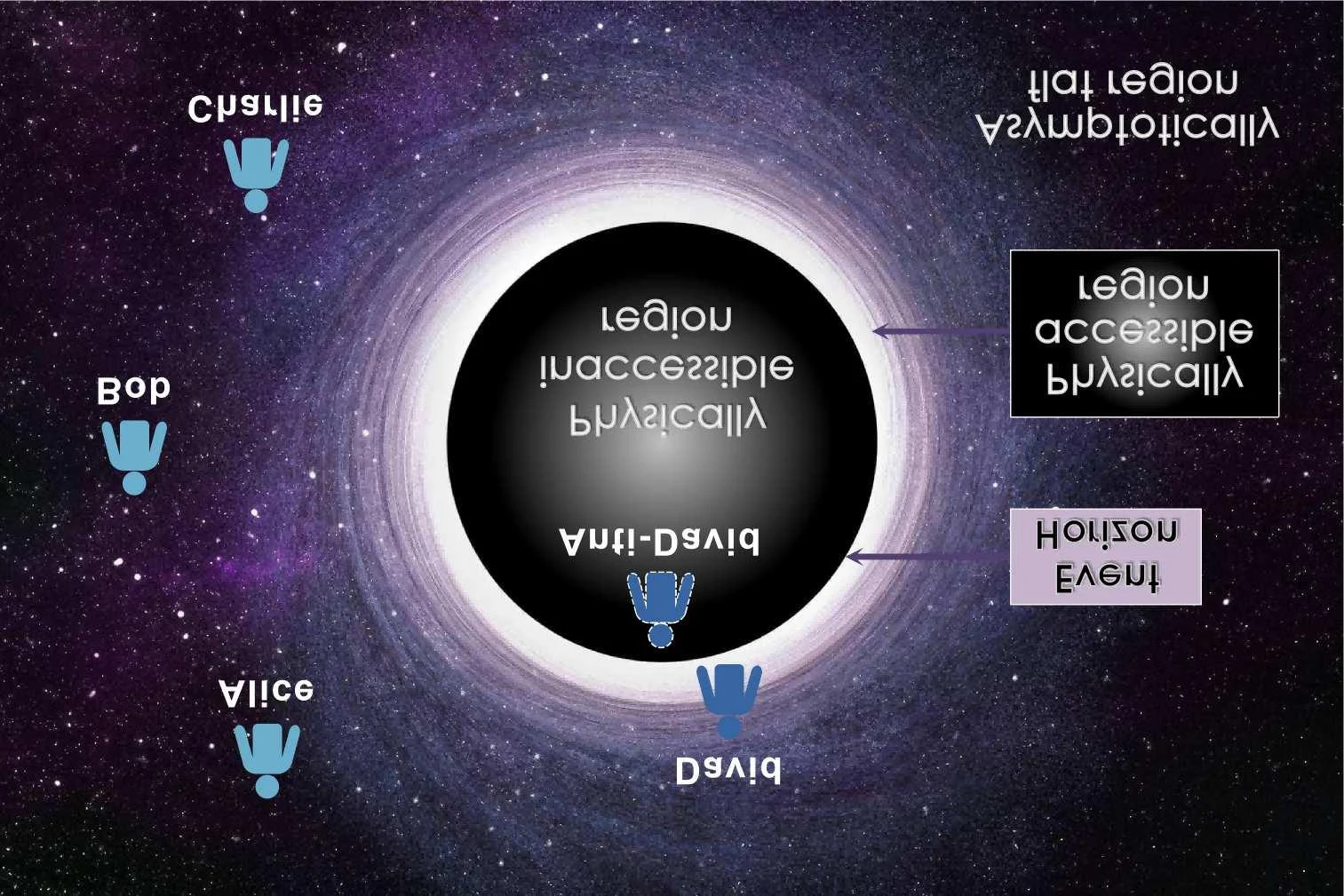
Fragile as ice in a furnace, quantum entanglement usually perishes from the slightest heat. Near a black hole, where space is twisted by Einstein's gravity and Hawking radiation Hawking's heats things up, any bond should be destroyed. But physicists found an exception. They took four specially prepared particles (a cluster state) and placed them near a black hole of Schwarzschild Schwarzschild. Force carrier particles (bosons) predictably lost their connection. But matter particles (fermions, like electrons) behaved differently: their entanglement remained exactly the same as it was at the start. Even as the black hole heated up, the bond did not weaken — it was maximal and unchanged.
This promises quantum communication and computation in space, where ordinary entanglement perishes from radiation and curved spacetime. The resilience of fermions opens the way to reliable information transfer even near massive objects. While the black hole evaporates and accumulates entropy (disorder), this does not affect the quartet.
Original abstract
as written by the authors arXiv:2602.11586
Gravitational effects associated with black holes are widely believed to universally degrade quantum entanglement, with the loss of maximal entanglement being particularly severe and even irreversible for bosonic fields. In this work, we investigate the entanglement properties of the four-qubit cluster state ($$CL_4$$) for fermionic fields in the curved spacetime of a Schwarzschild black hole. Remarkably, we uncover a counterintuitive phenomenon: as the Hawking temperature increases, quantum entanglement ($$1$$-$$3$$ tangle) of the $$CL_4$$ state remains strictly constant, indicating a ``complete freezing of initially maximal entanglement". This constitutes the first explicit example in which maximal entanglement remains perfectly preserved in a black hole environment, defying the conventional expectation that gravitational effects can only suppress maximal quantum correlations. Moreover, our results indicate that, within a relativistic framework, the $$CL_4$$ state constitutes a high-quality quantum resource with potential applications in relativistic quantum information processing, and may significantly improve the performance of such protocols.
The temperature of large black holes is billionths of a degree above absolute zero, yet even this tiny heating usually destroys quantum effects.