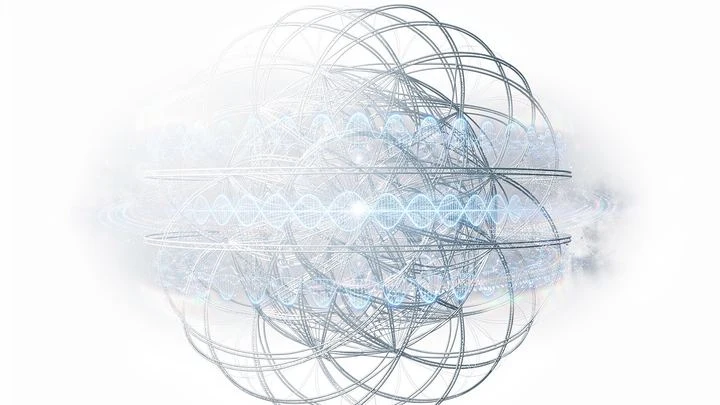
Bosons are particles with integer spin (0, 1, 2, ...) that follow Bose-Einstein statistics, meaning they can occupy the same quantum state simultaneously. Unlike fermions, which obey the Pauli exclusion principle and avoid each other, bosons are gregarious: they pile into the same energy level, enabling phenomena like lasers, superfluidity, and superconductivity. In the Standard Model, bosons act as force carriers — the photon for electromagnetism, gluons for the strong force, W and Z bosons for the weak force, and the Higgs boson for mass. Their collective behavior also underpins exotic states of matter, such as Bose-Einstein condensates, where a macroscopic number of atoms acts as a single quantum object.
History
The concept was introduced by Satyendra Nath Bose in 1924, who derived Planck's law by treating photons as indistinguishable particles. Albert Einstein extended the idea to massive particles, predicting the condensate in 1925. The term 'boson' was coined by Paul Dirac in honor of Bose.
How it works
The key is spin. Quantum mechanics dictates that particles with integer spin have symmetric wavefunctions: swapping two identical bosons leaves the wavefunction unchanged. This symmetry allows multiple bosons to share one quantum state, and in fact makes it more likely for them to do so. At low temperatures, this can lead to a Bose-Einstein condensate, where all particles settle into the ground state, behaving as one coherent wave. In force mediation, bosons are exchanged between fermions, transferring momentum and energy — the quantum mechanism behind forces.
In practice
Bosons are central to technologies like lasers (photons), MRI machines (superconducting magnets rely on Cooper pairs, which are bosons), and particle accelerators that collide bosons to probe fundamental physics. Research on Bose-Einstein condensates is used in quantum simulation and precision measurement.
Fun fact
The Higgs boson, discovered in 2012, is the only fundamental scalar boson — it has zero spin, making it the simplest kind of particle in the Standard Model.
A black hole is like a spinning top that never stops on its own. But if a cloud of ultra-light particles, bosons, forms around it, the picture changes. This "fog" acts like an invisible brake: the particles drain the hole's spin, slowing it down.
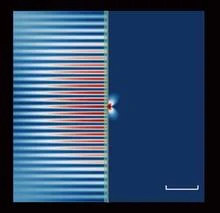
In an ultracold cloud of atoms cooled to near absolute zero, regions with different spin orientations emerge, like patches with different magnetization. The boundaries between them are called domain walls. Usually they are stationary, but in this experiment the walls started moving on their own.
A translator gets distracted by every rustle in the hall, and a one-hour meeting stretches into two. A single wrong intonation changes the meaning beyond recognition. That's roughly how a particle with spin 3/2—the gravitino — behaves. It cannot exist in isolation: its "speech" must be perfectly coordinated with its surroundings, or the whole structure falls apart.
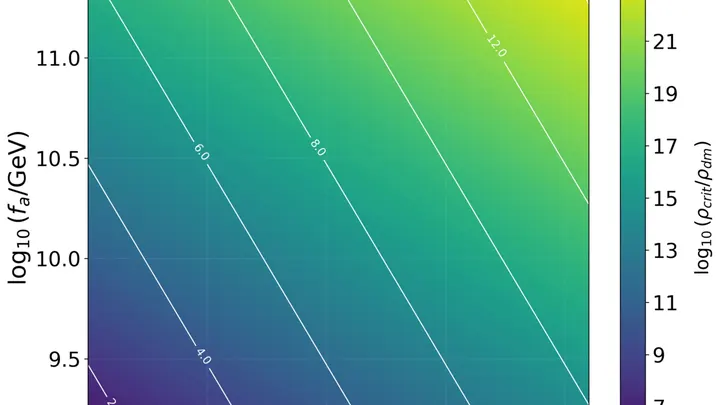
A black hole isn't just a cosmic vacuum cleaner. If it rotates, it can amplify waves around it, much like a mountain echo repeats sound. For ultralight dark matter (particles billions of times lighter than an electron), this effect, called superradiance, can create a huge cloud.
On the wall: light and dark fringes. That’s what light looks like when it cancels itself out.
Way back in the 17th century, Christiaan Huygens suggested that light is a wave.
In 1984, the world of crystallography was turned upside down: sharp diffraction peaks with fivefold symmetry were discovered in an alloy of aluminum and manganese – as if nature had mocked the strict theorems forbidding repeating patterns from having axes of order 5, 8, 10, or 12.
Boson stars are gravitational atoms. Only instead of electric charge, gravity itself serves as the nucleus, holding a cloud of scalar field in quantized clumps.
Textbooks divide particles into two camps: bosons love to crowd into the same state, fermions absolutely refuse. But nature allows a third option. Anyons are quasiparticles whose behavior lies somewhere in between. They can 'remember' how they were exchanged and obey a nonstandard exclusion principle.
Gravitational-wave observatories are like a keen ear listening for distant rumbles of cosmic catastrophes. To catch the faint whisper of merging black holes, detectors of gravitational waves use specially prepared light — known as squeezed vacuum.
Picture a pot of boiling soup, but every grain in it is not just a point but a tiny top spinning around its own axis. That's the world of spin-1 particles. For example, some short-lived mesons born in accelerator collisions.
If a black hole spins quickly, it can hold a cloud of ultralight particles around it, so light that their mass almost vanishes. They arrange themselves in layers, like electrons in an atom, only here gravity does the job instead of electric forces. This structure stores energy, like a coiled spring.
A pot of water always boils the same way: hit 100 degrees and bubbles start. Quantum fluids are different. When a cloud of atoms is cooled to near absolute zero, it can turn into a single matter wave — a Bose–Einstein condensate. But the transition itself, it turns out, can happen in three different ways.
A lump of dark matter drifts through the void — invisible, almost intangible. No one knows what it's made of, but a new study suggests viewing it as a drop of quantum liquid. Two kinds of fermion particles — call them "heavy" (ψ) and "light" (χ)—exchange signals via a third mediator particle (φ), like floats tied to a single line.
Every quantum particle has spin — an intrinsic magnetic property, like a tiny arrow. In an experiment, a beam of such particles passing through a magnet splits in two, like a coin that lands either heads or tails. That’s exactly how particles like a hydrogen atom behave.
The end of the Universe is not just the fading of light. If dark energy, the mysterious substance accelerating cosmic expansion, tears it apart in a Big Rip scenario, or if expansion reverses into a contraction that pulls everything back to a point like a big bang in reverse, a…
The universe is full of invisible substance that governs the movement of galaxies. In the 1970s, astronomer Vera Rubin showed: without dark matter, stars on the outskirts would have long since flown apart. But what it's made of remains unknown.
A pinch of salt falls into water, and sodium and chlorine ions scatter, surrounded by water molecules. Now, instead of an ion, a positron (an antiparticle, the electron's twin but with a plus instead of a minus) joins the molecular crowd.
A glass chip, threaded with 128 optical waveguides, has been turned into a kind of quantum pinball machine. The role of balls is played by photons — quanta of light, and instead of mechanical flippers, microheaters control the routes, instantly altering the optical paths.
Every isolated quantum system inevitably moves toward thermal equilibrium — a state where all details of the past are erased. It’s like an orchestra: instead of a symphony, it starts playing white noise — random but statistically predictable notes.
In particle physics, it has long been taken for granted that the forces of nature (electromagnetism, the weak and strong interactions) obey a strict symmetry called gauge symmetry. It's like a set of rules by which particles exchange force carriers. But where do the rules themselves come from?
Usually, isotopes are separated by exploiting the difference in nuclear weight. That difference is tiny, like sorting grains of sand that differ by one hundredth of a millimeter. The new method ignores weight and instead looks at the nucleus's rotation: its spin.
The laser hits the molecules twice with a short pause in between.
In an orchestra where every musician plays the same note, the sound merges into a powerful unison. This is how a Bose–Einstein condensate is born: many boson particles at extremely low temperatures behave as a single entity.
Two particles flying apart in opposite directions behave as a single whole: measuring one instantly determines the state of the other. Such quantum entanglement has long been known for light particles, but now it has been observed for the first time in heavy Z bosons — the carriers of the weak force.
Magnetic waves in an ultracold gas behave like elastic cords. Two or three such cords can twist into a single knot that breathes: it contracts and expands, but never unravels. For the first time, scientists assembled such knots in the lab and confirmed that their breathing matches calculations exactly.
The gas consisted of two atomic species that do not mix, like oil and water.
Ordinary tiles form a repeating pattern. But atoms can do more: under certain conditions, they themselves lay out a complex mosaic where the pattern never repeats, like on antique tile panels.
In the 19th century, James Clerk Maxwell imagined a tiny demon. It knows the speed of every gas molecule and opens a door: fast ones to the left, slow ones to the right. This creates a temperature difference without expending energy, seemingly violating the laws of physics.
A single photon passes through two slits and leaves an interference pattern on a screen. Quantum mechanics describes this process with a wave function, but what happens to the particle itself?
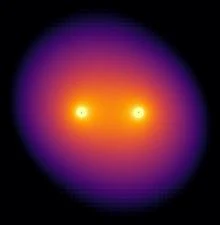
Two black holes circle in a tight dance, and around them something remarkable is born: a gravitational molecule. A cloud of ultralight bosons, particles with masses below an electronvolt, envelops the pair like the electron cloud in an H2+ ion.
Deep inside a superconductor, electrons pair up into Cooper pairs and glide without resistance. But if a vortex appears in this perfect order, a tiny region where superconductivity vanishes, special excitations emerge there: Bogoliubov quasiparticles.
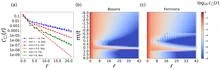
Two actors on the same stage. One is a fermion, finicky and demanding, hard to make follow the rules of a quantum simulator. The other is a boson, easygoing and undemanding, ready to take any role. The director hopes the audience won't notice the substitution.