concept

quantum vacuum

The lowest energy state of a quantum field, filled with virtual particles and fluctuations.
13 related articles · 1 formulas

Description

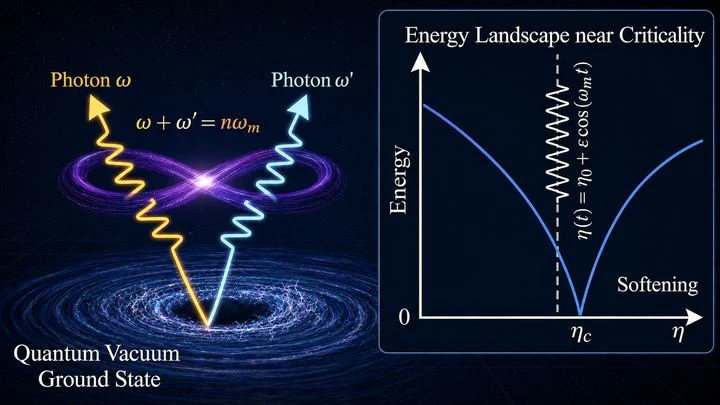
The quantum vacuum is the lowest possible energy state of a quantum field, but it is far from empty. According to quantum field theory, fields are never completely still; they undergo constant fluctuations, creating and annihilating 'virtual particles' that pop in and out of existence. This vacuum energy has observable consequences, such as the Casimir effect, where two uncharged metal plates attract each other due to vacuum fluctuations between them.

History

The concept emerged from early quantum electrodynamics in the 1930s, with key contributions from Dirac, Heisenberg, and others. The Casimir effect was predicted by Hendrik Casimir in 1948 and later confirmed experimentally.

How it works

In quantum mechanics, the Heisenberg uncertainty principle allows for temporary violations of energy conservation, permitting the creation of particle-antiparticle pairs that quickly annihilate. These virtual particles are not directly observable, but they influence real particles and fields. For example, they cause a tiny shift in the energy levels of atoms (Lamb shift) and contribute to the effective charge of the electron. The vacuum also has a nonzero energy density, which is a candidate for dark energy driving cosmic acceleration.

In practice

The quantum vacuum is relevant to nanotechnology (Casimir forces affect microelectromechanical systems), and it is a central concept in attempts to understand dark energy and the early universe.

Fun fact

The vacuum energy density predicted by quantum field theory is about 120 orders of magnitude larger than what is observed as dark energy, one of the biggest unsolved problems in physics.

Concept graph →

Formulas

$$\int_{-\infty}^{\infty} \langle T_{\mu\nu} k^\mu k^\nu \rangle f(t) dt \ge -\frac{C}{t_0^4}$$
Negative energy flux is bounded by a quantum inequality.
What is in the formula
T_{\mu\nu}variablestress-energy tensor — stress energy tensor joule per metre cubed
k^\muvariablenull vector — null vector
tvariabletime coordinate — time second
f(t)variablesampling function — sampling function
Cvariabledimensionless constant — dimensionless constant
t_0variablecharacteristic timescale — time second
\int_{-\infty}^{\infoperatorintegration over all time — integral
\int_{-\infty}^{\infty}\langlet_{μν}k^μk^ν\ranglef(t)dt\ge-\frac{c}{t_0^4} · 2605.14027v1

Related articles · 13

Tamed Phantom: The Axion Spring of the Universe
Since Saul Perlmutter and his colleagues discovered the accelerated expansion of the universe, physicists have been scratching their heads over the nature of dark energy.
Math Physics2026-06-212 minarXiv:2606.22666express
Quantum Field Theory with a Built-In Limit
Quantum electrodynamics, or QED, describes how light interacts with charged particles — for example, electrons. It is one of the most precise theories in history: its predictions match experiment to the eleventh decimal place.
HEP Theory2026-06-181 minarXiv:2606.20334express
Vacuum’s Memory: How Information Survives in a Black Hole
The black hole paradox has haunted physicists for decades. If a hole evaporates, where does its contents go? Discoveries by Stephen Hawking and Jacob Bekenstein showed that saving the laws of nature requires an unconventional move. Imagine the universe as a woven blanket of invisible threads.
Cosmology2026-06-031 minarXiv:2606.04886express
Dark energy may be losing energy: explaining strange behavior
In the late 1990s, astronomers including Saul Perlmutter discovered that the universe is expanding at an accelerating rate. The cause was dubbed dark energy — an invisible force stretching the cosmos.
Strongly Correlated2026-05-071 minarXiv:2605.06302express
Quantum Dance of Electrons in a Sandwich
Two thin sheets with honeycomb patterns were stacked and slightly rotated, creating a new pattern — a moiré, like the shimmer of silk. The electrons in the experiment behaved similarly: they arranged themselves into two layers, with one layer rotated exactly 30 degrees relative to the other.
Waffle Structure of the Vacuum: From String Fluxes to Dark Energy
The mystery of dark energy is a chasm. Quantum field theory predicts a density 10¹²⁰ times larger than observed. In the string landscape, this abyss takes shape — myriads of vacua with different energies, and we are nestled in one of them.
Quantum Physics2026-04-161 minarXiv:2604.14721express
How the Void Sticks Atoms to the Wall
Vacuum is not silent emptiness, but a boiling cauldron of quantum fluctuations, born from nothing and vanishing in billionths of a second. This invisible symphony acts like a constant wind, pressing an atom against a wall — as if a powerful bass note pushes a light ball.
Quantum Physics2026-04-121 minarXiv:2604.10406express
Birth of Light from the Quantum Void
The quantum vacuum is not emptiness, but a tautly stretched string, where particles constantly appear and vanish. Abruptly changing conditions, like shifting the mirrors of a microcavity, causes the 'string' to emit real photons.
Memory in Vibrating Sand
A handful of sand on a vibrating table is like a crowd on a dance floor that still holds the rhythm of the old song for a second after the DJ has switched to a new one. Scientists made a thin layer of grains bounce on a vertically shaking platform and abruptly changed the shaking intensity.
General Relativity2026-02-121 minarXiv:2602.11586express
Black Hole Did Not Destroy Quantum Entanglement
Fragile as ice in a furnace, quantum entanglement usually perishes from the slightest heat. Near a black hole, where space is twisted by Einstein's gravity and Hawking radiation Hawking's heats things up, any bond should be destroyed.
Quantum Physics2026-01-201 minarXiv:2601.14381express
Magnetic field turns the void into a motor
Two metal plates in a perfect vacuum attract each other. Even Richard Feynman compared emptiness to a boiling foam: particle pairs are born and immediately vanish, creating the Casimir effect. If the plates are asymmetric, they also start to twist — that's a vacuum motor. But rotation doesn't require oddly shaped parts.
Quantum Physics2026-01-131 minarXiv:2601.09020express
Salt in the Cell Changes the Rules of the Game
In a glass of salty water, even if it sits perfectly still, something is always happening. Tiny salt particles, ions, float and collide, sending ripples through the water. These ripples are invisible, but they create a force that attracts or repels nearby objects. Previously, it was thought that this force only acts over very short distances, as if it quickly fades out.
The Vacuum as Conductor: How Quantum Emptiness Rewrites the Properties of Matter
The hall is silent, but the conductor has already raised the baton. The orchestra is quiet, yet the score is changing. So it is in an optical resonator: there is no light, but the quantum vacuum—that emptiness filled with short-lived field fluctuations—is already conducting the…