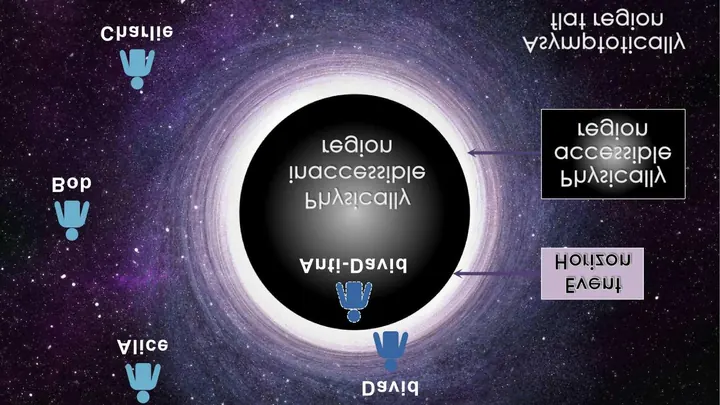
The black hole information paradox is a fundamental conflict between quantum mechanics and general relativity. Quantum mechanics insists that information about a system's initial state is never destroyed; it may be scrambled, but it always remains encoded in the final state. General relativity, however, predicts that anything falling into a black hole is lost forever behind the event horizon, and Hawking radiation (which causes black holes to slowly evaporate) carries no information about what fell in. If the black hole evaporates completely, the information would be gone, violating quantum mechanics.
History
The paradox was formulated by Stephen Hawking in the mid-1970s following his derivation of black hole radiation. It has remained an active area of research, with recent developments like the firewall paradox and the island formula suggesting possible resolutions.
How it works
The paradox arises from combining two well-established theories. Quantum field theory in curved spacetime suggests black holes emit thermal radiation (Hawking radiation) with a temperature inversely proportional to their mass. This radiation is purely thermal, meaning it contains no information about the matter that formed the black hole. As the black hole loses mass and eventually disappears, the initial quantum state of the infalling matter becomes unrecoverable. Resolving this requires either modifying quantum mechanics, changing our understanding of black holes, or finding a mechanism for information to escape.
In practice
While primarily a theoretical problem, it drives research into quantum gravity, holography, and the nature of spacetime, which could inform future quantum computing and fundamental physics.
Fun fact
Recent work using the 'island formula' suggests that information may actually be encoded in the Hawking radiation after all, if one correctly accounts for quantum entanglement between the black hole and its radiation.
Alice prepares a quantum particle in one of several states and sends it to Bob. The channel the particle travels through isn't perfect: it's noisy, scatters, interacts with the environment. Bob receives the signal and tries to figure out what Alice actually sent. This is the classic "prepare-send-measure" scheme, and there's always a risk of losing something along the way.
A black hole has three laws, just like an ideal gas. The first: energy is conserved. The second: the horizon area never decreases. And the third, the most finicky, demands that at zero temperature the entropy (a measure of disorder) tend to zero or a universal constant.
A black hole that swallows matter might not just evaporate over billions of years: it could pop like a soap bubble and turn into its opposite: a white hole. This scenario emerged from numerical experiments in semiclassical gravity.
A quantum computer is like a fragile snowflake resting on a warm palm. The slightest breath of heat or a gentle vibration, and it turns into a droplet. To keep the snowflake alive, you constantly adjust it, restoring its original shape. That's quantum error correction.
General relativity, which describes the structure of the universe, does not forbid closed timelike curves. But Stephen Hawking put forward the 'chronology protection' conjecture: quantum effects should destroy such curves, making time travel to the past impossible.
Water turns to ice at zero degrees — sharply, with no intermediate states. Something similar happens to complexity when we take a random quantum state of an entire system and look only at a part of it. As long as that part occupies less than half the system, its complexity grows smoothly. But as soon as the fraction crosses 50%, a jump occurs.
A black hole is not eternal. Even in a perfect vacuum, it slowly loses energy — a process known as Hawking radiation. Quantum effects near the event horizon create pairs of particles, one of which escapes, carrying away some of the black hole's mass.
A black hole is not just an abyss where everything falls. Right at its horizon, in the so-called quantum atmosphere, a faint glow is born — Hawking radiation. This is not calm light but a churning stream of particles that can influence the most delicate quantum connections.
The cosmological horizon — the edge of the observable Universe, which is expanding at an accelerating rate — is like a safe with a timer. Information about what crosses this boundary doesn’t vanish but returns, albeit with a delay. Physicists have figured out how long this pause lasts.
A black hole resembles a safe that slowly gives up its contents, energy and information, through a faint glow known as Hawking radiation. But if the safe opens too quickly, a 'firewall' may flare up at its boundary — a region where the familiar laws of physics break down.
In the new work, physicists complicated the model of this safe.
The black hole paradox has haunted physicists for decades. If a hole evaporates, where does its contents go? Discoveries by Stephen Hawking and Jacob Bekenstein showed that saving the laws of nature requires an unconventional move.
Imagine the universe as a woven blanket of invisible threads.
A bonfire doesn't burn out all at once. If you glance at the flames at a random moment, all you see is a jumble of fire tongues, and you can never tell what exactly burned: a wet branch, an old magazine, or an armful of dry grass. But if you watch the fire hour after hour, rhythms emerge in its dance: a burst of heat, a lull, a change in color. These rhythms tell the story of what was thrown into the flames.
In 1867, James Clerk Maxwell proposed an image that still stirs physicists today. Two compartments of gas are separated by a door. Molecules dart about chaotically: fast and slow. A tiny gatekeeper opens the door only for fast ones, letting them through to one side, and slow ones to the other. The hot compartment gets hotter, the cold one colder.
Stephen Hawking showed that black holes, regions with gravity so strong that even light cannot escape, emit particles and eventually evaporate. This process is called Hawking radiation. But a question arises: where does the information about what fell into the hole go?
When a balloon with a painted pattern deflates, the pattern ripples and distorts. Something similar happens to a black hole that slowly evaporates, losing energy through the radiation discovered by Stephen Hawking.
The standard picture of black hole evaporation, painted by Hawking, long seemed reassuring: quantum fluctuations near the horizon produce thermal radiation, the hole slowly melts away, and the spacetime behind it remains smooth.
Two coins are flipped in different cities, but they always land the same way. Physicists call this entanglement: particles behave as if an invisible thread connects them. But what if the thread isn't instantaneous, just very fast — still not faster than light? Then some signal could slip between measurements, and the coincidences would be explained without any magic.
Fragile as ice in a furnace, quantum entanglement usually perishes from the slightest heat. Near a black hole, where space is twisted by Einstein's gravity and Hawking radiation Hawking's heats things up, any bond should be destroyed.
The 'double copy' method in physics is a culinary trick: a chef takes a cold soup recipe, doubles the ingredients, and gets a recipe for a hot roast. Likewise, particle interactions via electric forces (the basis of the Standard Model) morph into gravity, which describes spacetime curvature.
In 2017, the LIGO and Virgo gravitational detectors caught ripples in spacetime from the merger of two black holes 540 megaparsecs away. The event was named GW170814. But what remained after this cosmic collision? Besides distorted space, tiny black holes, or 'crumbs', might have been born.