A black hole can turn into a wormhole express
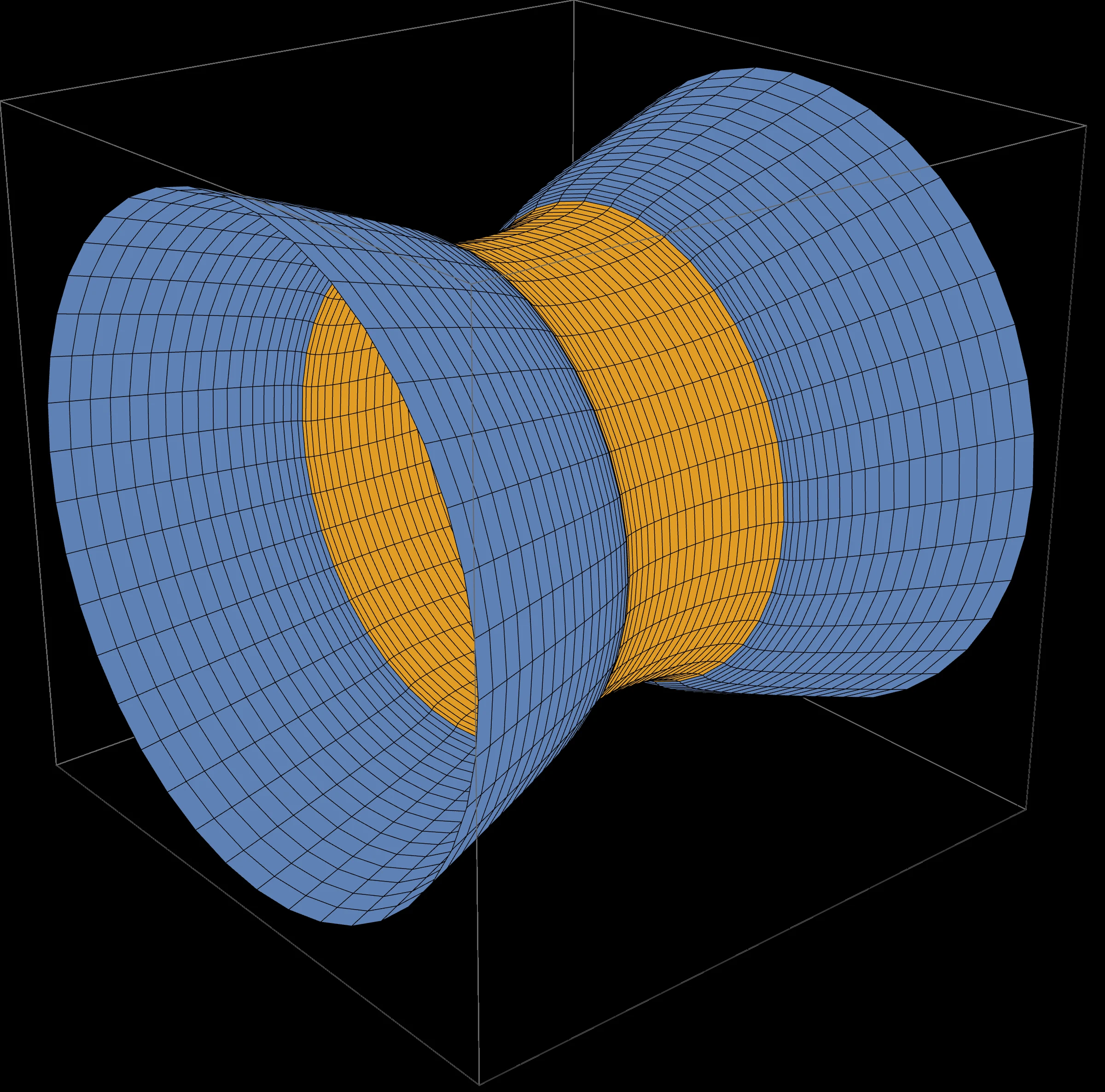
An ordinary black hole is a bottomless pit from which not even light can escape. However, physicists have found a way to turn this pit into a through-tunnel — a wormhole. Taking as a basis the black hole model that Karl Schwarzschild derived in 1916 from Einstein's equations, scientists added an unusual ingredient — negative energy. This substance has antigravity: it doesn't attract, but pushes space apart.
By colliding two streams of such energy, moving at the speed of light, you can cause a black hole to be reborn into a warped passage connecting distant regions of space. The main surprise: to keep the tunnel from collapsing, its throat must be wide enough — a narrow sleeve would crumple under its own weight, while a spacious one remains gaping, like a mountain ridge pierced through.
Such dynamics show for the first time the birth of a traversable wormhole from a black hole. And negative energy is not fantasy: it is already produced in labs using the Casimir effect. Someday this will allow us to reach other stars not in thousands of years, but in an instant.
Original abstract
as written by the authors arXiv:2602.13609
We study spherically symmetric, self-similar wormhole solutions supported by colliding streams of negative-energy null dust, and their dynamical formation. Under the assumption of self-similarity, the Einstein equations reduce to a system of ordinary differential equations, which we solve numerically under boundary conditions enforcing the existence of a minimal areal radius (the throat) on constant-time hypersurfaces. For a sufficiently large throat radius, the resulting geometries remain regular at both spatial and future null infinity, while a singularity is retained in the past direction. We then construct a dynamical formation scenario by patching together three regions: a Schwarzschild black hole, negative-energy Vaidya spacetimes, and the self-similar wormhole geometry. These regions are joined across null shells using the Barrabes--Israel formalism, which provides explicit relations among the throat radius, the black hole's mass and the energy injection by the shell, demonstrating that an initial black hole can evolve into a wormhole. Our analysis generalizes the formation model for static wormhole solutions proposed by Hayward and Koyama in 2004 to non-static wormhole solutions, offering a novel perspective on the formation of regular traversable wormholes.
Negative energy can be created in the lab using the Casimir effect: two metal plates in a vacuum attract each other because fewer virtual particles are born between them than outside.
In the film Interstellar, a wormhole is used for interstellar travel — exactly what scientists dream of.