The Copper Highway with No Traffic Lights express
An electron in a metal is usually like a person in rush hour: it constantly bumps into others and loses its way. But if you remove the obstacles, it can fly in a straight line, like a car on an empty night highway. This kind of motion is called ballistic — from the word "ballista," an ancient catapult that hurled a stone without interference.
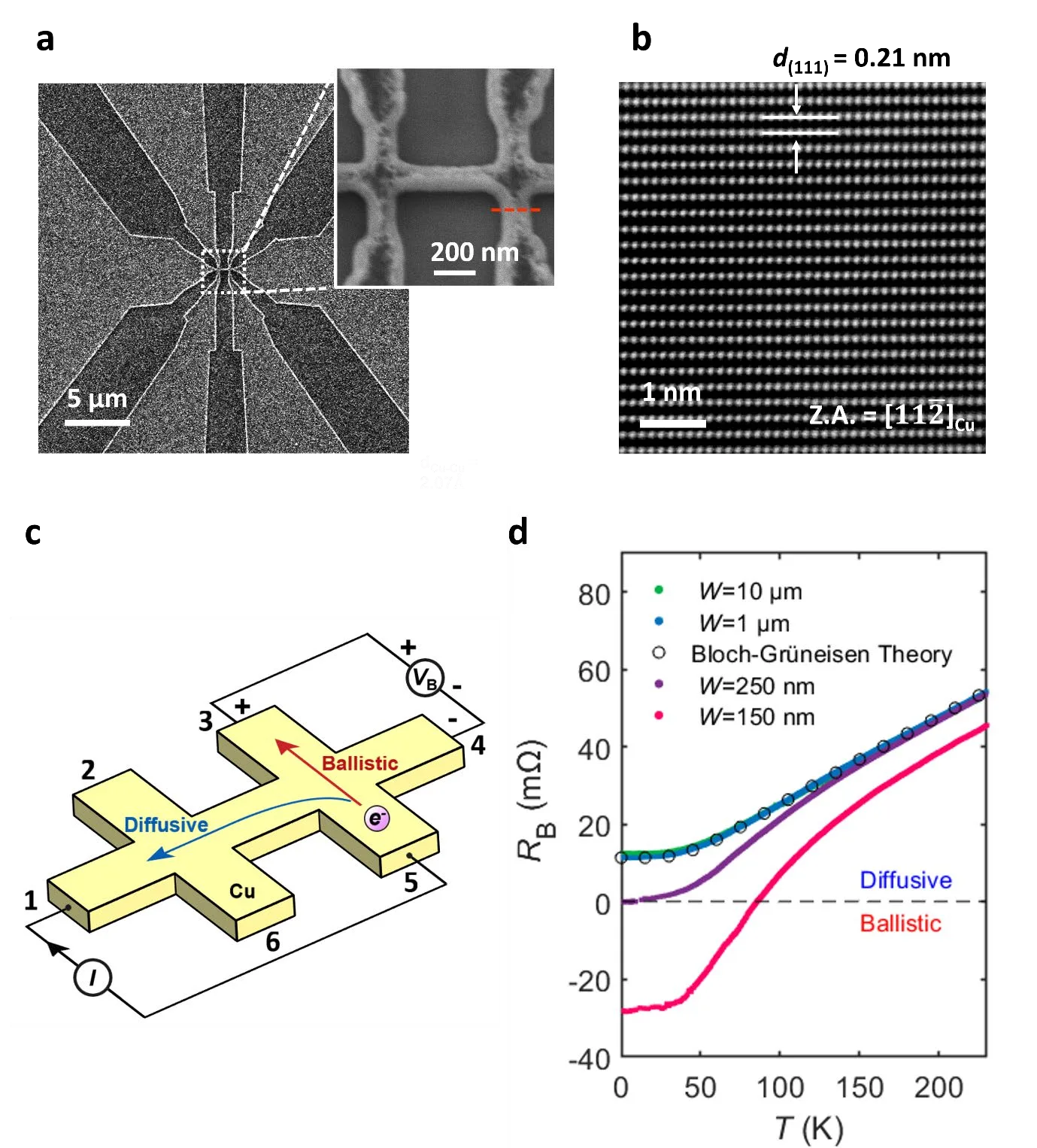
Scientists took a copper film 90 nanometers thick, a thousand times thinner than a human hair, and removed all the boundaries between crystalline grains. Typically, copper consists of many small grains, and at their junctions electrons scatter like light in frosted glass. Here, they achieved an almost perfect crystal.
Then they carved narrow channels less than 150 nanometers wide into the film and cooled everything to minus 188 degrees Celsius. At such cold, thermal vibrations of atoms quiet down, and electrons stop tripping over them. Measurements showed that the channel's resistance becomes negative at bends — a sure sign of ballistic motion.
Why does this matter? Ballistic conductors barely heat up and don't lose signal. If we can make such copper traces in mass-produced microchips, computers will become faster and more energy-efficient. It's also a way to probe the pure quantum properties of copper — without interference from disorder.
An electron that used to jostle in a crowd now races down an empty highway. And that highway can be laid right inside a processor.
At temperatures below 85 Kelvin (minus 188 degrees Celsius), copper becomes so "quiet" that an electron can pass through it without hitting a single atom.
In Arthur C. Clarke's novel "The City and the Stars," transport instantly carries people through underground tunnels — similarly, ballistic electrons could instantly deliver signals in chips.