Light Catches Electrons on the Fly express
Sunlight hits a rooftop, and electrons are born in a thin film. They must reach the wires before they cool down and lose their energy. In tin sulfide, a cheap and accessible material for batteries, this sprint and cooldown has now been captured with unprecedented sharpness: frames follow every billionth of a billionth of a second.
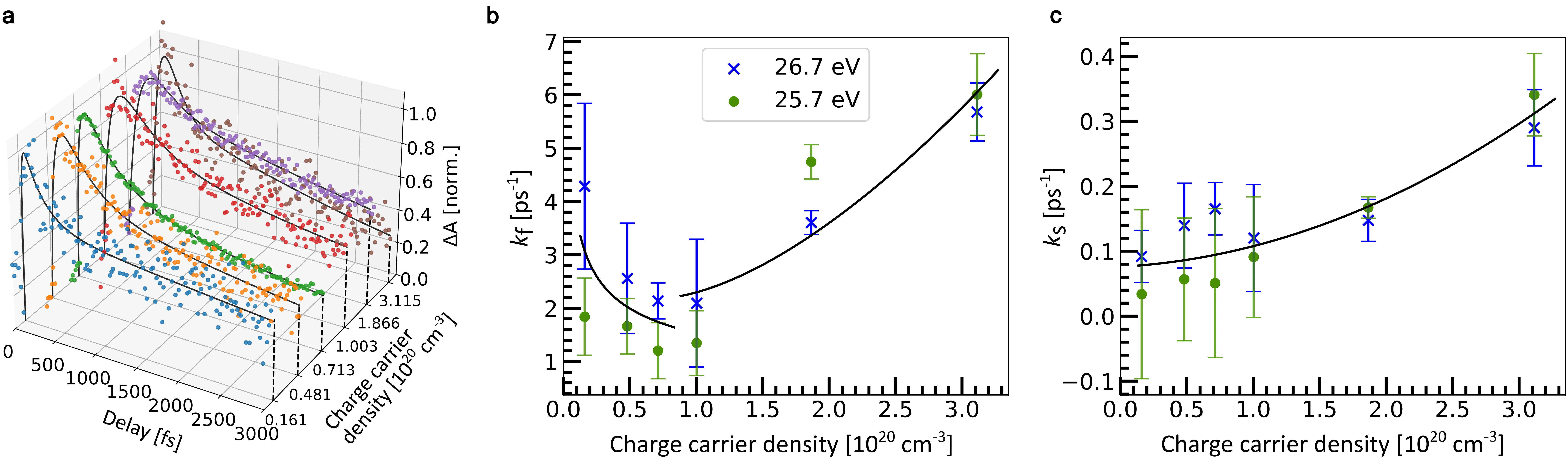
The laser pulse knocks out electrons like a cue stick sending billiard balls scattering. Right after the strike, the balls race fast but gradually slow down as they collide with each other and the cushions. The scientists watched the light the material absorbs during such collisions. Under weak light, as if there are few balls, and they mostly lose speed against the walls. Under strong light: there are so many balls that they start getting in each other's way, and the whole batch freezes faster.
But there's also a table tremor in this game. The crystal's atoms vibrate, and their rhythm—188 femtoseconds per oscillation — shows up in every snapshot. Electrons don't just fly on their own; they're nudged by the lattice's jitter. Understanding this rhythm could help build solar cells where electrons reach their destination without losing energy along the way.
Original abstract
as written by the authors arXiv:2602.13886
Metastable cubic tin(II) sulfide ($$\pi$$-SnS) is an earth-abundant semiconductor whose three-dimensionally bonded chiral lattice may overcome the short minority-carrier lifetime of orthorhombic SnS while maintaining a near-ideal bandgap for tandem photovoltaics. Despite its promise, ultrafast carrier cooling and recombination mechanisms over illumination density remain poorly constrained. We use core-level extreme-ultraviolet attosecond transient absorption spectroscopy at the Sn $$4d$$ edge to track carrier injection, cooling, and recombination in $$\pi$$-SnS with element- and orbital-specific sensitivity. Following femtosecond near-infrared excitation, the Sn $$4d\rightarrow$$CB onset exhibits conduction-band state filling and a carrier-induced edge shift, enabling extraction of density-dependent kinetics. The transient response follows a biexponential decay with a fast hot-carrier cooling component and a slower recombination component. At low carrier densities, recombination is consistent with interface-limited processes, whereas above $$\sim1\times10^{20}$$ cm$$^{-3}$$ both cooling and recombination accelerate, indicating a crossover to carrier-carrier interaction-dominated dynamics. Coherent phonon oscillations with a period of $$\sim188$$ fs reveal coupling between electronic excitation and lattice motion. These results provide a comprehensive picture of nonequilibrium carrier and phonon dynamics in cubic SnS, reveal a change of mechanisms over a range of carrier densities, and establish the value of using attosecond transient absorption spectroscopy to study ultrafast processes in complex semiconductors that have optoelectronic and energy-conversion applications.
An attosecond is so short that more of them pass in one second than seconds have passed since the Big Bang.