How lizards and snakes plan their falls express
A lizard falling from a branch doesn't just tumble: it catches the air with its body and turns the fall into a glide. Engineers have long borrowed tricks from such feats, but until now there was no common language to compare the gliding of a snake, a lizard, and a man-made wing. The new study introduces such a language: a three-dimensional map of velocities that shows where any motion inevitably ends up.
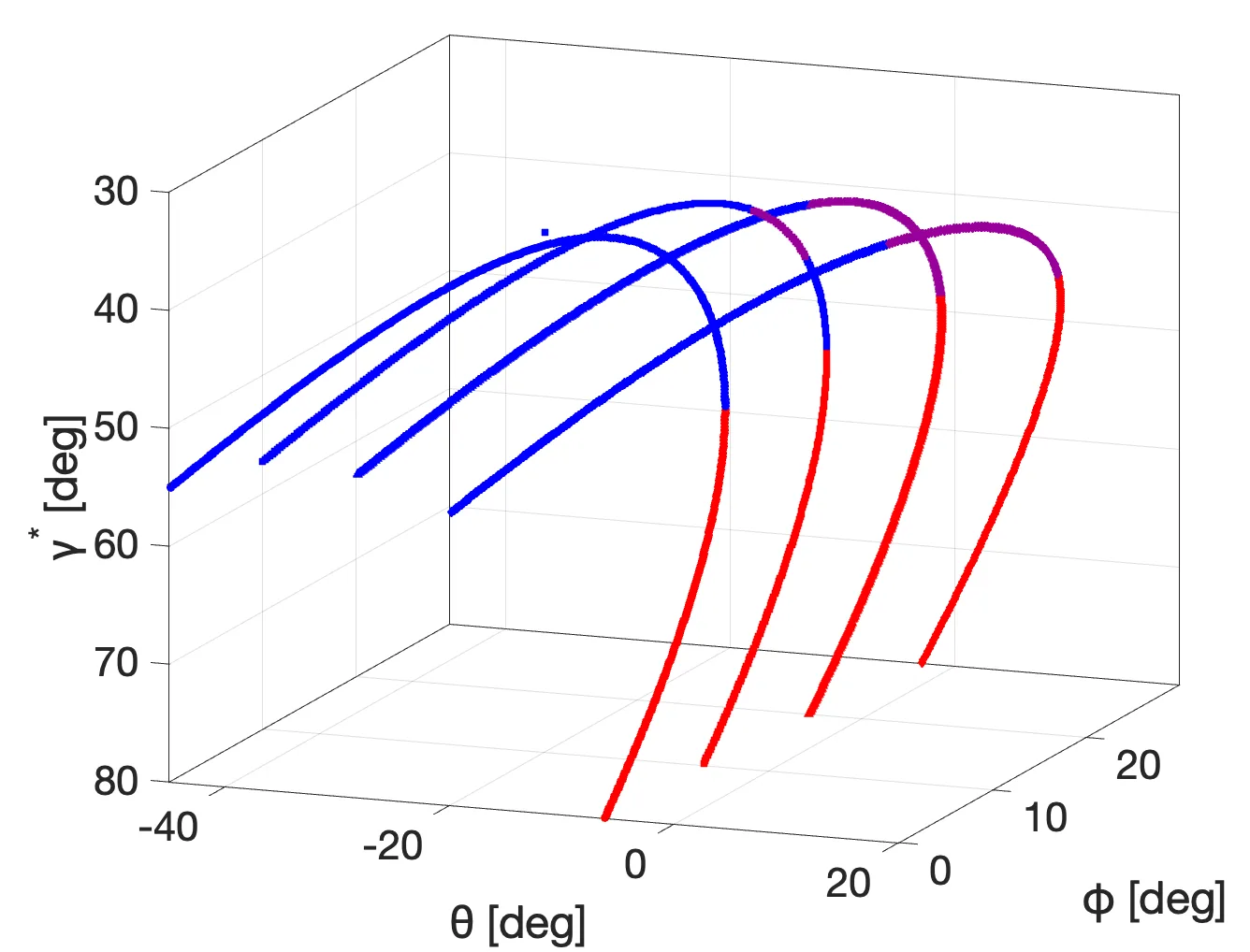
The authors first noticed that no matter how you launch a glider, its velocity quickly gets pulled toward an invisible surface: they call it the terminal manifold. From there, the motion slowly creeps along this surface toward an equilibrium point — steady gliding. But the surface has a fold that splits fates: on one side lies a smooth, long descent; on the other, a steep fall where the air no longer supports but drags.
This geometry was constructed for three profiles: one inspired by a flying snake, one by the Draco lizard, and one classic airfoil. It turned out that for the bio-profiles, the fold is compact, so even with a wide spread of initial conditions (how the lizard jumped, with what speed and at what angle), it more often ends up in the smooth gliding regime. For the classic wing, the region of steady gliding is narrower: it requires a precise launch.
The study unifies biology and engineering in a single geometric framework. Now, gliding reliability can be assessed not by trial and error but by the shape of the dividing surface, like judging mountain passability from a map of ridges.
Original abstract
as written by the authors arXiv:2602.15234
We develop a three-dimensional dynamical-systems framework for passive gliding and identify the global phase-space structures that organize its motion. Extending previous two-dimensional models of non-equilibrium gliding, we show that the 3D velocity dynamics possess an attracting, normally hyperbolic invariant surface, the terminal velocity manifold (TVM), onto which all trajectories rapidly collapse before evolving slowly toward a glide equilibrium. There is also a separatrix surface associated with an invariant manifold of an unstable equilibrium within the TVM, which partitions initial conditions into qualitatively distinct descent behaviors: efficient shallow glides versus steep, drag-dominated descent. Using lift-drag data from three representative airfoils--a snake-inspired bluff body, the Zimmerman planform characteristic of Draco lizards, and the classical NACA 0012--we compute the full equilibrium surfaces, analyze their pitch-roll bifurcations, and reconstruct the TVM and separatrix geometry in three dimensions. The results reveal that (i) equilibrium stability changes with both pitch and roll, rather than pitch alone; (ii) separatrix geometry determines the dynamic accessibility of shallow glides; and (iii) bio-inspired airfoils possess compact separatrix regions that make efficient gliding robust across a wide range of initial jump conditions. This work unifies biological and engineered gliders within a single global geometric framework and establishes separatrix geometry on the TVM as a principled diagnostic for glide robustness.
Draco lizards spread their ribs in flight, turning their bodies into a kind of hang glider, and can glide up to 60 meters from tree to tree.